
Transgenic Insect and Use of Same in Methods for Testing Natural or Synthetic Substances
a technology of insect and method, applied in the field of transgenic insects, can solve the problems time-consuming and cost-intensive systems, and specific systems, and achieve the effects of high operation and maintenance costs, high operating and maintenance costs, and high cost of particular systems
- Summary
- Abstract
- Description
- Claims
- Application Information
AI Technical Summary
Benefits of technology
Problems solved by technology
Method used
Image

Examples
Embodiment Construction
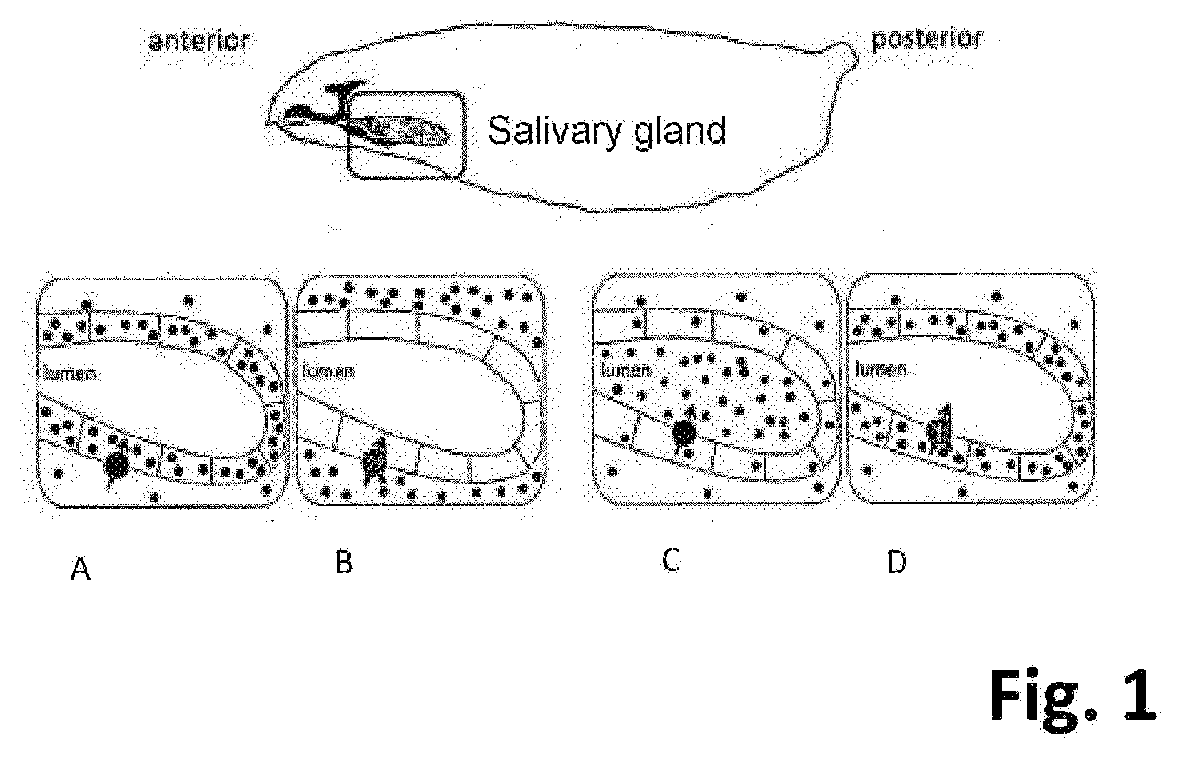
[0083]FIG. 1 depicts, in the top part, an insect embryo 10 (Drosophila), with depiction of the anterior on the left and the posterior on the right. Furthermore, the salivary gland 12 of the insect embryo is drawn in schematically. The salivary gland in the insect embryo consists of a monolayer of epithelial cells that form a lumen. On the basal side thereof, said cells come into contact with blood (hemolymph), and on the apical side, the cells secrete glycoproteins, which are only required during pupation for substrate adhesion by the animal, but not in the embryo or early larval stages.
[0084]The bottom part of FIG. 1 shows enlarged representations of salivary glands as exemplary specific tissue of two different embodiments of transgenic insects: in A and B, a human uptake membrane transporter protein is expressed in the transgenic insect, specifically in a tissue-specific manner, whereas in C and D, an efflux membrane transporter protein is expressed in a tissue-specific manner.
[00...
PUM
| Property | Measurement | Unit |
|---|---|---|
| thick | aaaaa | aaaaa |
| fluorescent | aaaaa | aaaaa |
| fluorescence microscopy | aaaaa | aaaaa |
Abstract
Description
Claims
Application Information
 Login to View More