
Overscan for 3D display
a 3d display and overscan technology, applied in the field of display processors, can solve the problems of (very) low frequency aliasing, reduce visibility, and degrade the display quality of content, etc., and achieve the effect of reducing visibility, no or no
- Summary
- Abstract
- Description
- Claims
- Application Information
AI Technical Summary
Benefits of technology
Problems solved by technology
Method used
Image

Examples
Embodiment Construction
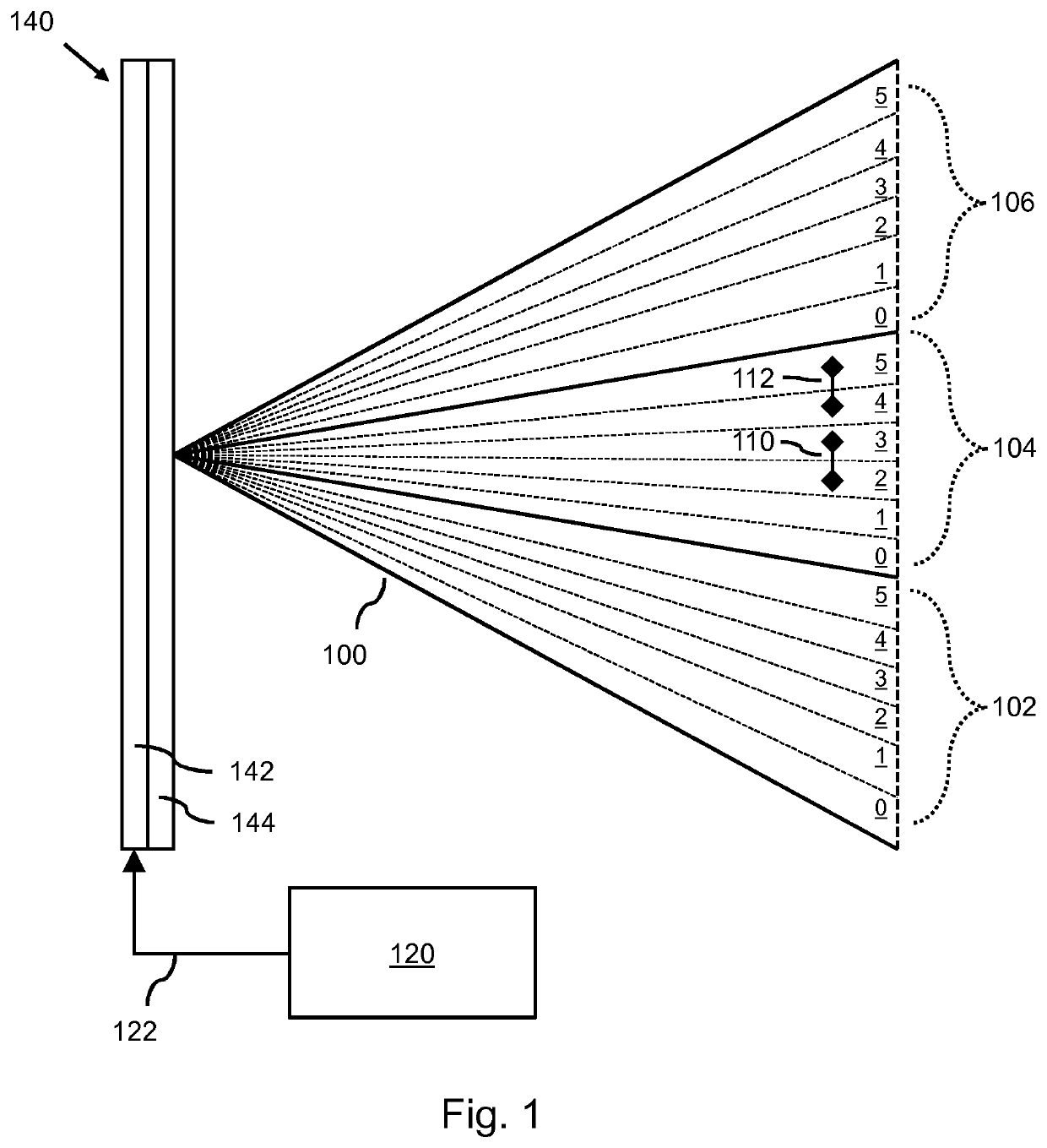
[0060]FIG. 1 shows a display processor 120 which is connected to a 3D display 140 and configured for providing a series of images, e.g., in the form of display data 122, to the 3D display. The 3D display 140 is an autostereoscopic 3D display for enabling stereoscopic viewing of content displayed thereon without a need for the user to wear glasses. The 3D display 140 comprises a light generating portion 142 which is typically comprised of an array of light emitting or light modulating elements. For example, the light generating portion 142 may be formed by a Liquid Crystal Display (LCD) panel and a backlight, as is known from the technical field of displays.
[0061]The 3D display 140 further comprises optical means 144 for redirecting light generated by the light generating portion 142 into different directions. The light generating portion 142 may be suitably arranged and cooperative with the optical means 144 such that a series of views 0-5 are emitted from the 3D display 140 in the ...
PUM
 Login to View More
 Abstract
Description
Claims
Application Information
 Login to View More