Network address translation based internet protocol mobility

a network address and internet protocol technology, applied in the field of mobile communications networks, can solve the problems of gateway b>18/b> requiring a substantial amount of computing power and thus being very expensive, and the ip standard is not designed to provide optimal services in the mobile network

US6845094B1Inactive Publication Date: 2005-01-18TAMIRAS PER PTE LTD LLC
6 Cites 68 Cited by

Patent Information

Authority / Receiving Office
US · United States
Patent Type
Patents(United States)
Current Assignee / Owner
Publication Date
2005-01-18
Estimated Expiration
Not applicable · inactive patent

Smart Images

  • Figure 1
    Figure 1
  • Figure 2
    Figure 2
  • Figure 3
    Figure 3
Patent Text Reader

Abstract

In an end to end fully internet protocol (IP) enabled network, a dynamic IP address space is used to address mobile hosts in order to facilitate mobility management. The network includes a wireless mobile network having a plurality of base stations each being associated with a portion of the dynamic IP address space. The base stations are operative to allocate dynamic IP addresses from the associated portion of the dynamic IP address space for each authenticated mobile host. Each of the base stations provides translation between the dynamic IP address space and a permanent IP address space so that the dynamic IP address space is transparent from the point of view of the mobile hosts. A gateway provides communicative coupling between the backbone of the wireless mobile network and a wire lined IP network. The gateway also provides translation between the dynamic IP address space and the permanent IP address space.
Need to check novelty before this filing date? Find Prior Art

Description

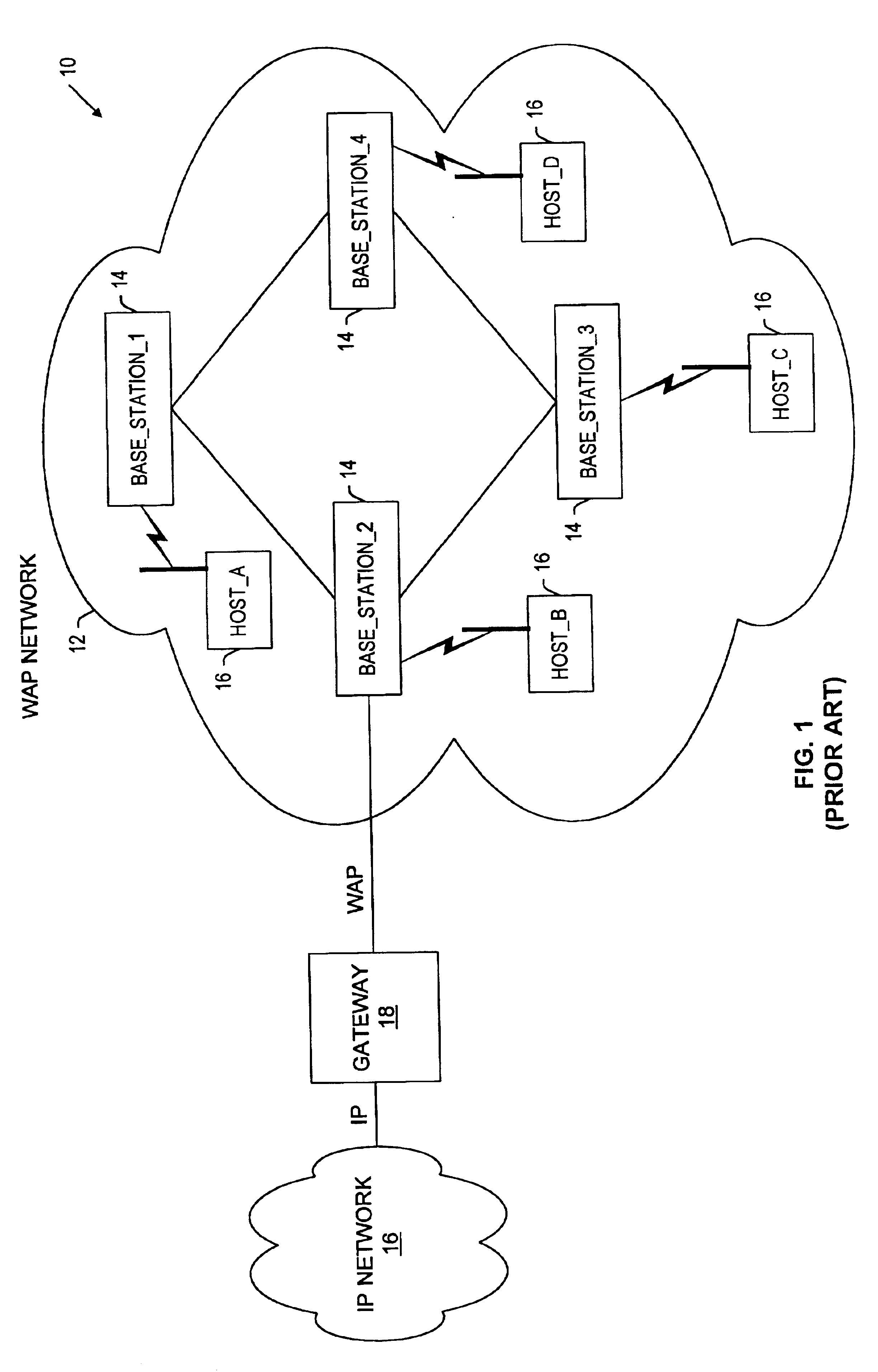
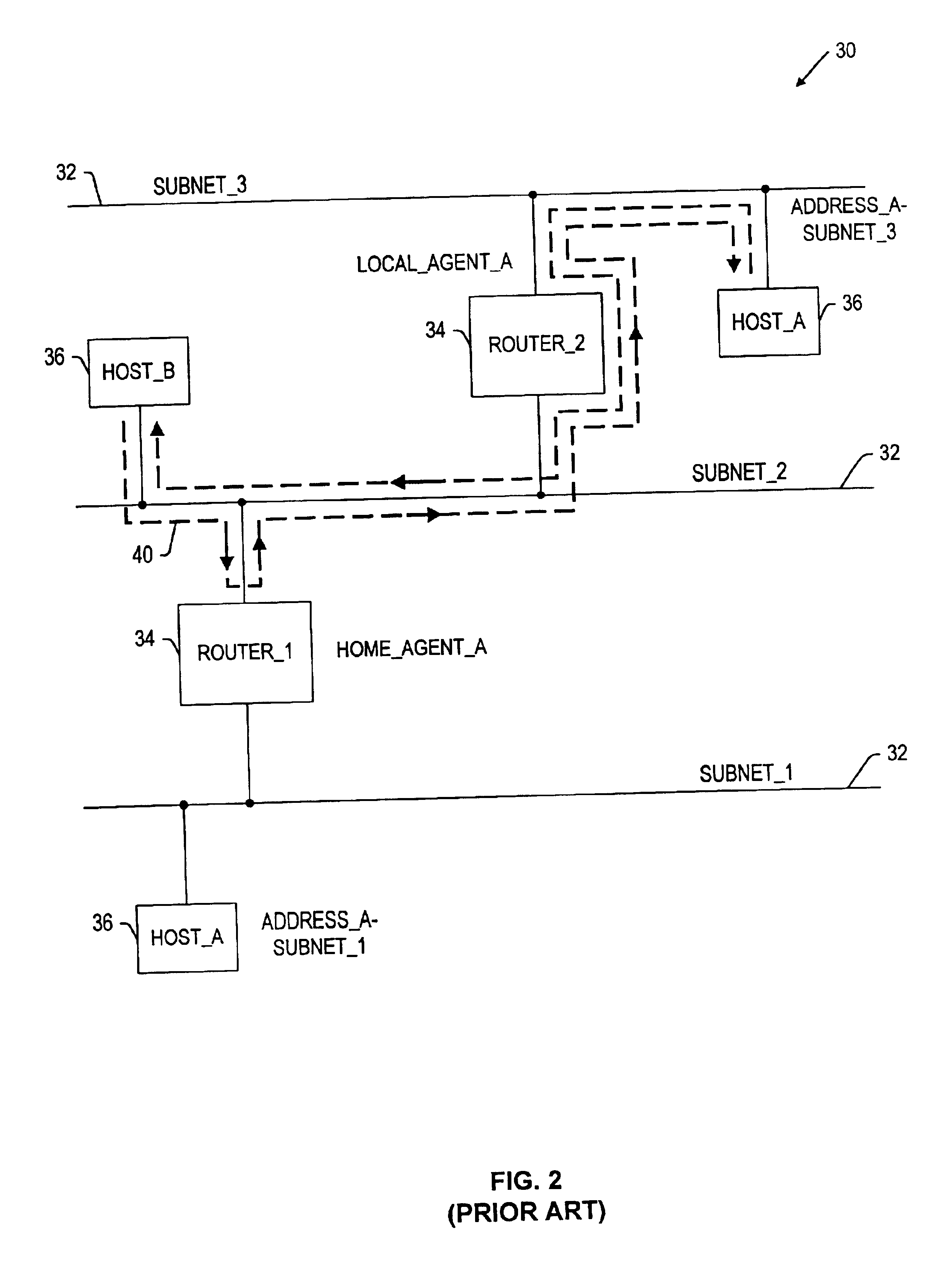
FIELD OF THE INVENTIONThe present invention relates generally to mobile communications networks, and more specifically to an addressing and mobility management scheme for use in a mobile communications network.DESCRIPTION OF THE PRIOR ARTWith the rapid advances in both TCP / IP and wireless technologies, new advances in mobile network technology are being developed. One of the most attractive models currently being considered in mobile networking is a fully end to end IP enabled mobile network which would provide the ability to communicate from end to end using IP as the transport protocol in a highly mobile network. However, the operational requirements for implementing a fully end to end IP enabled mobile network are very different from the operational requirements for implementing conventional TCP / IP networks. The mechanisms for handling mobility and providing packet transfer for mobile hosts must be very robust, must be integrated with wireless technology, and must be able to be s...

Examples

Embodiment Construction

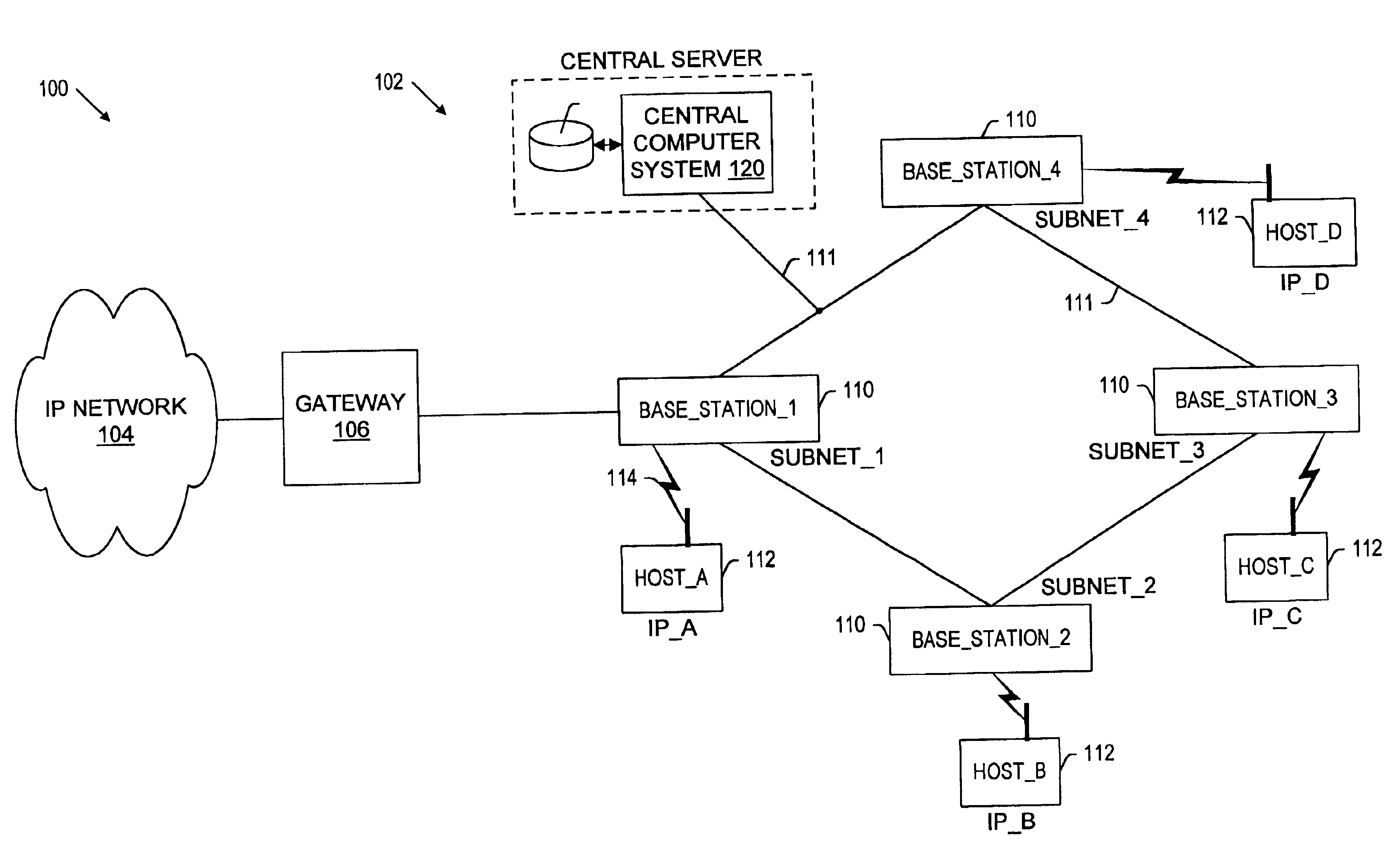
FIG. 3A shows a generalized block diagram of an end to end fully enabled internet protocol (IP) network system at 100 in accordance with the present invention. The network system 100 includes: a fully end to end IP enabled wireless mobile network 102; and a wire lined IP network 104 (e.g., the Internet) communicatively coupled with the wireless mobile network 102 via a gateway 106.

The wireless IP mobile network 102 includes: a plurality of base stations 110 designated BASE_STATION_1, BASE_STATION_2, BASE_STATION_3, and BASE_STATION_4, each having an associated coverage area having at least one cell, each of the base stations 110 being communicatively coupled with each other and with the gateway 106 via a back bone 111 of the wireless mobile network 102; and a plurality of mobile hosts 112 designated HOST_A, HOST_B, HOST_C, and HOST_D, each being operative to communicate with corresponding ones of the base stations 110 via wireless links 114 in accordance with the internet protocol (...