
Paper elimination in the production of battery plates
a battery plate and paper elimination technology, applied in the field of continuous production of positive and negative electrode plates, can solve the problems of attendant and achieve the effects of reducing paper costs, reducing recycling costs of battery electrolytes, and reducing the loss of valuable production time during downtim
- Summary
- Abstract
- Description
- Claims
- Application Information
AI Technical Summary
Benefits of technology
Problems solved by technology
Method used
Image

Examples
example
Laboratory Trials
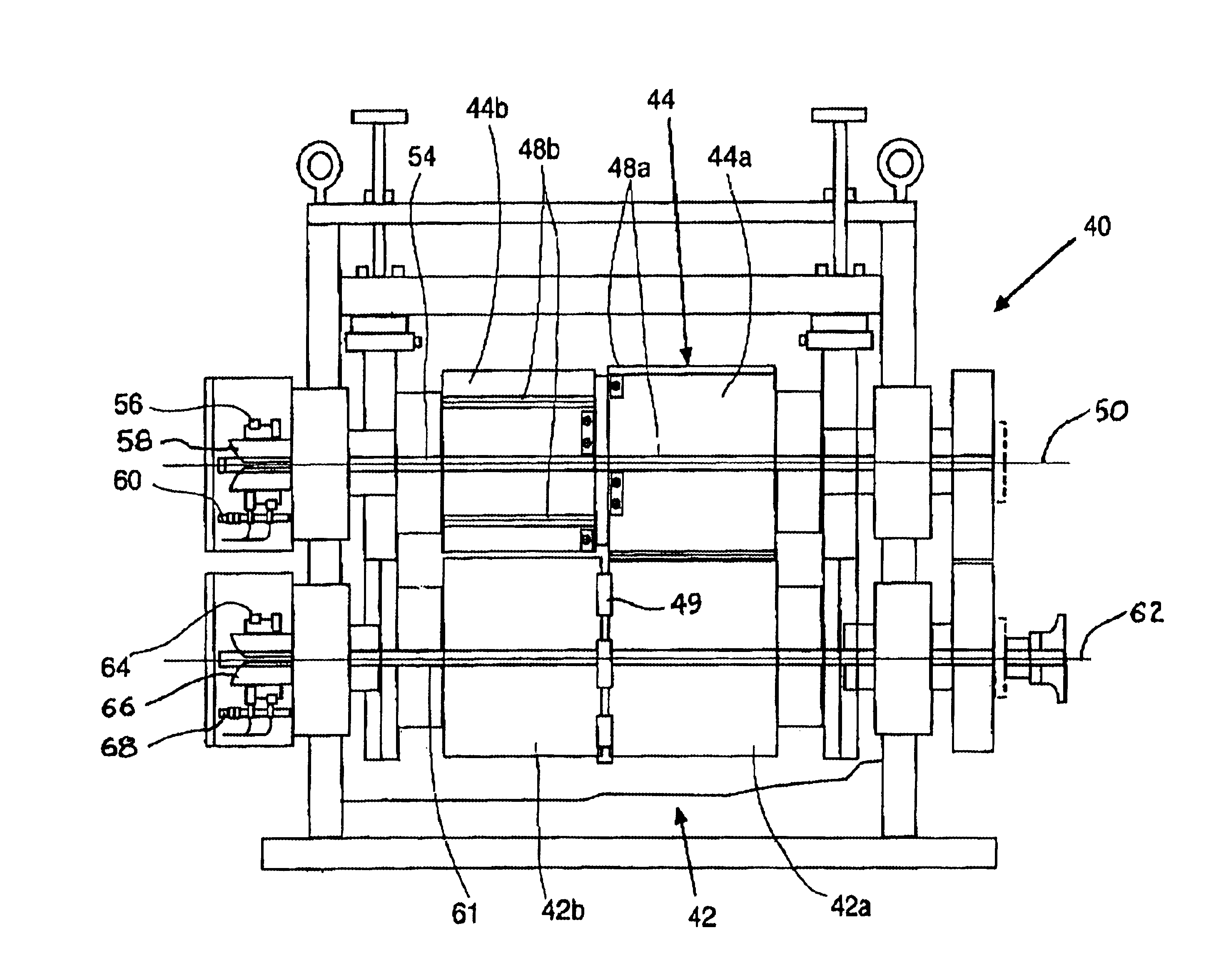
[0031]Experiments to test the method of the invention were initially carried out in laboratory trial, using a rolling mill. The rolls were operated at ambient room temperature and at various elevated temperatures. The mill was fitted with a pair of clamped-in-place cutting blades on the top roll for elevated-temperature cutting trials. All the tests conducted at the identified optimum temperature range performed flawlessly with no sticking of paste to the cutting blades, support roll or anvil roll. An experimental divider module was designed and fabricated. After a debugging period, successful no-sticking cutting performance was obtained. Six lengths of pasted mesh (each 20 feet long) were cut into battery plates (4½ inches wide by 5½ inches long), in a laboratory environment, with successful results; that is, the paste did not stick to the cutter die components.
[0032]It has been found for conventional battery paste for use on lead or lead alloy plates that the die ...
PUM
| Property | Measurement | Unit |
|---|---|---|
| temperature | aaaaa | aaaaa |
| temperature | aaaaa | aaaaa |
| temperature | aaaaa | aaaaa |
Abstract
Description
Claims
Application Information
 Login to View More