
Organometallic platinum complexes for phosphorescence based organic light emitting devices
a technology of organic light emitting devices and platinum complexes, which is applied in the direction of discharge tube luminescnet screens, other domestic articles, natural mineral layered products, etc., can solve the problems of difficult to develop organic molecules that phosphore in the technologically useful blue and green colors of the visible spectrum, and achieve the effect of improving electroluminescen
- Summary
- Abstract
- Description
- Claims
- Application Information
AI Technical Summary
Benefits of technology
Problems solved by technology
Method used
Image

Examples
Embodiment Construction
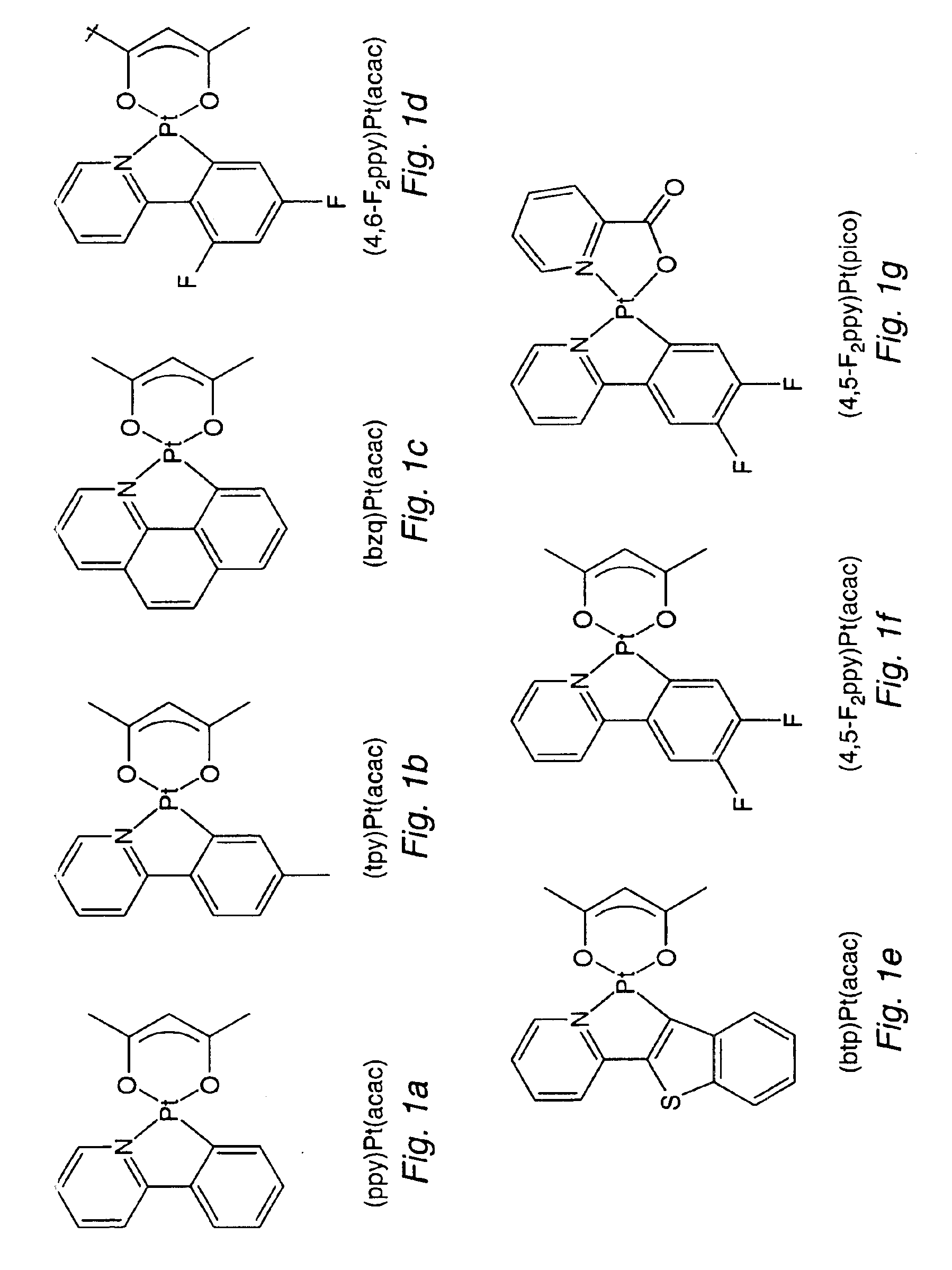
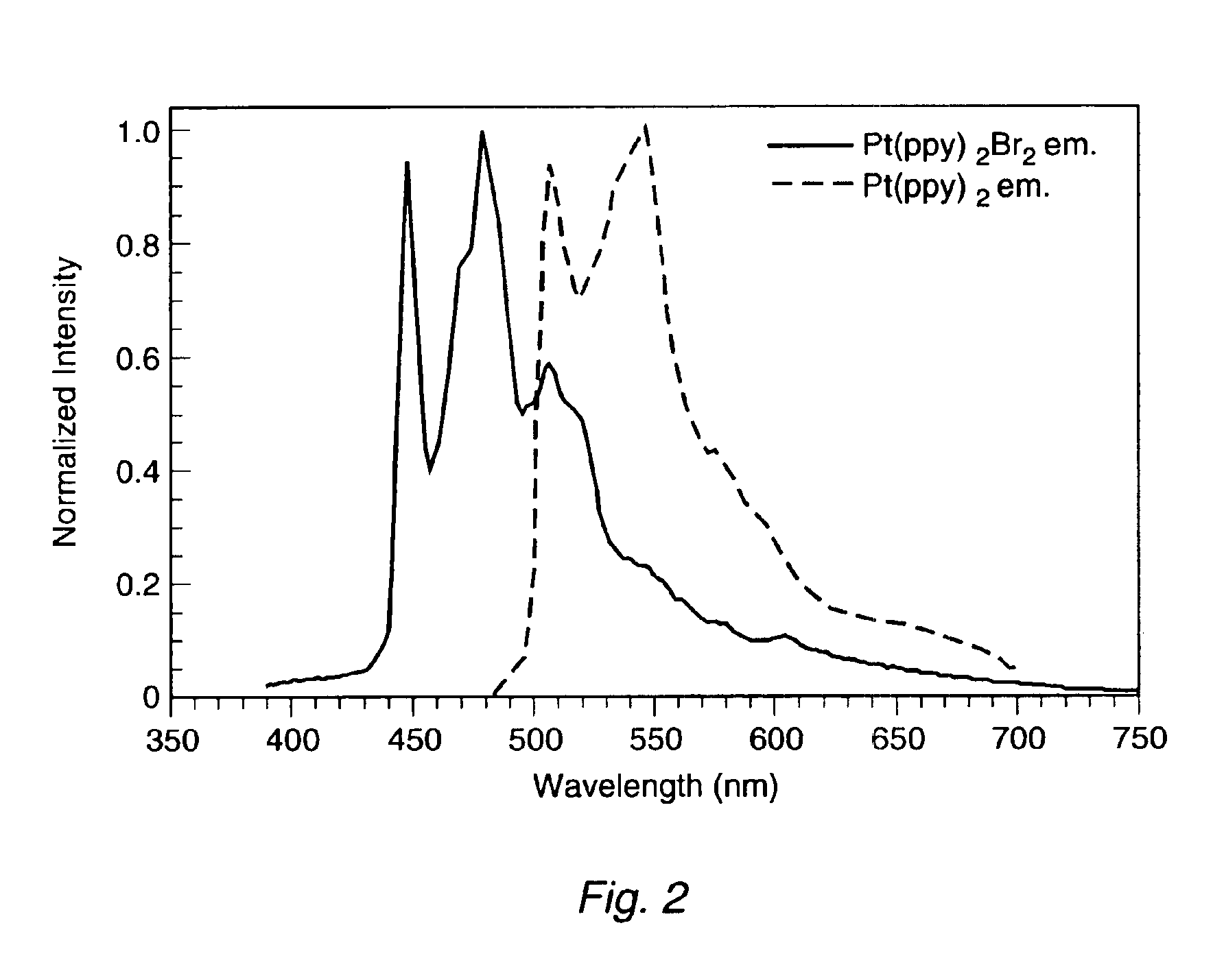
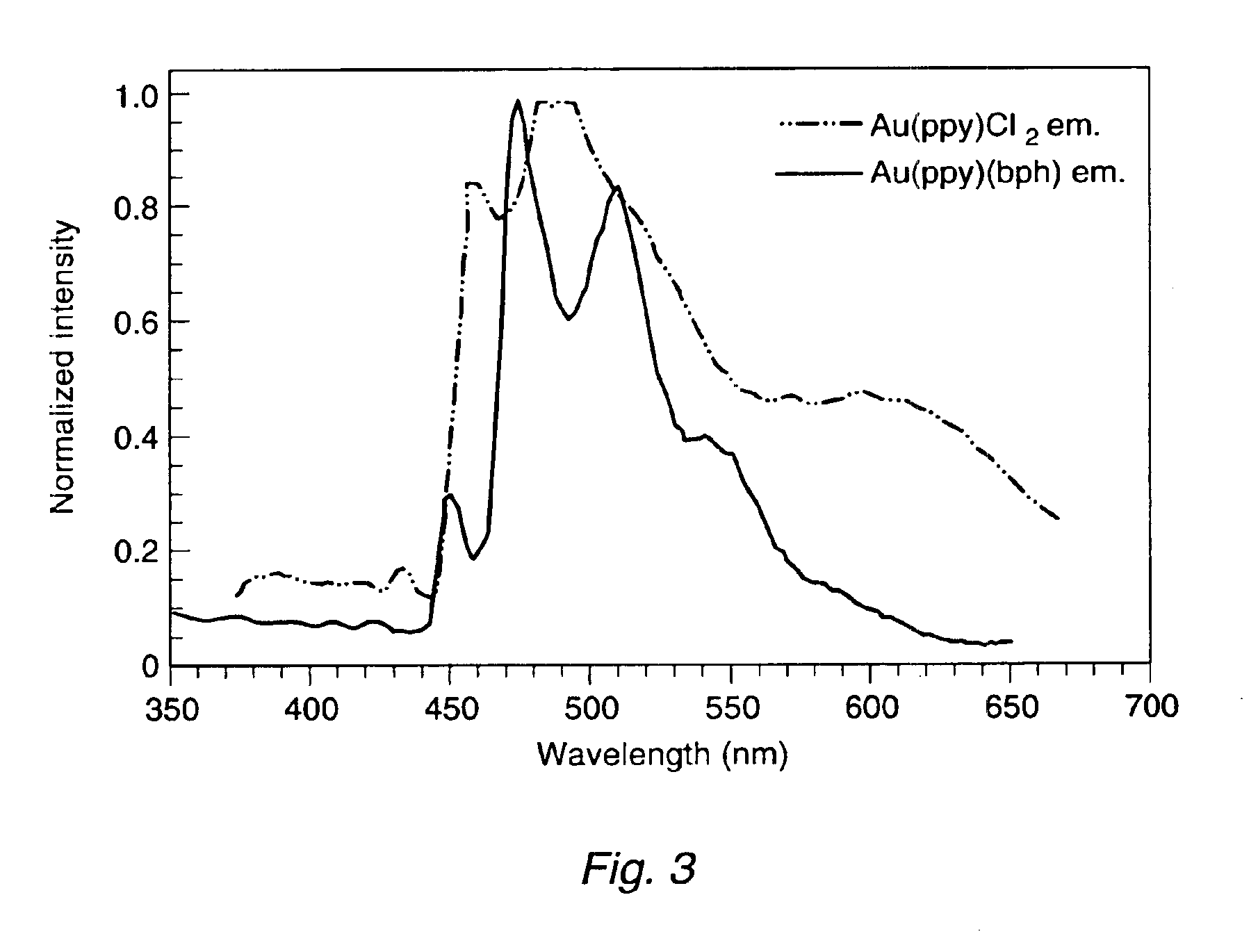
[0032]The present disclosure is aimed at a new class of platinum complexes, which give efficient phosphorescence. The representative complexes have a single organometallic ligand (cyclometallated) and a bidentate coordination ligand (such as acetylacetonate). Several examples of these complexes are given below along with their spectra. The emission spectra from these complexes show vibronic fine structure, consistent with strong ligand π-π* character in the phosphorescent transition. Strong ligand π-π* character is also consistent with the fact that the emission energy is strongly dependent on the identity of the ligand, as shown in the spectra shown below. Emission from these complexes results from a mixture of metal to ligand charge transfer (MLCT) and ligand based transitions. The MLCT is critical to enhance the efficiency of intersystem crossing and phosphorescence. The emission is dominated by the cyclometallated ligand and the MLCT between the Pt ion and that ligand. The emiss...
PUM
| Property | Measurement | Unit |
|---|---|---|
| Chemical structure | aaaaa | aaaaa |
Abstract
Description
Claims
Application Information
 Login to View More