Multi-channel SONET/SDH desynchronizer

Inactive Publication Date: 2006-01-03
PMC-SIERRA
View PDF9 Cites 15 Cited by
  • Summary
  • Abstract
  • Description
  • Claims
  • Application Information

AI Technical Summary

Benefits of technology

[0018]The same arithmetic unit circuit can be used to execute all operations necessary for a single or multi-channel desynchronizer using a narrow-band second order type dual PLL with adjustable loop bandwidth to avoid FIFO spill while simultaneously, independently processing adjustment related bits in the FIFO using an open loop method of modulating the endless phase modulator.
[0019]The proposed endless modulator block is a novel way to generate multiple clocks at different frequencies using one delay line and one calibration circuit. Novel use of a look-up list (LUT), built using a RAM, that converts the instantaneous phase value to the select signal for each of the multiplexer circuits that generate different clocks, results in a loop bandwidth independent of the number of taps whose delay is equivalent to one clock pulse. Use of a dual port RAM and calibration circuit reduce the size of the LUT. This method results in a PLL loop bandwidth independent of process variation and temperature. Use of the endless phase modulator significantly reduces power consumption and gate count compared to a numerically controlled oscillator (NCO) method.

Problems solved by technology

The pointer adjustment due to lack of synchronism of the nodes in the network gives rise to another form of jitter which is more serious than mapping jitter.
One pointer adjustment results in 8 cycles of network clock jitter.
The pointer adjustment occurrence is a stochastic process and, as a result, it is difficult to predict its behaviour.
Multiple channels, for example 12 channels of DS3 can be dropped from OC12, can have output frequencies quite close to each other and, as a consequence, mutual coupling can cause excessive jitter.
The reason for the excessive jitter is caused by the large index of modulation of the frequency modulation device.
Thus, small frequency offsets between desynchronized clocks, if there is even a very small coupling between the desynchronization circuits, would produce through PLL action very low modulation frequencies on the control voltages which would modulate, excessively, the VCO outputs.
However, a large number of the NCO devices on the same chip, especially if generating high frequencies, would result in large power consumption.
In an ASIC implementation of the desynchronizer use of the LC filter is not an option.
The second conclusion from investigating a multiple channel desynchronizer is that a separate desynchronizer for each channel will result in an extremely large circuit size.
None of the prior art discloses the re-use of the circuitry.

Method used

the structure of the environmentally friendly knitted fabric provided by the present invention; figure 2 Flow chart of the yarn wrapping machine for environmentally friendly knitted fabrics and storage devices; image 3 Is the parameter map of the yarn covering machine
View more

Image

Smart Image Click on the blue labels to locate them in the text.
Viewing Examples
Smart Image
  • Multi-channel SONET/SDH desynchronizer
  • Multi-channel SONET/SDH desynchronizer
  • Multi-channel SONET/SDH desynchronizer

Examples

Experimental program
Comparison scheme
Effect test

Embodiment Construction

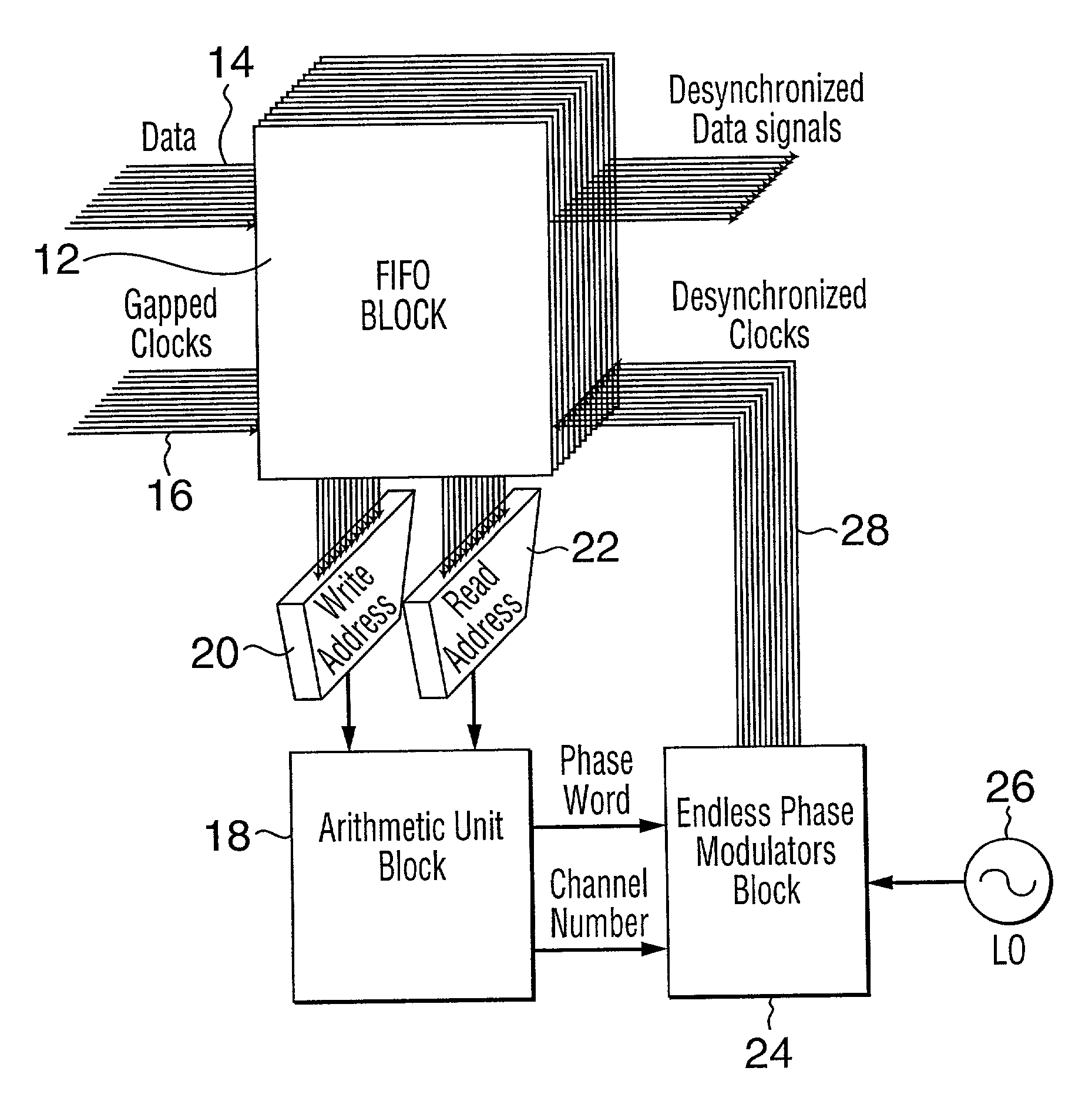
[0032]Referring to FIG. 1, the desynchronizer includes a FIFO block 12, which receives synchronized data from a set of SONET / SDH data lines 14 and gapped clock signals on gapped clock lines 16. An arithmetic unit block 18 is coupled to the FIFO block 12 by both a write address block 20 and a read address block 22. An endless phase modulator block 24 couples to the arithmetic unit block 18 and to a crystal oscillator 26. The crystal oscillator 26 oscillates at a nominal data rate of the digital signal which, for example, for desynchronizing DS3 is a rate of 44.736 MHz. The output of this crystal oscillator 26 is used in the endless phase modulator block 24 to generate the desynchronized clocks on desynchronized clock lines 28. A delay line with taps and a multiplex circuit that selects a specific tap generates different output clocks (see FIG. 13). Successive selecting of a higher and higher tap number of the delay line creates a lower frequency clock than the crystal oscillator freq...

the structure of the environmentally friendly knitted fabric provided by the present invention; figure 2 Flow chart of the yarn wrapping machine for environmentally friendly knitted fabrics and storage devices; image 3 Is the parameter map of the yarn covering machine
Login to View More

PUM

No PUM Login to View More

Abstract

A desynchronizer for desynchronizing one or multiple channels of SONET / SDH data signals, which includes a first in first out (FIFO) buffer having an input coupled to said data signals and an output for outputting asynchronous data obtained from one or more of said SONET / SDH data channels. An arithmetic unit coupled to the FIFO performs all operations required for single or multi-channel desynchronization. An endless phase modulator is coupled to the arithmetic unit and to the FIFO and is operative, in response to input from the arithmetic unit, to produce a single output desynchronized clock or multiple output desynchronized clocks.

Description

FIELD[0001]The present invention relates to multi-channel SONET / SDH desynchronizer for reading and transmitting asynchronous data received from several synchronous channels.BACKGROUND[0002]Data carried over a number of tributaries such as DS1, DS3, E1, E3, etc., each of generally different frequencies, may be multiplexed together so that it can share a common transmitter, receiver and transmission media. In order to transmit such data together, it is mapped onto a frame at the place where it enters the network. All of the signals from the various tributaries are synchronized to a single network clock. Excess bandwidth is filled with stuff bits which carry no information. A pointer adjustment can be used in place of or, in addition to, the stuff bits to indicate changes in the data rate of the synchronous channel and lack of synchronism of the nodes in the network. At the other end of the network a desynchronizer reads and transmits asynchronous data that had been carried over the sy...

Claims

the structure of the environmentally friendly knitted fabric provided by the present invention; figure 2 Flow chart of the yarn wrapping machine for environmentally friendly knitted fabrics and storage devices; image 3 Is the parameter map of the yarn covering machine
Login to View More

Application Information

Patent Timeline
no application Login to View More
IPC IPC(8): H04J3/06H03L7/081H04J3/07
CPCH04J3/076H03L7/0814
InventorACIMOVIC, PREDRAG SAVA
OwnerPMC-SIERRA