Data transformation to maintain detailed user information in a data warehouse

US7024431B1Inactive Publication Date: 2006-04-04MICROSOFT TECH LICENSING LLC
11 Cites 56 Cited by

Patent Information

Authority / Receiving Office
US · United States
Current Assignee / Owner
Publication Date
2006-04-04
Estimated Expiration
Not applicable · inactive patent

Smart Images

  • Figure 1
    Figure 1
  • Figure 2
    Figure 2
  • Figure 3
    Figure 3
Patent Text Reader

Abstract

Transforming data prior to loading the data into a data warehouse. Software of the invention partitions data records received from a plurality of servers and performs sequential file management operations and identifier management operations on each of the partitions prior to loading the data records into the data warehouse. Data records transformed according to the invention are easier to load into the data warehouse and easier to manipulate after loading. The invention enables analysis and data mining of tens of terabytes of user level detail data and summary data.
Need to check novelty before this filing date? Find Prior Art

Description

CROSS-REFERENCE TO RELATED APPLICATION

[0001] This is a continuation-in-part of U.S. patent application Ser. No. 09 / 611,405, U.S. Pat. No. 6,721,749, filed Jul. 6, 2000, which is hereby incorporated herein by reference in its entirety for all purposes.TECHNICAL FIELD

[0002] The present invention relates to the field of data warehousing. In particular, this invention relates to techniques for transforming data gathered from a variety of sources for storage in a data warehouse.BACKGROUND OF THE INVENTION

[0003] A data warehouse is a database designed to support decision-making in an organization. A typical data warehouse is batch updated on a periodic basis and contains an enormous amount of data. For example, large retail organizations may store one hundred gigabytes or more of transaction history in a data warehouse. The data in a data warehouse is typically historical and static and may also contain numerous summaries. It is structured to support a variety of analyses, including elaborat...

Examples

Embodiment Construction

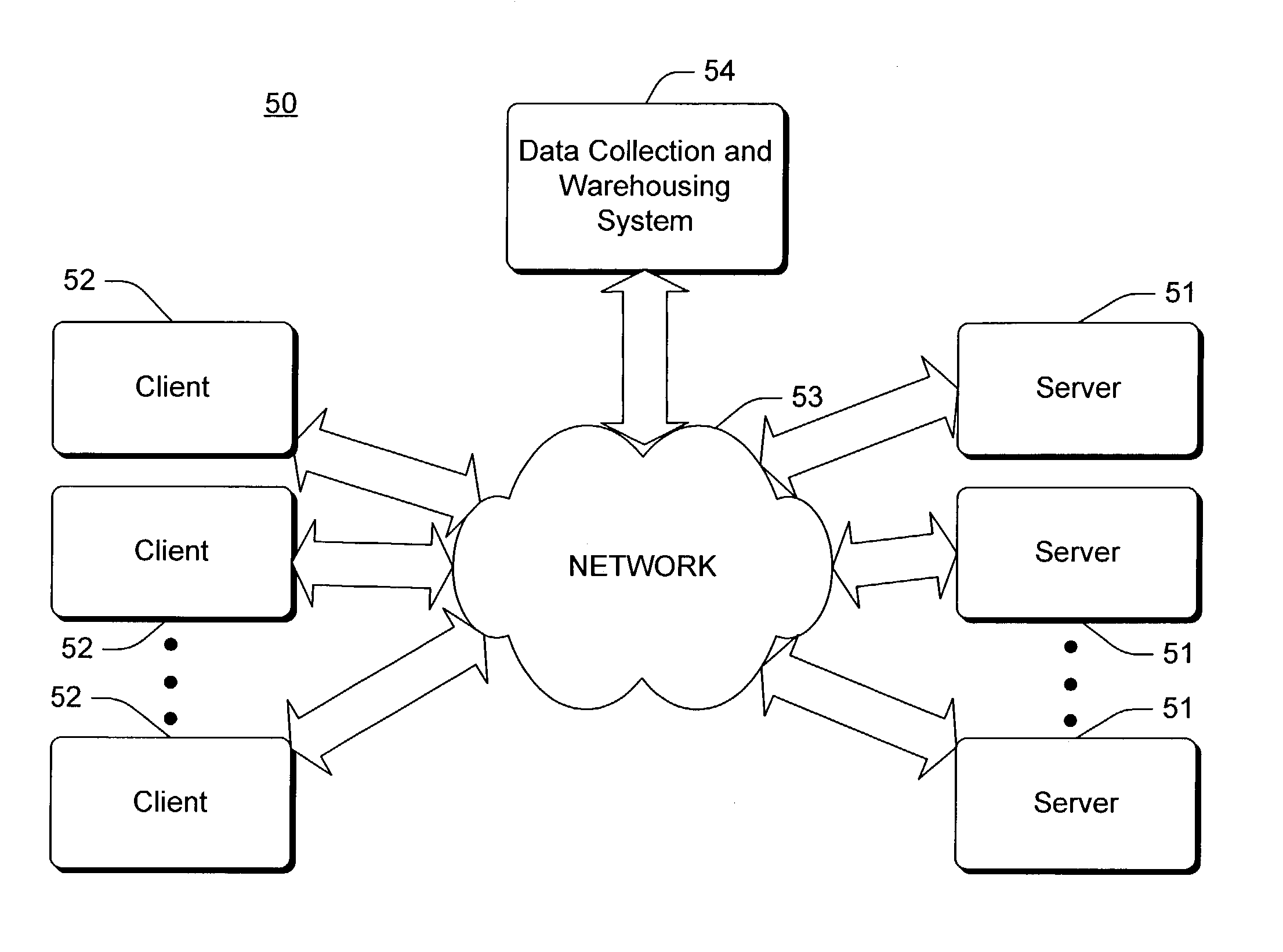
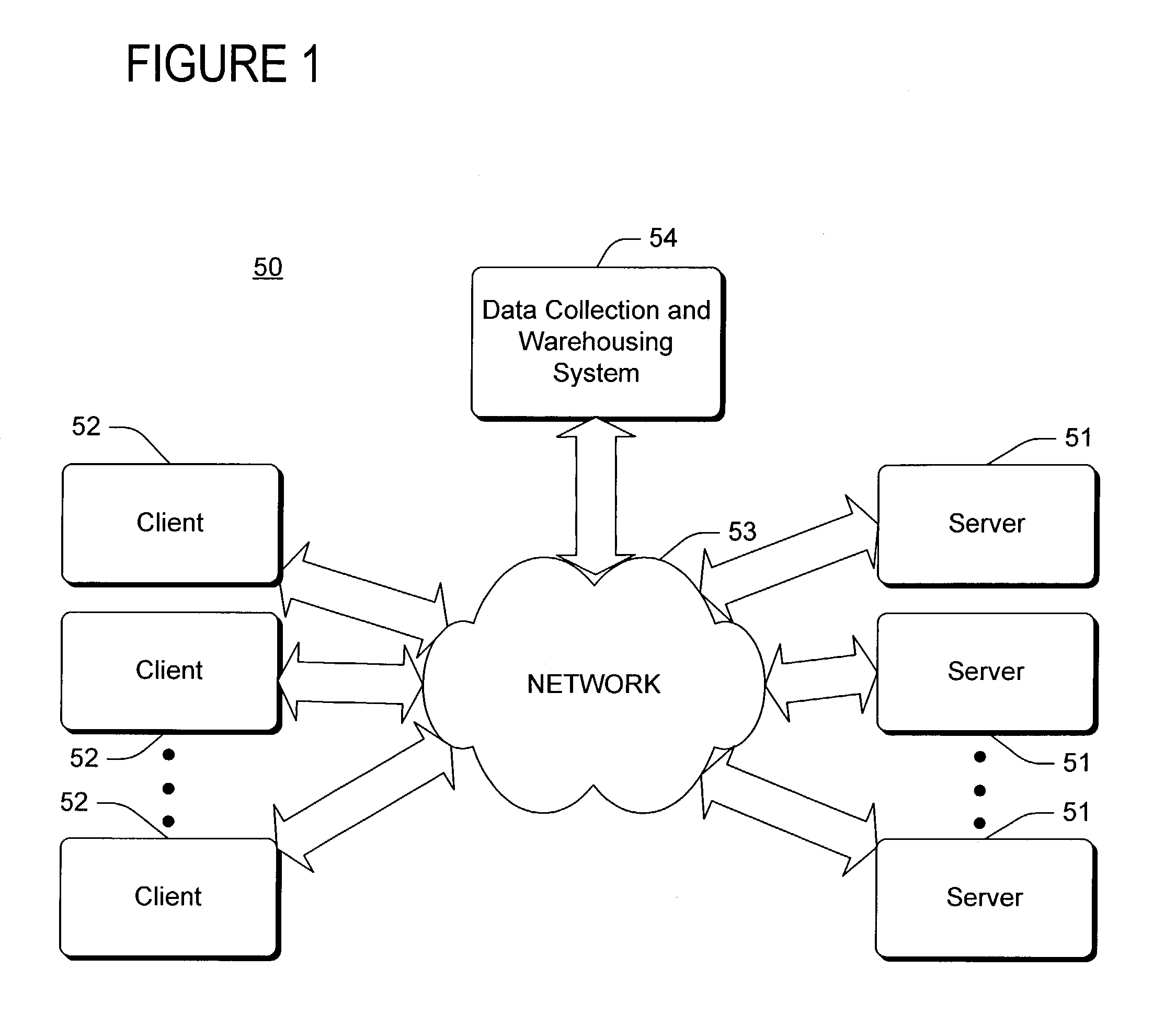
[0034]Referring first to FIG. 1, an exemplary embodiment of the invention includes a client / server network system 50 and a data collection and warehousing system 54. FIG. 1 shows the network system 50 comprising a plurality of servers 51 and clients 52. These computers 51, 52 are connected for high-speed data communications over a network 53, using well-known networking technology. The Internet is one example of network 53. Servers 51 accept requests from large numbers of remote network clients 52. The data servers 51 provide responses comprising data that potentially includes graphically formatted information pages. In many cases, the data is in the form of hypertext markup language (HTML) documents. In addition to the servers 51 and clients 52, the system of FIG. 1 includes a central collection facility or data warehousing system 54. The data warehousing system 54 communicates through network 53 with other network nodes such as servers 51 and clients 52, although other means of co...