
Printing and quilting method and apparatus
a printing and quilting technology, applied in the field of quilting, can solve the problems of affecting the quality of quilting around the pre-applied patterns or the quilting of pattern details of a and is difficult to achieve the high quality outline quilting around the pre-applied patterns or the fraction of an inch in scale quilting, and achieves the effect of efficient and economical operation
- Summary
- Abstract
- Description
- Claims
- Application Information
AI Technical Summary
Benefits of technology
Problems solved by technology
Method used
Image

Examples
embodiment 100
[0078]FIG. 2 illustrates an embodiment 100 of the invention that employs a single-needle, frame-supported, discrete-panel quilting machine such as those described in U.S. Pat. No. 5,832,849. Other machines of that type are disclosed in U.S. Pat. Nos. 5,640,916 and 5,685,250. These single needle quilting machines apply patterns to panels 129 that are often precut. Such machines are useful for manufacturing comforters, for example. The machine 100 has an operator accessible stack 116 of preformed panels from which the panel 129 is taken and loaded into the machine 100. A conveyor or conveyor system 120 moves a set of panel supporting edge clamps or other edge securements 121 to bring the panel 129 into a fixed position for application of a combination pattern by printing onto the outer top layer 115 of the multilayered fabric 129 and by quilting the multilayered fabric 129.
[0079]In the embodiment 100, a printing station 125, which in this embodiment includes a combined drying station ...
embodiment 200
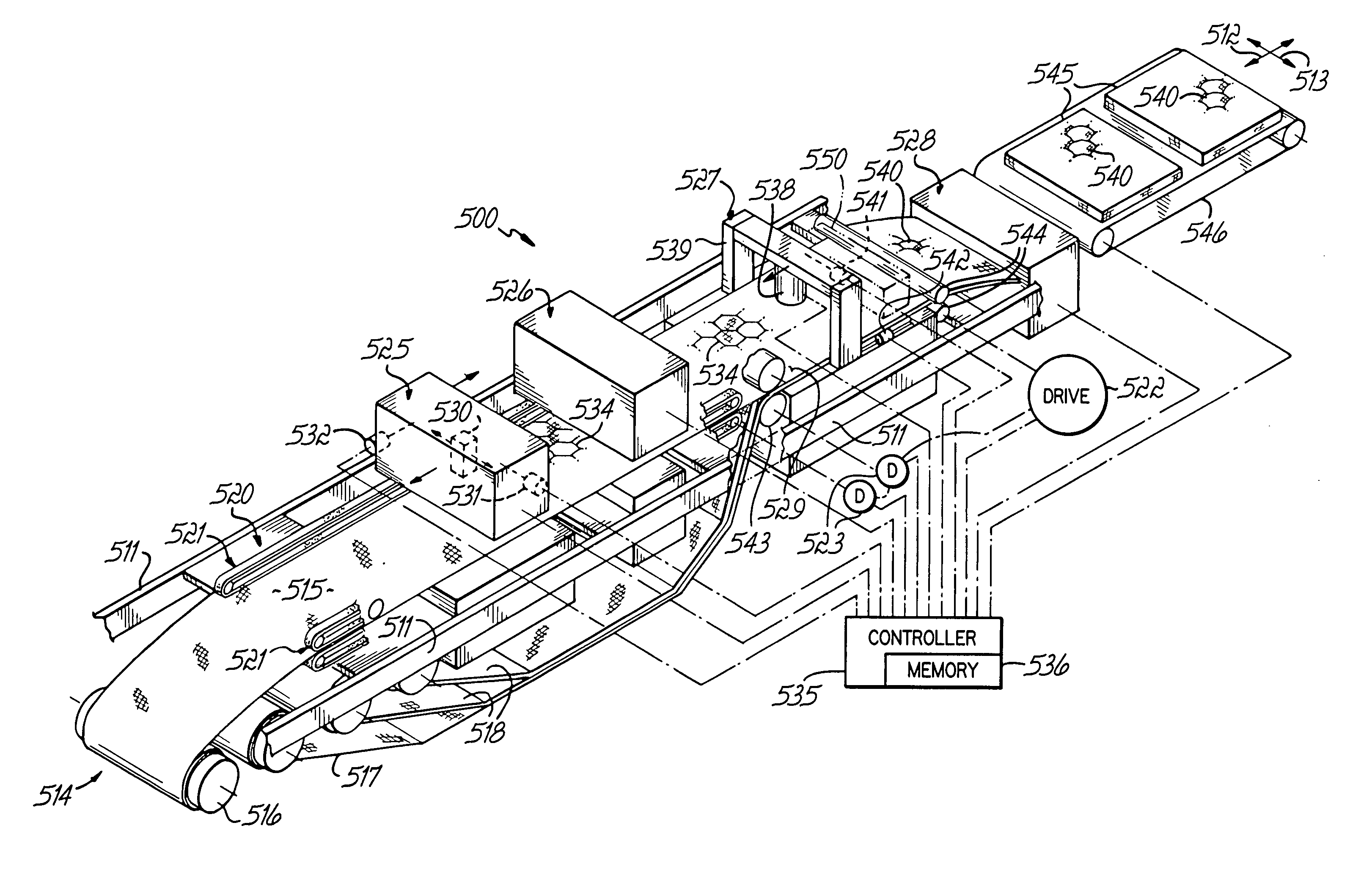
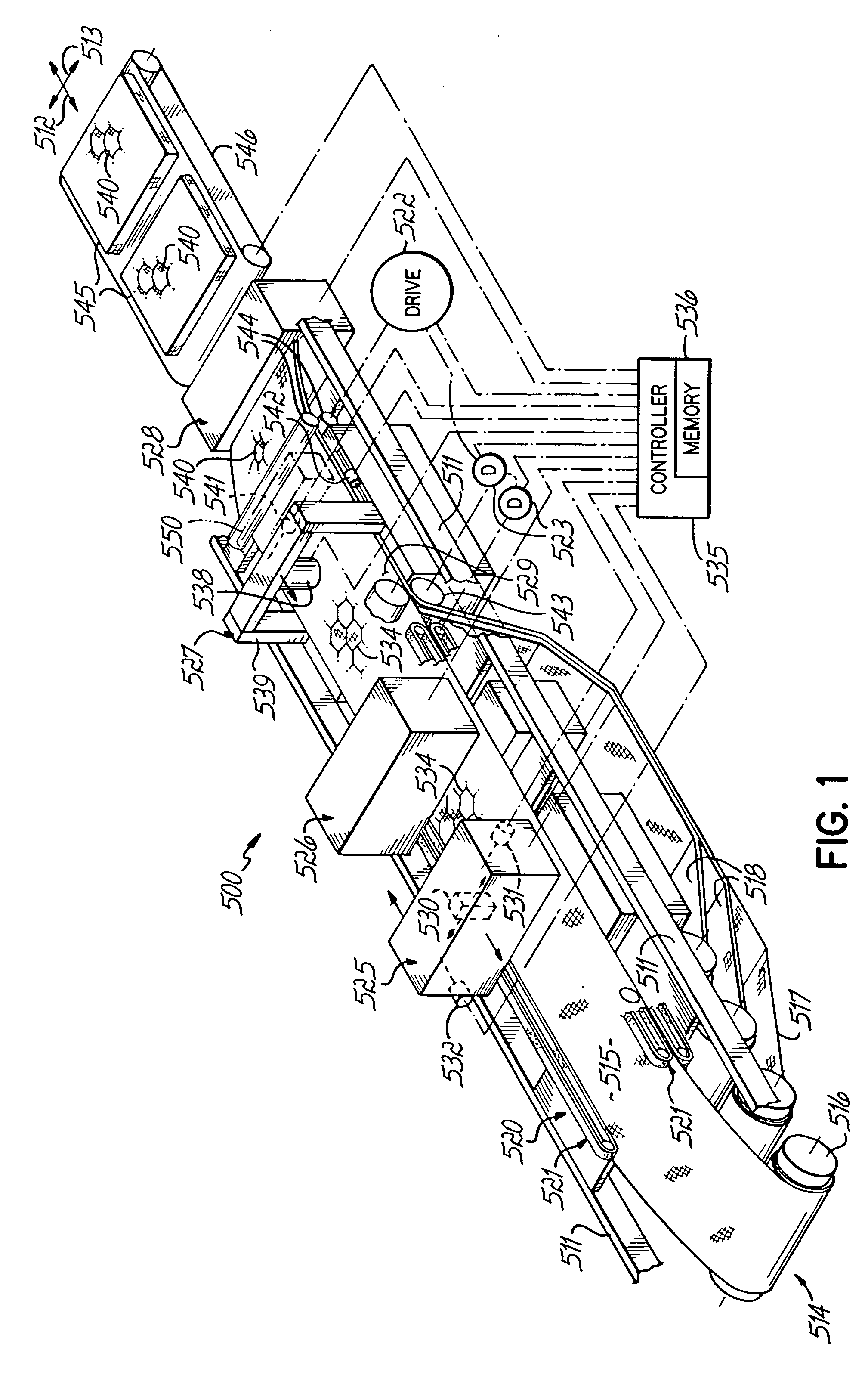
[0082]FIG. 3 illustrates an embodiment 200 that is similar in certain respects to the machine 500 of FIG. 1, but which further includes the capability to apply combination patterns to different areas of ticking material 215 on a wide multilayered fabric 229 to produce top or bottom panels 251 with matching or otherwise corresponding border panels 252 of a mattress cover. In the preferred arrangement, a web of ticking or facing material 215 from a roll 216 is printed in an efficient arrangement of panels on the facing material 215. The machine 200 is provided with a supply 217 of backing material and supplies 218 and 219 of filler material, which are preferably, for this embodiment, of different thicknesses at different positions across the width of the facing material 215, to form the multi-layered fabric 229, on which the arrangement of panels is then quilted at a quilting station 227 in a way that spatially corresponds to the printed patterns. The machine 200 is also provided with...
embodiment 400
[0100]An alternative configuration of the embodiment 400 of FIG. 5 employs magnetic particle brakes for the controllable elements 461 in place of servo motors. With such brakes, differential tension is applied on the opposite side edges of the web 429 as the web is pulled by drive rolls 420 upstream of the quilting station 427. The unequal tension on the opposite side edges of the web 429 affects the skew adjustment. Further, by locating the split feed roll 460 upstream of a set of rolls (not shown) at which the backing and fill layer webs 417 and 418 are joined to the facing web 429, shrinkage of the facing layer 429 bearing the printed pattern can be controlled and limited, so that the printed pattern can be, in effect, lengthened relative to quilted pattern. Typically, the longitudinal scale of the printed pattern at the printing station 425 takes into account predicted shrinkage due to the gathering of material during quilting. Sometimes dimensional changes occur that result in ...
PUM
 Login to View More
 Abstract
Description
Claims
Application Information
 Login to View More