
Inverse-vector method for smoothing dips and azimuths
a dip and azimuth technology, applied in the field of seismic data processing, can solve the problems of prone to amplify noise, large data windows, loss of resolution, etc., and achieve the effects of convenient interpretation, simple implementation, and improved computational efficiency
- Summary
- Abstract
- Description
- Claims
- Application Information
AI Technical Summary
Benefits of technology
Problems solved by technology
Method used
Image

Examples
example
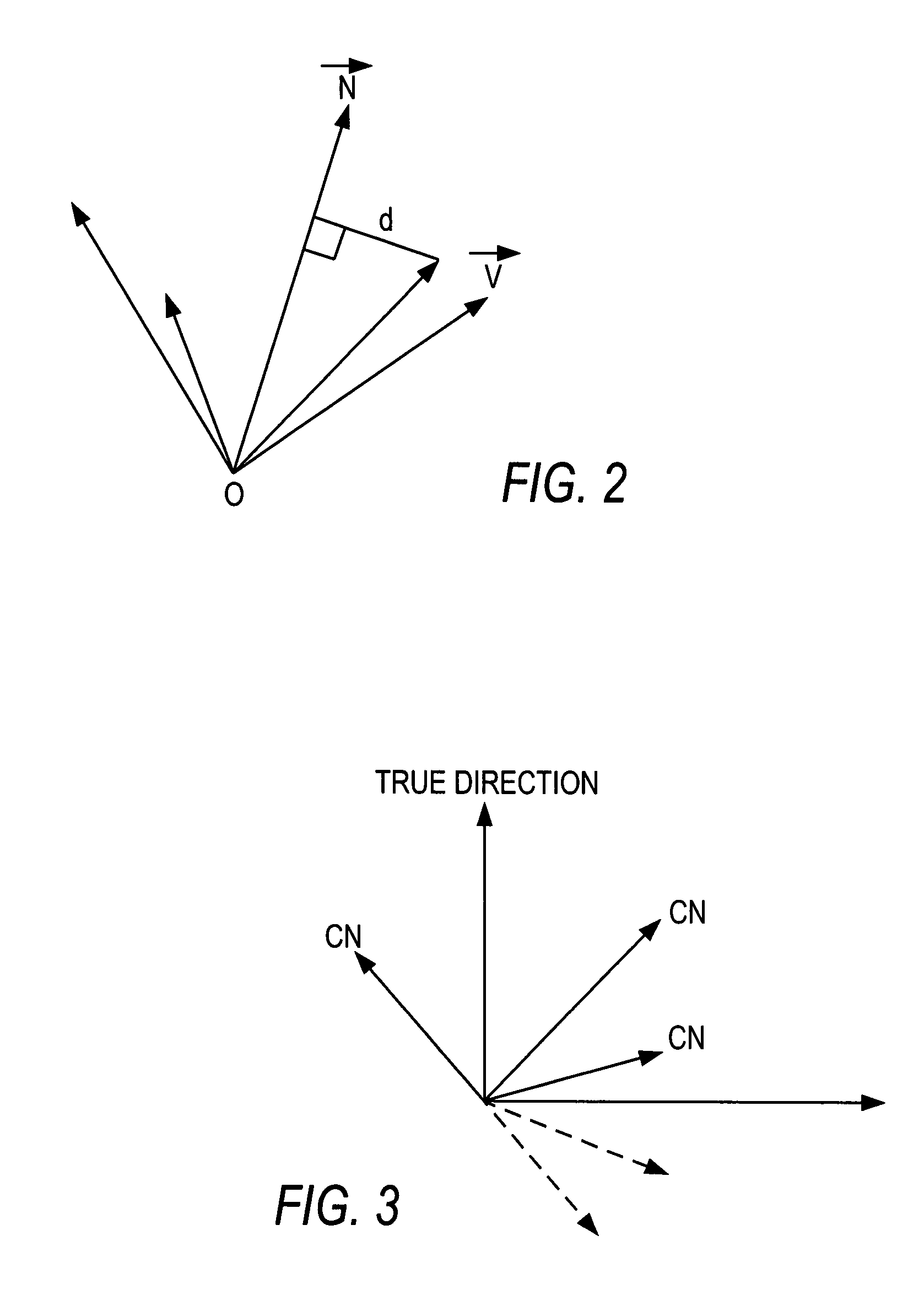
[0058]The seismic amplitude data shown in FIG. 5A extends about 5 km underground and is sampled at 4 ms. The raw dips computed with a finite difference method are shown in FIG. 5B, which appear very scattered and un-interpretable. After applying 21×21 smoothing with the structure-tensor method described above, the results are shown in FIG. 5C, which result in abnormal dips being generated. However, application of the inverse-vector method of the present invention after five iterations generates the smoothed image as shown FIG. 5D. To compare the two methods in detail, a timeline is illustrated in FIG. 6. The structure-tensor method produces abnormal dips bouncing between +90° and −90°, due to “inverse wrong then average” as explained above in conjunction with FIG. 3. The inverse-vector method of the present invention overcomes these instabilities and produces more interpretable dips. The spatially consistent dips are essential in computing curvature and other dip based attributes.
[0...
PUM
 Login to View More
 Abstract
Description
Claims
Application Information
 Login to View More