
Method for interpretation of a radio-electrical command
a radio-electrical command and radio-electrical technology, applied in the field of remote control, can solve the problems of inability to use fairly complex methods for measuring distance or detecting the proximity of sources, and the method is scarcely convenien
- Summary
- Abstract
- Description
- Claims
- Application Information
AI Technical Summary
Benefits of technology
Problems solved by technology
Method used
Image



Examples
first embodiment
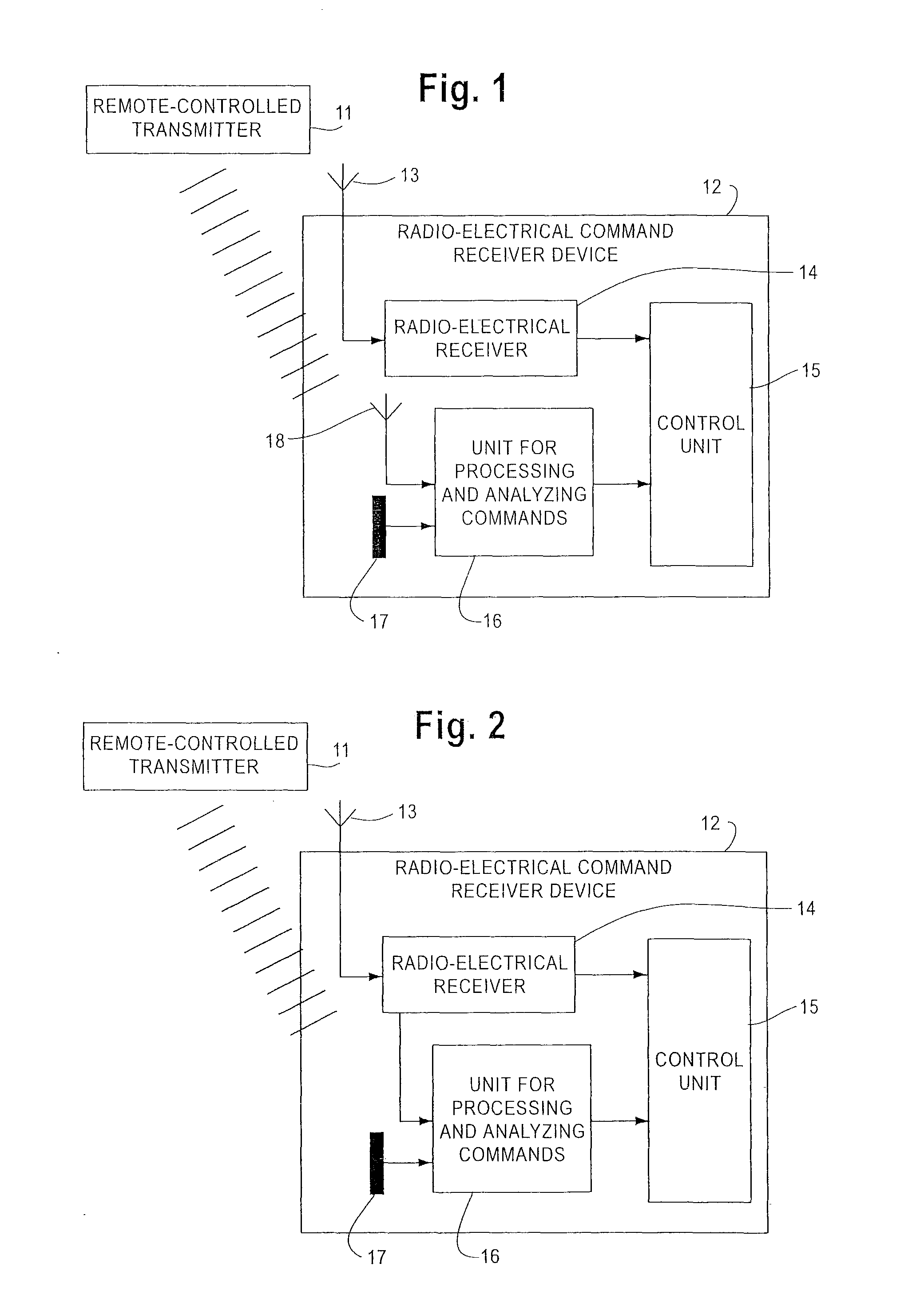
[0032]In the device according to the invention, which is represented in FIG. 1, the auxiliary antenna 17 is an antenna of the coil type and the auxiliary antenna 18 is an antenna of the quarter-wave type. When a radio-electrical command is received, the antenna 17 delivers a signal essentially representing the variations of the magnetic field H as a function of time. When a radio-electrical command is received, the antenna 18 delivers a signal representing the variations of the magnetic field H and the electric field E as a function of time. The transmission zone of the radio-electrical command is identified by comparing these two signals, or their powers. If a command has been transmitted from the near-field zone, specifically, then the ratio of power received by the antenna 17 / power received by the antenna 18 is substantially greater than if the command was transmitted from the far-field zone. Two auxiliary antennas of different types therefore make it possible, preferably by trai...
second embodiment
[0034]In order to simplify the layout in a second embodiment, which is represented in FIG. 2, one auxiliary antenna is replaced by an output of the radio-electrical receiver 14 that directly gives the power level received at the main antenna 13. These outputs are commonly referred to as RSSI, standing for Received Signal Strength Indicator. For example, the circuit CC1000 marketed by CHIPCON has such an analog output on its terminal 28.
[0035]In both of the embodiments described above, the signals output by the antennas may be adjusted so as to obtain a same amplitude at the transition between near field and far field, for example with the aid of potentiometric dividers.
third embodiment
[0036]A third embodiment, which is represented in FIG. 3, consists in using two auxiliary antennas 37 and 38 of the same type, namely multiturn coils. These two antennas are arranged substantially one behind the other in the direction coming from the transmission point of the radio-electrical command. The distance between these antennas, which must be selected to be less than the wavelength, leads to a significant decrease of the signal received at the antenna further away from the source so long as the near-field conditions are met. In the case of a distance source, however, the powers received by each coil are almost identical. For example, in the case of a command transmitted at a frequency of 433 MHz and with a distance of 3 cm between the antennas 37 and 38:[0037]if the command is transmitted from a point located 1 m away from the device, then a 6% difference in received power will be detected between the two antennas 37 and 38,[0038]if the command is transmitted from a point l...
PUM
 Login to View More
 Abstract
Description
Claims
Application Information
 Login to View More