Air-to-ground cellular communication network terrestrial base station having multi-dimensional sectors with alternating radio frequency polarizations

a cellular communication network and terrestrial base station technology, applied in the field of cellular communications, can solve the problems of limited radio frequency spectrum available, limited call handling capacity in any single cell, radio frequency communication link between aircraft and terrestrial base stations, etc., to increase the call handling capacity, increase the overall traffic throughput, and increase the network availability of the composite air-to-ground radio frequency communication link substantially more robust

US8145208B2Active Publication Date: 2012-03-27GOGO BUSINESS AVIATION LLC
91 Cites 50 Cited by

Patent Information

Authority / Receiving Office
US · United States
Patent Type
Patents(United States)
Current Assignee / Owner
Publication Date
2012-03-27

Smart Images

  • Figure 1
    Figure 1
  • Figure 2
    Figure 2
  • Figure 3
    Figure 3
Patent Text Reader

Abstract

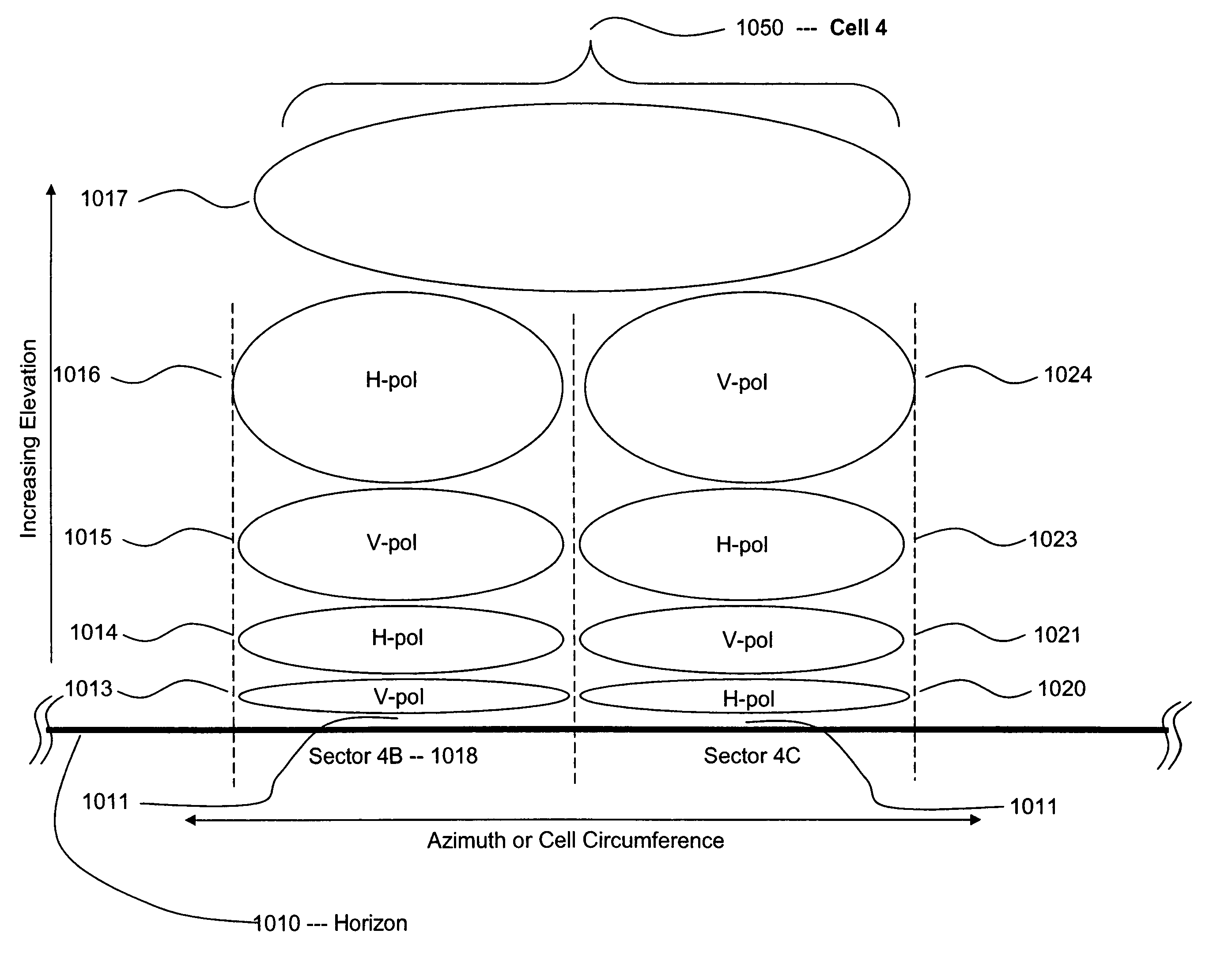
The Multi-Link Aircraft Cellular System makes use of multiple physically separated antennas mounted on the aircraft, as well as the use of additional optional signal isolation and optimization techniques to improve the call handling capacity of the Air-To-Ground cellular communications network. These additional techniques can include polarization domain and ground antenna pattern shaping (in azimuth, in elevation, or in both planes). Further, if code domain separation is added, dramatic increases in capacity are realized. Thus, the Air-To-Ground cellular communications network can increase its capacity on a per aircraft basis by sharing its traffic load among more than one cell or sector and by making use of multiple physically separated antennas mounted on the aircraft, as well as the use of additional optional signal isolation and optimization techniques.
Need to check novelty before this filing date? Find Prior Art

Description

CROSS-REFERENCE TO RELATED APPLICATIONS

[0001] This application is related to an application titled “Multi-Link Aircraft Cellular System For Simultaneous Communication With Multiple Terrestrial Cell Sites” filed on the same date as the present application, and to an application titled “System For Managing The Multiple Air-To-Ground Communications Links Originating From Each Aircraft In An Air-To-Ground Cellular Communication Network” filed on the same date as the present application.FIELD OF THE INVENTION

[0002] This invention relates to cellular communications and, in particular, to a system for providing multiple Radio Frequency communication links simultaneously between the aircraft and multiple terrestrial cell sites.BACKGROUND OF THE INVENTION

[0003] It is a problem in the field of cellular communications to efficiently and continuously meet the communications requirements of the passengers in multiple aircraft as the aircraft fly their routes and approach / depart airports.

[0004] A typ...

Examples

Embodiment Construction

[0048]The provision of highly reliable and highly available Air-To-Ground cellular communications service is a complex process, since many of the components of the Air-To-Ground cellular communications network interact and influence the composite overall Air-To-Ground cellular communications network traffic handling capacity (data, voice, other). Changing a network component may improve one network attribute but simultaneously impair another. From a systems perspective, the network design should have both high reliability and high availability as well as have high traffic capacity. To operationally manage these attributes, the network architecture should be capable of being scaled up over time to incrementally add traffic capacity.

Call Handling Capacity Enhancement Problem

[0049]In particular, the issue of capacity enhancement for Air-To-Ground cellular communications networks is an acute problem, since the Air-To-Ground Radio Frequency communications link represents a fixed bandwidt...