Mechanism to support flexible decoupled transactional memory

a transactional memory and flexible technology, applied in computing, instruments, electric digital data processing, etc., can solve the problems of limiting the application of tm applications, affecting the performance of tm applications, so as to maximize the overall system utilization, maximize concurrency, and encourage forward progress of tm applications

Active Publication Date: 2014-02-25
UNIV OF ROCHESTER OFFICE OF TECH TRANSFER
View PDF1 Cites 30 Cited by
  • Summary
  • Abstract
  • Description
  • Claims
  • Application Information

AI Technical Summary

Benefits of technology

FlexTM achieves performance comparable to fixed-policy HTMs, outperforming hardware-accelerated and software-only TM systems, and maximizes concurrency by allowing software to control policy decisions, reducing metadata overhead and enabling flexible conflict management strategies.

Problems solved by technology

Optimistic (lazy) systems delay conflict management until commit time (though they may detect conflicts earlier).
Full hardware systems are typically inflexible in policy, with fixed choices for eagerness of conflict management, strategies for conflict arbitration and back-off, and eagerness of versioning.
Software-only systems are typically slow by comparison, at least in the common case.
Unfortunately, metadata management imposes significant software costs.
Also, since LogTM does not allow transactions to abort one another, it is possible for running transactions to “convoy” behind a suspended transaction.
Similar to the hybrid systems, it suffers from per-access metadata bookkeeping overheads.
Furthermore, it supports only limited policies for contention management (i.e., only self aborts) and requires expensive commit time arbitration on every speculatively written location.
To decouple version management from conflict detection and management, however, RTM software had to segregate data and metadata, retaining much of the bookkeeping cost of all-software TM systems.

Method used

the structure of the environmentally friendly knitted fabric provided by the present invention; figure 2 Flow chart of the yarn wrapping machine for environmentally friendly knitted fabrics and storage devices; image 3 Is the parameter map of the yarn covering machine
View more

Image

Smart Image Click on the blue labels to locate them in the text.
Viewing Examples
Smart Image
  • Mechanism to support flexible decoupled transactional memory
  • Mechanism to support flexible decoupled transactional memory
  • Mechanism to support flexible decoupled transactional memory

Examples

Experimental program
Comparison scheme
Effect test

Embodiment Construction

[0066]A preferred embodiment of the present invention will be set forth in detail with reference to the drawings, in which like reference numerals refer to like elements or steps throughout.

[0067]FlexTM provides hardware mechanisms for conflict detection, conflict management, and versioning. We first describe these separately, then discuss how they work together to enable flexible TM.

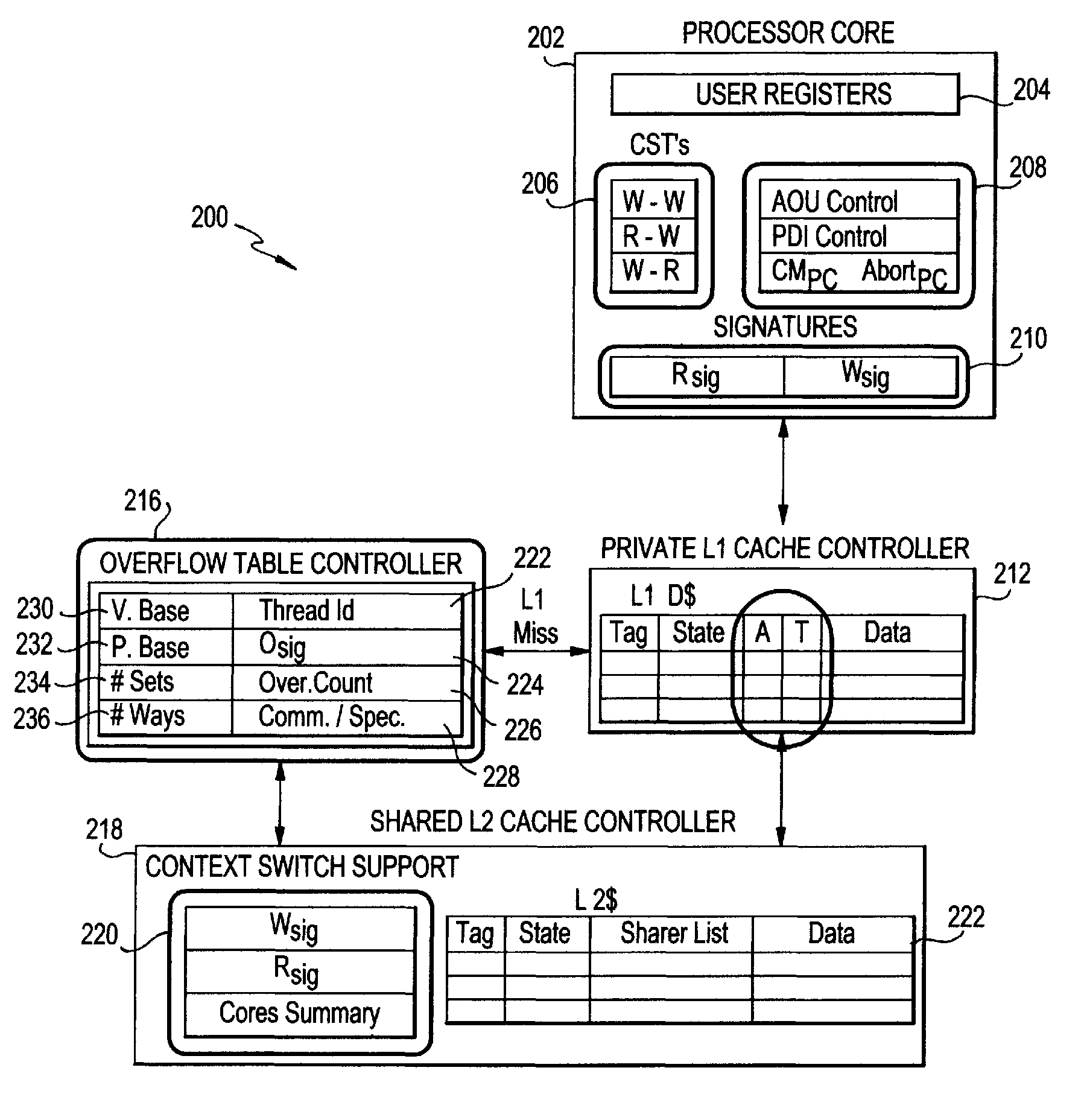
[0068]Access tracking, including read-set and write-set signatures, will now be described. Bulk and LogTM-SE use Bloom filter signatures to summarize the read and write sets of transactions in a concise but conservative fashion (i.e., false positives but no false negatives). Signatures decouple conflict detection from critical L1 tag arrays and enable remote requests to test for conflicts using local processor state, without walking in-memory structures. As in these systems, every FlexTM processor maintains a read signature (Rsig) and a write signature (Wsig) for the current transaction. The signatures ...

the structure of the environmentally friendly knitted fabric provided by the present invention; figure 2 Flow chart of the yarn wrapping machine for environmentally friendly knitted fabrics and storage devices; image 3 Is the parameter map of the yarn covering machine
Login to View More

PUM

No PUM Login to View More

Abstract

The present invention employs three decoupled hardware mechanisms: read and write signatures, which summarize per-thread access sets; per-thread conflict summary tables, which identify the threads with which conflicts have occurred; and a lazy versioning mechanism, which maintains the speculative updates in the local cache and employs a thread-private buffer (in virtual memory) only in the rare event of an overflow. The conflict summary tables allow lazy conflict management to occur locally, with no global arbitration (they also support eager management). All three mechanisms are kept software-accessible, to enable virtualization and to support transactions of arbitrary length.

Description

REFERENCE TO RELATED APPLICATION[0001]The present application claims the benefit of U.S. Provisional Patent Application No. 60 / 935,470, filed Aug. 15, 2007, whose disclosure is hereby incorporated by reference in its entirety into the present disclosure.STATEMENT OF GOVERNMENT INTEREST[0002]The work leading to the present invention was supported by NSF grants CCF-0702505, CCR-0204344, CNS-0411127, CNS-0615139 and CNS-0509270 and by NIH grant 1 R21 GM079259-01A1. The government has certain rights in the invention.FIELD OF THE INVENTION[0003]The present invention is directed to computer memory and more particularly to transactional computer memory in which the hardware requirements for concurrent access tracking, speculative update buffering and conflict management are decoupled from one another.DESCRIPTION OF RELATED ART[0004]Transactional Memory addresses one of the key challenges of programming multicore systems: namely, the complexity of lock-based synchronization. At a high level...

Claims

the structure of the environmentally friendly knitted fabric provided by the present invention; figure 2 Flow chart of the yarn wrapping machine for environmentally friendly knitted fabrics and storage devices; image 3 Is the parameter map of the yarn covering machine
Login to View More

Application Information

Patent Timeline
no application Login to View More
Patent Type & AuthorityPatents(United States)
IPC IPC(8): G06F12/00G06F13/00
CPCG06F9/528G06F12/0815G06F12/0842G06F9/524
InventorDWARKADAS, SANDHYASHRIRAMAN, ARRVINDHSCOTT, MICHAEL
OwnerUNIV OF ROCHESTER OFFICE OF TECH TRANSFER