Decomposing hyperspectral or multispectral image data

a multi-spectral image and data technology, applied in the field of electronic image processing, can solve the problems of difficult determination of the underlying endmember, inability to use methods, and difficulty in finding any underlying spectra in the radiance spectra, and achieve the effect of greater us

US8670620B2Active Publication Date: 2014-03-11NAT ICT AUSTRALIA
3 Cites 8 Cited by

Patent Information

Authority / Receiving Office
US · United States
Patent Type
Patents(United States)
Current Assignee / Owner
Publication Date
2014-03-11

Smart Images

  • Figure 1
    Figure 1
  • Figure 2
    Figure 2
  • Figure 3
    Figure 3
Patent Text Reader

Abstract

The disclosure concerns processing of electronic images, such as hyperspectral or multispectral images. In particular, but is not limited to methods, software and computer systems for determining underlying spectra of an image of a scene. The image data comprises for each pixel location a sampled image spectrum that is a mixture of plural reflectance spectra. Processor 310 determines or accesses plural hyperplanes that each have plural linearly independent basis vectors. Each hyperplane represents an estimate of one of the plural reflectance spectra. The processor 310 then determines for each pixel location, a contribution of the plural basis vectors of each hyperplane to the image spectrum of that pixel location. The processor 310 determines or accesses plural hyperplanes and not plural endmembers directly. Hyperplanes are two-dimensional while endmembers are only one-dimensional. As a result, hyperplanes carry more information, such as the illumination spectrum and are therefore of greater use. The decomposition of the image data into hyperplanes is possible without knowing the illumination spectrum. This decomposition allows for a range of new applications such as endmember extraction and compact representation.
Need to check novelty before this filing date? Find Prior Art

Description

TECHNICAL FIELD

[0001] The disclosure concerns processing of electronic images, such as hyperspectral or multispectral images. In particular the invention concerns, but is not limited to, methods, software and computer systems for determining underlying spectra of materials in a scene captured in the image.BACKGROUND ART

[0002] Aerial surveillance is commonly used for investigating the surface of the earth. In particular, images taken by satellites are used to identify objects or materials on the ground.

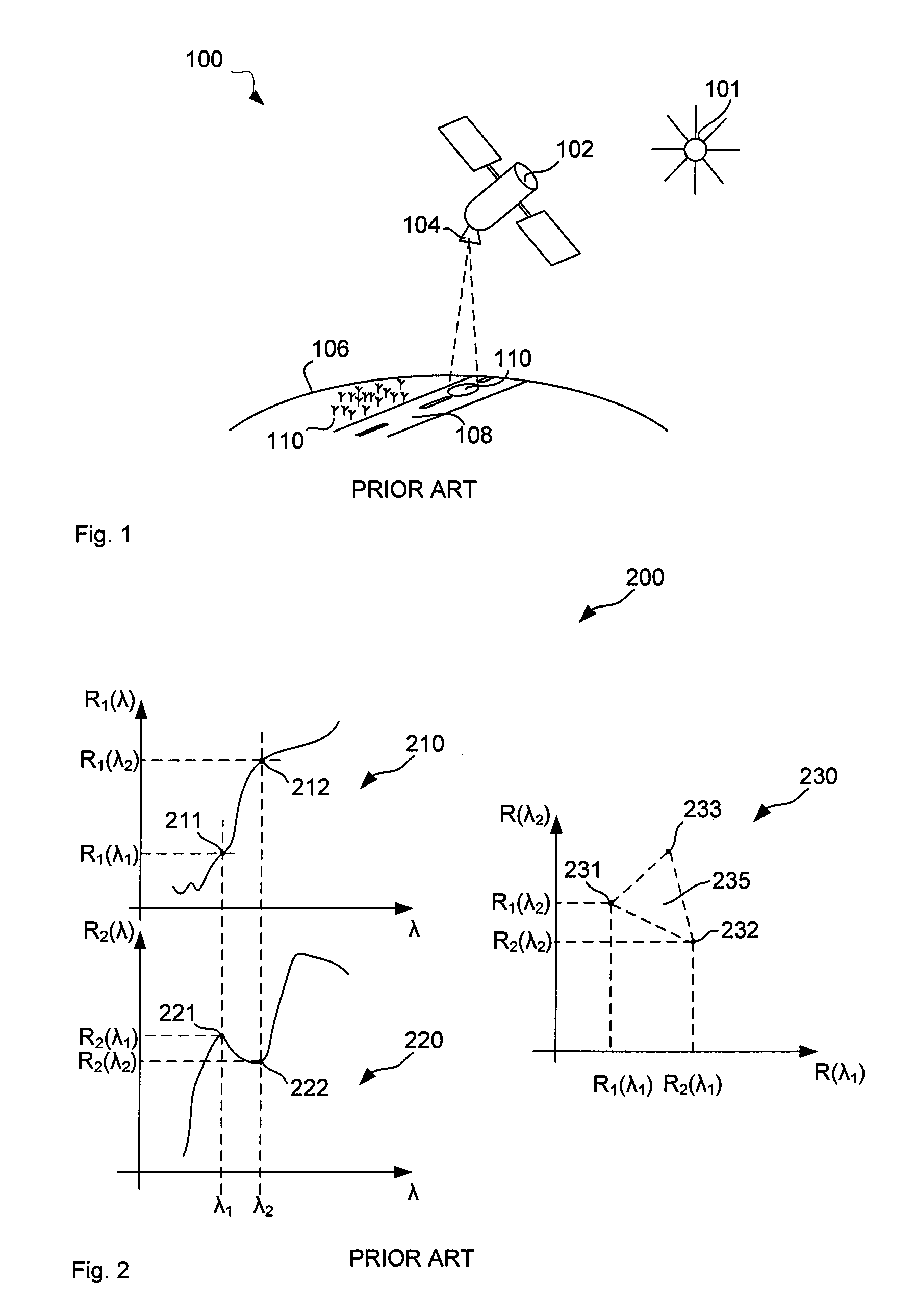
[0003] FIG. 1 illustrates a surveillance system 100 comprising an illumination source 101, such as the sun and a satellite 102 with a camera 104. The camera captures images of the surface of the earth 106. Located on the surface of the earth 106 are in this example a street 108 and plants 110. The street 108 and the plants 110 differ in the way they reflect the light which is the reason why they appear as having different colours to the eye. The measure of reflection of light from differe...

Examples

Embodiment Construction

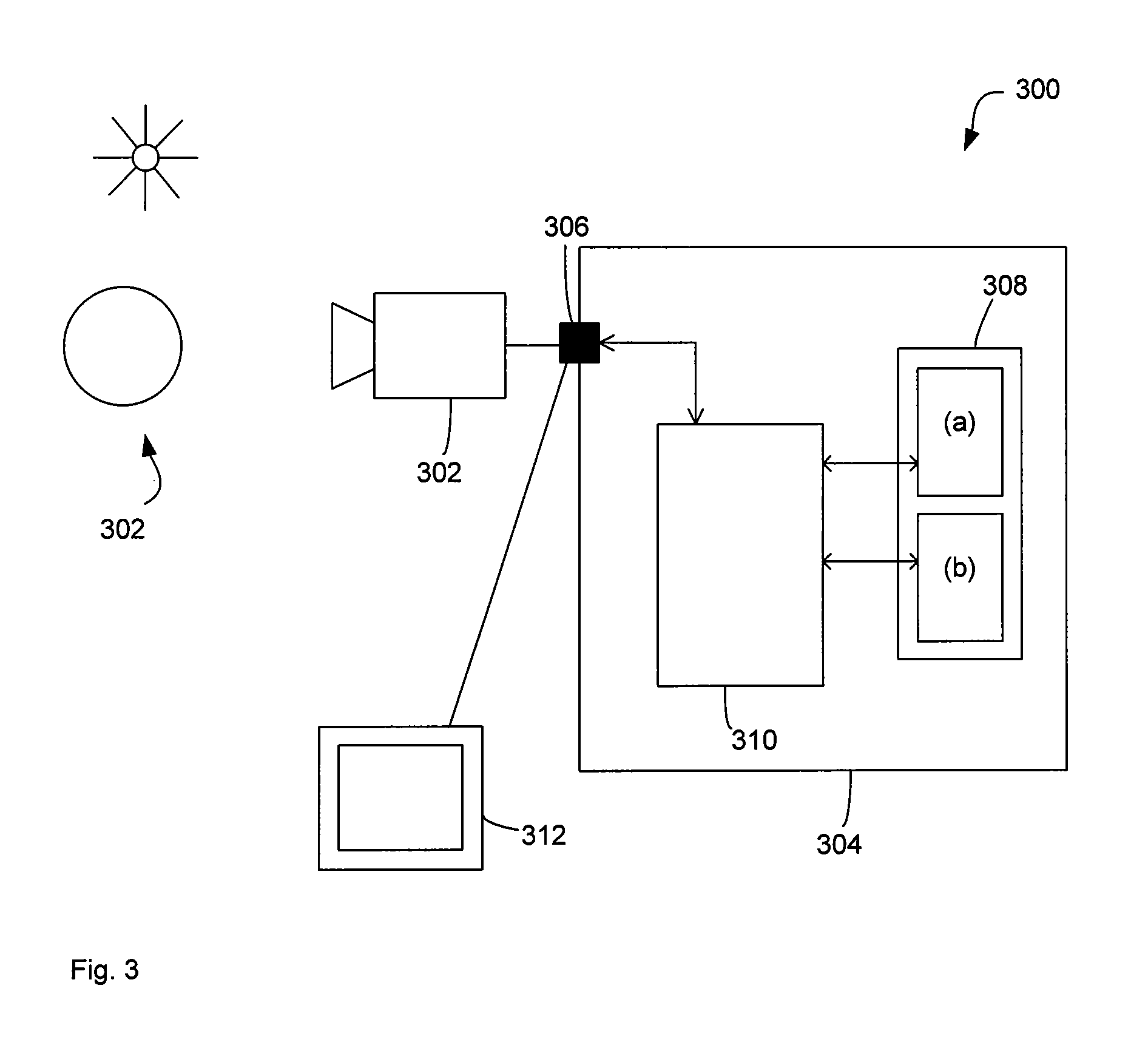
[0078]FIG. 3 illustrates a computer system 300 for determining basis spectra, that is underlying independent spectra, of wavelength indexed image data and decomposing the image data into the underlying spectra. Computer system 300 comprises a sensor 302 and a computer 304. In this example the sensor 302 is a hyperspectral or multispectral sensor that is able to capture an image of a scene 305, in this case the earth illuminated by the sun.

[0079]In one example, the computer system is integrated into a satellite orbiting the sun. In other examples the computer system is integrated into a handheld device such as a consumer camera and the scene 302 may be any scene on the earth, such as a tourist attraction or a person. The scene may also be illuminated by multiple artificial light sources, such as fluorescent lamps. The sensor 302 may have a number of bands that balances computational costs with accuracy. The sensor 302 may have as low as four bands and as high as hundreds.

[0080]The co...