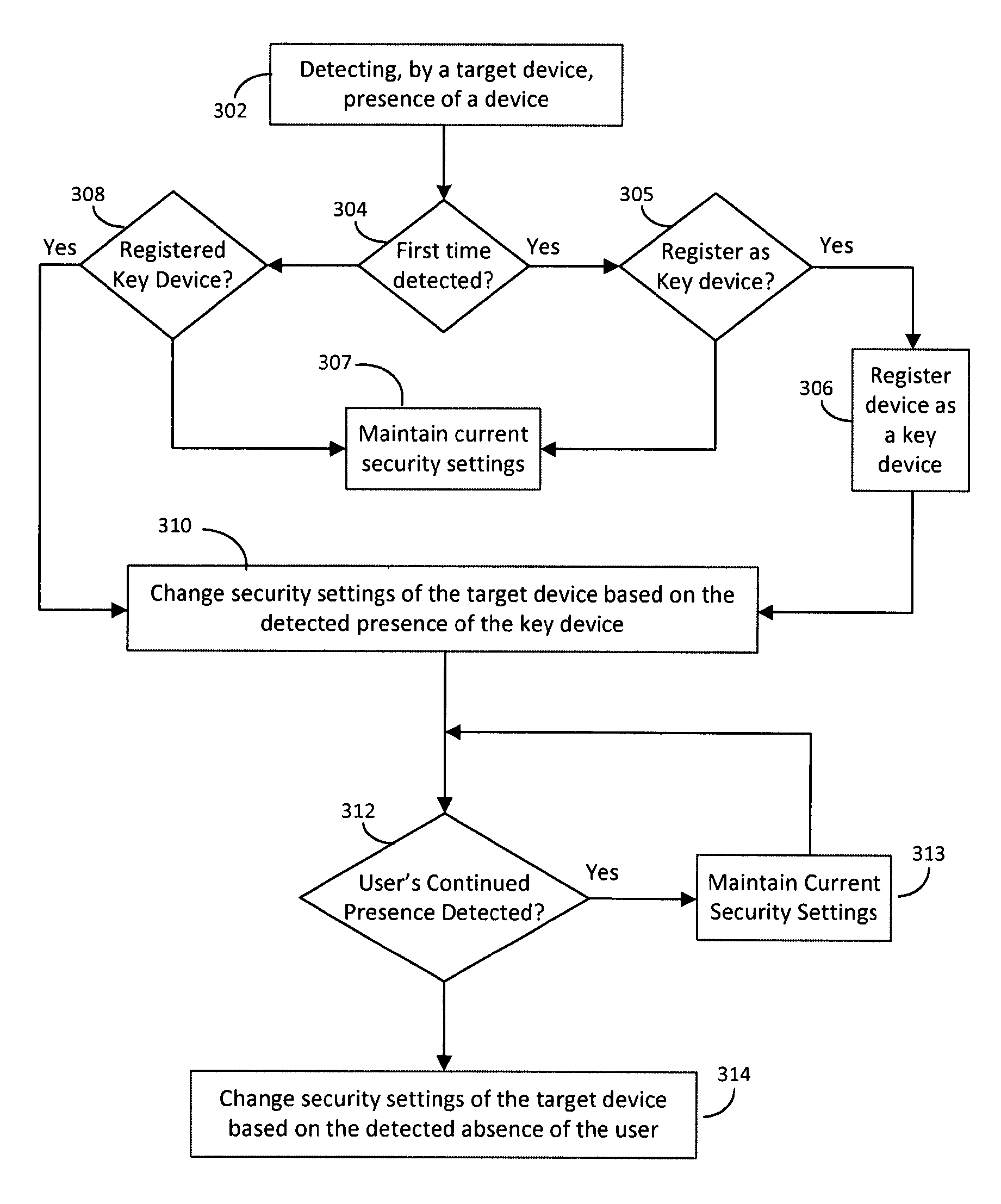
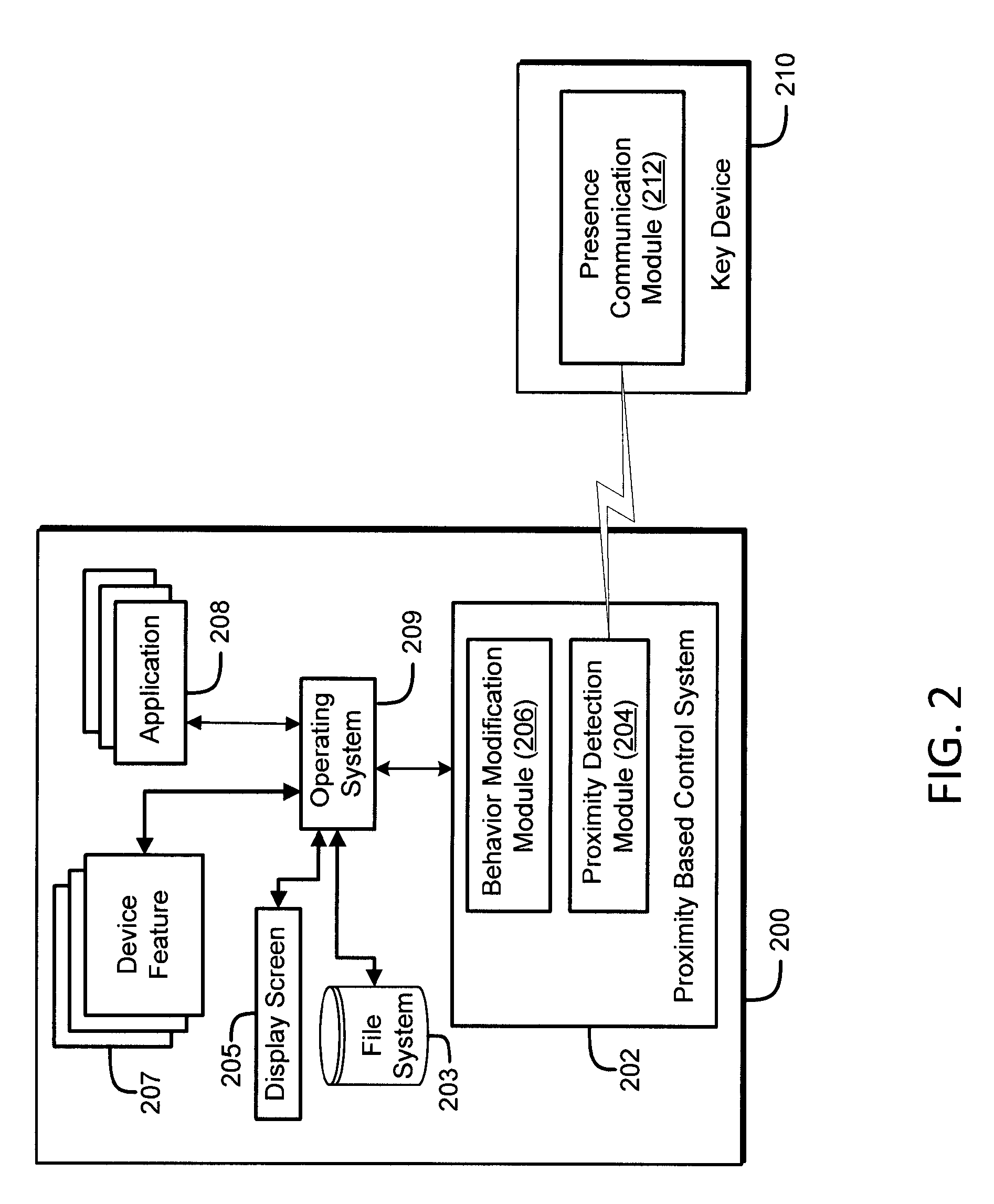
[0007]According to an embodiment, a system for automatically unlocking an electronic device based on the detection of the presence of another device (referred to as a “key device”) is provided. In this embodiment, when the presence of the key device is detected by the electronic device (referred to as a “target device”), a user of the target device is presumably in proximity to the target device and the target device can automatically change its state from locked to unlocked; and so long as the key device is within a specified distance and / or so long as the user's presence is detected within the specified distance, the target device can suppress the lock mechanism. In an embodiment, the key device can be a dedicated device. In another embodiment, the key device can be embedded into another personal electronic device associated with the user, e.g., a smart phone, a car fob, or any other personal item typically carried by the user.
[0010]In a specific embodiment, the security and convenience of a mobile communications device is enhanced based on a separate key device. If the key device is near the mobile communications device, the mobile communications device may be automatically unlocked without the user having to input an unlock code. The mobile communications device may be automatically unlocked into a first mode having a first level of functionality. If the user inputs a correct unlock code, the mobile communications device may be unlocked into a second mode having a second level of functionality, greater than the first level of functionality.
[0011]Authentication methods used today on mobile devices, laptops or tablets, websites, web apps, or other systems are inconvenient to the user, may have high implementation costs, and have security weaknesses; i.e., they are not as secure as they could be. To perform authentication of a user, the user can provide something that the user knows (for example, a PIN or password or answer to a secret question), or something that the user is (for example, a biometric such as a fingerprint, or a retinal scan, or a DNA sample or an electrocardiogram, or a brainwave, or the user's face for a facial recognition system, or an observable behavioral trait such as the user's gait while walking or the result of the user creating a signature with a pen), or something that the user has (a key card, a smart card, a device such as a smartphone, an RFID or NFC tag, a physical key that unlocks a physical lock, etc.). The above forms of user authentication may be used in combination with each other for a more stringent level of authentication. But the conflict between convenience and cost versus strength of security for authentication systems has traditionally led to authentication system implementations that have sacrificed strength of security for increased user convenience and lowered implementation cost. The user convenience factor has become more important over the years as users are called upon to interact with more and more different systems to accomplish work and personal tasks, and as users are employing more devices (smartphones, tablets, PCs, smart watches, and so on) to access them, thus requiring very many separate authentication events during a user's day.
[0015]What is needed is an authentication system which can support the user knowing and using a strong password because the user has only one such password to enter, can greatly reduce user inconvenience by hardly ever requiring the user to input such a password, and can cost efficiently use multiple other factors for authentication while minimizing user inconvenience.
[0016]As will be discussed below, the system described in this application employs user authentication in various combinations with acceptable proximity determination, acceptable person presence at and possession of a device or token or other object, and other factors to extend the realm of what is possible in authentication, authorization, and changing security and operational settings of devices. The terms “acceptable proximity,”“acceptable presence,” and “acceptable possession” are explained further on in the specification. The system is more secure regarding the use of something the user has, by using acceptable proximity detection and person presence and possession monitoring to verify that only an authenticated user is in possession of a device or token or object used to aid in authentication. The system takes advantage of the increasingly inexpensive and widely deployed sensor systems which are integrated as part of devices such as smartphones to detect events which can indicate a person's presence at a device, or acceptable proximity of two devices to each other.


 Login to View More
  Login to View More