
Poly-pyrrole and metal nanometer particle composite gas sensor and preparation thereof
A technology of metal nanoparticles and gas sensors, applied in the direction of material resistance, etc., can solve problems such as low sensitivity, poor selectivity, and practical limitations, and achieve the effects of increasing body surface area, improving stability, and enhancing action
Patent Information
- Authority / Receiving Office
- CN · China
- Patent Type
- Patents(China)
- Current Assignee / Owner
- Publication Date
- 2011-10-26
- Estimated Expiration
- Not applicable · inactive patent
Smart Images
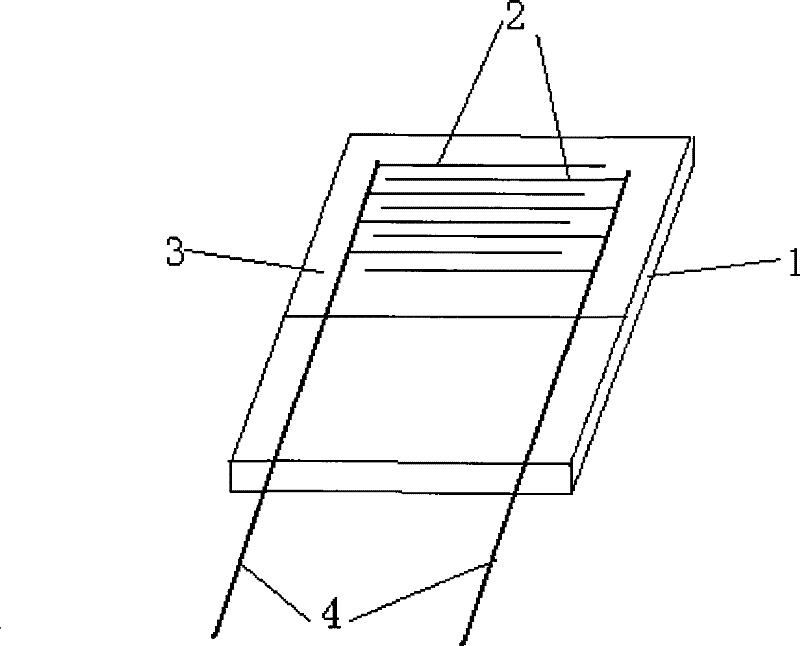
Figure 1 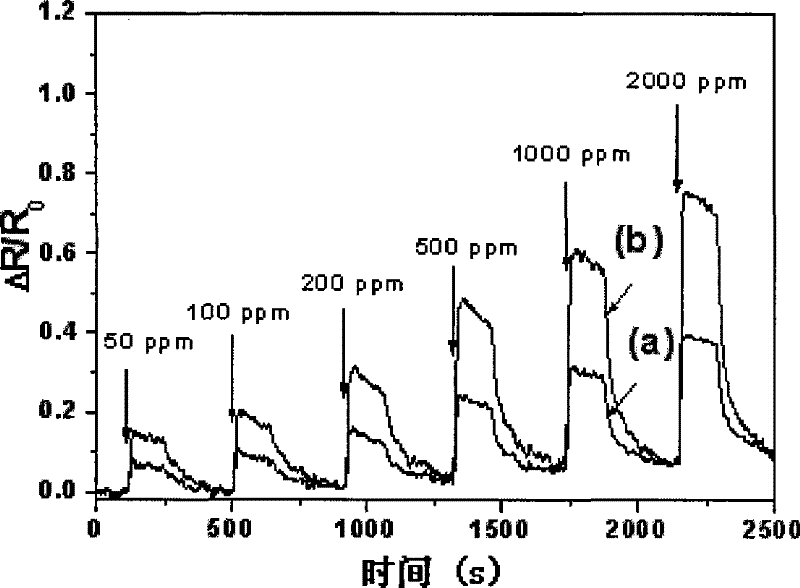
Figure 2 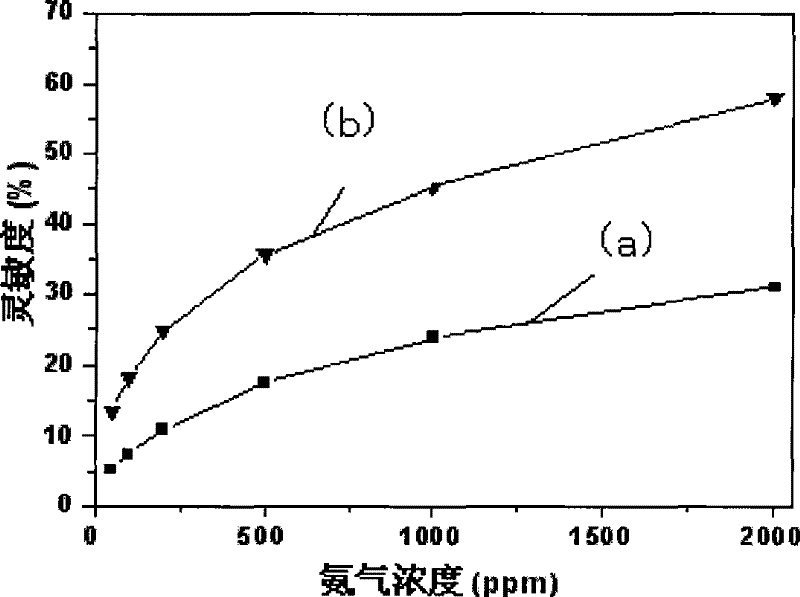
Figure 3
Abstract
Description
technical field
[0001] The invention relates to a polypyrrole and metal nano particle composite gas sensor and a manufacturing method thereof. Background technique
[0002] Toxic gas seriously endangers human life and health. Its room temperature detection plays an important role in industrial and agricultural production and environmental monitoring, which provides a broad space for the development of gas sensors. Polymer intrinsically conductive polymer material gas sensors have developed rapidly in recent years. Compared with traditional ceramic material gas sensors, it has the characteristics of room temperature detection, easy integration, miniaturized mass production, and low price. Among them, the polymer resistive gas sensor is well compatible with the current integrated circuit technology, easy to realize integration, and realizes simultaneous detection and control of various gases, and room temperature detection does not require heating and requires low power, espec...
Examples
Embodiment 1
[0028] 1) Clean the surface photolithography and evaporate the ceramic substrate with interdigitated gold electrodes, and dry it for later use;
[0029] 2) Palladium chloride, sodium polystyrene sulfonate, and polyvinylpyrrolidone are added to deionized water, palladium chloride: sodium styrene sulfonate unit in sodium polystyrene sulfonate: vinylpyrrolidone unit in polyvinylpyrrolidone The molar ratio is 1:1:1, prepare a solution with a palladium chloride concentration of 0.0012mol / L, then add methanol to the solution, the volume ratio of methanol to deionized water is 1:0.5, and react at 50°C for 0.5h, Obtain the precursor solution.
[0030] 3) Add ammonium persulfate with a concentration of 0.005mol / L to the precursor solution prepared in step 2), and use a dipping machine to immerse the ceramic substrate with interdigitated gold electrodes in step 1) in the precursor solution for 0.5min, After being pulled out and dried in the air, it was gas-phase polymerized in saturate...
Embodiment 2
[0032] 1) cleaning the surface photolithography and evaporating the ceramic substrate with interdigitated gold electrodes, and drying for later use;
[0033] 2) Palladium chloride, sodium polystyrene sulfonate, and polyvinylpyrrolidone are added to deionized water, palladium chloride: sodium styrene sulfonate unit in sodium polystyrene sulfonate: vinylpyrrolidone unit in polyvinylpyrrolidone The molar ratio is 1:10:10, prepare a solution with a palladium chloride concentration of 0.0048mol / L, then add methanol to the solution, the volume ratio of methanol to deionized water is 1:4, and react at 80°C for 8h to obtain precursor solution.
[0034] 3) Ammonium persulfate with a concentration of 0.08mol / L was added to the precursor solution prepared in step 2), and the ceramic substrate with interdigitated gold electrodes in step 1) was immersed in the precursor solution for 8 minutes using a dipping machine to extract After being pulled out and dried, it was gas-phase polymerized...
Embodiment 3
[0036] 1) cleaning the surface photolithography and evaporating the ceramic substrate with interdigitated gold electrodes, and drying for later use;
[0037] 2) Palladium chloride, sodium polystyrene sulfonate, and polyvinylpyrrolidone are added to deionized water, palladium chloride: sodium styrene sulfonate unit in sodium polystyrene sulfonate: vinylpyrrolidone unit in polyvinylpyrrolidone The molar ratio is 1:5:2.5, prepare a solution with a palladium chloride concentration of 0.0024mol / L, then add methanol to the solution, the volume ratio of methanol to deionized water is 1:2, and react at 60°C for 4h to obtain precursor solution.
[0038] 3) Add ammonium persulfate with a concentration of 0.02mol / L to the precursor solution prepared in step 2), and use a dipping machine to immerse the ceramic substrate with interdigitated gold electrodes in step 1) in the precursor solution for 4 minutes to improve After being pulled out and dried, it was gas-phase polymerized in satura...