
Application of gingko extract nanometer liposome in bromidrosis treatment
A technology of ginkgo extract and nano-liposome, which is applied in the fields of biomedicine and therapeutic cosmetics, can solve problems such as the application of ginkgo extract nano-liposome that have not yet been reported, and achieve safe use, no side effects, and inhibit proliferation Effect
Patent Information
- Authority / Receiving Office
- CN · China
- Current Assignee / Owner
- Publication Date
- 2014-04-30
- Estimated Expiration
- Not applicable · inactive patent
Smart Images
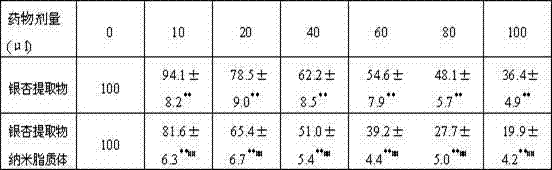
Figure 1 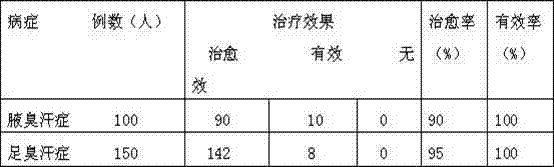
Figure 2
Abstract
Description
technical field
[0001] The invention belongs to the technical field of biomedicine and therapeutic cosmetics, and in particular relates to the application of ginkgo extract nano-liposomes in the treatment of bronchus. Background technique
[0002] Bromidrosis can be divided into generalized bronchial sweating and local bronchial sweating. Underarm odor is a common hereditary skin metabolic disease, commonly known as body odor, mainly manifested as armpit odor. The main cause of sweat odor is the excessive secretion of organic substances in the sweat excreted by the apocrine glands, such as protein, lipid and other components, which are decomposed by skin surface bacteria (Staphylococcus epidermidis, Staphylococcus aureus, etc.) to produce unsaturated fatty acids and microbes. Molecular ammonia nitrogen compounds and other metabolites produce unpleasant odors. Therefore, destroying the apocrine glands is considered to be the key to the cure of underarm odor. Bromohidrosis ...
Examples
Embodiment 1
[0020] Peel the ginkgo nuts and crush them in a tissue grinder. Accurately weigh a certain amount of crushed ginkgo fruit, add 80% ethanol with a solid-to-liquid ratio of 1:10 (W / V), and stir and extract twice at a water bath temperature of 60°C, each extraction time is 4 hours. After the leaching, centrifuge (5000 rpm, 15 minutes), and take the supernatant. Concentrate the supernatant with a vacuum rotary evaporator under the conditions of temperature 55°C, pressure 0.008-0.009MPa, concentrate under reduced pressure, and vacuum-dry at 60°C to obtain Ginkgo biloba extract. The properties are: light yellow extract, soluble in Alcohol, insoluble in water.
[0021] Phospholipid absolute ethanol solution, filter; add the above-mentioned ginkgo extract extract, vitamin E, shake evenly, put in a round bottom flask, 30 ℃ water bath constant temperature rotary evaporation, reduce pressure to form a film, so that the film material is uniformly formed on the bottle wall Add PBS buffer...
Embodiment 2
[0024] Peel the ginkgo nuts and crush them in a tissue grinder. Accurately weigh a certain amount of crushed ginkgo fruit, add distilled water with a solid-to-liquid ratio of 1:10 (W / V), and stir and extract twice at a water bath temperature of 60°C, each extraction time is 4 hours. After the leaching, centrifuge (5000 rpm, 15 minutes), and take the supernatant. Concentrate the supernatant, and dry it under vacuum at 60°C to obtain the ginkgo extract. The properties are: light yellow extract, soluble in alcohol, insoluble in water.
[0025] Ginkgo extract nanoliposome suspension was prepared according to the preparation process of Ginkgo extract nanoliposome suspension in Example 1.
[0026] Preparation of the gel: Sprinkle 10 g of Carbopol on the surface of 500 ml of distilled water, and swell overnight. Weigh 60 g of glycerin and 120 ml of propylene glycol, respectively add them to the swollen Carbopol, and grind them evenly to obtain a transparent gel matrix. Take 40ml o...
Embodiment 3
[0028] Peel the ginkgo nuts and crush them in a tissue grinder. Accurately weigh a certain amount of crushed ginkgo fruit, add 80% petroleum ether with a solid-liquid ratio of 1:10 (W / V), and stir and extract twice at a water bath temperature of 60°C, each extraction time is 4 hours. After the leaching, centrifuge (5000 rpm, 15 minutes), and take the supernatant. Concentrate the supernatant with a vacuum rotary evaporator under the conditions of temperature 55°C, pressure 0.008-0.009MPa, concentrate under reduced pressure, and vacuum-dry at 60°C to obtain Ginkgo biloba extract. The properties are: light yellow extract, soluble in Alcohol, insoluble in water.
[0029] Ginkgo extract nanoliposome suspension was prepared according to the preparation process of Ginkgo extract nanoliposome suspension in Example 1.
[0030] Preparation of ointment: Take 5ml of the above-mentioned ginkgo extract nanoliposome suspension, dissolve it in 100ml of 95% ethanol solution, add 50ml of trie...