

Ferric ion reduction method
A ferric iron and ion technology, applied in chemical instruments and methods, inorganic chemistry, non-metallic elements, etc., can solve problems such as low conversion rate, and achieve low operating conditions, simple reduction process, and simple and easy preparation process. Effect
Patent Information
- Authority / Receiving Office
- CN · China
- Patent Type
- Patents(China)
- Current Assignee / Owner
- Publication Date
- 2016-12-07
- Estimated Expiration
- Not applicable · inactive patent
Smart Images
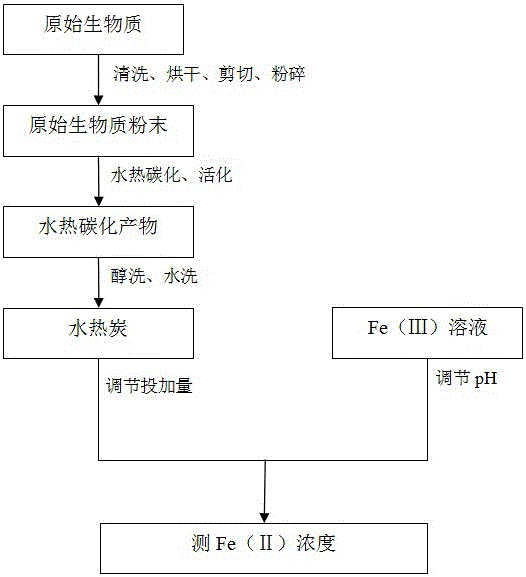
Figure 1 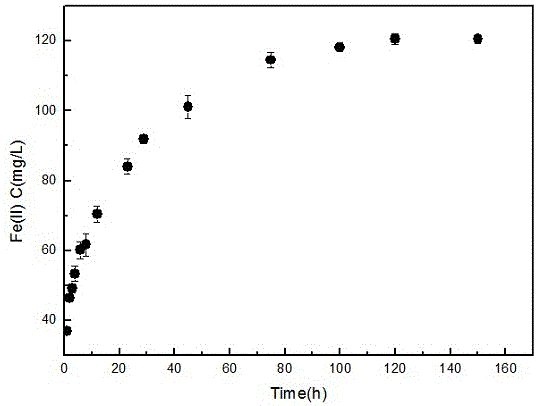
Figure 2 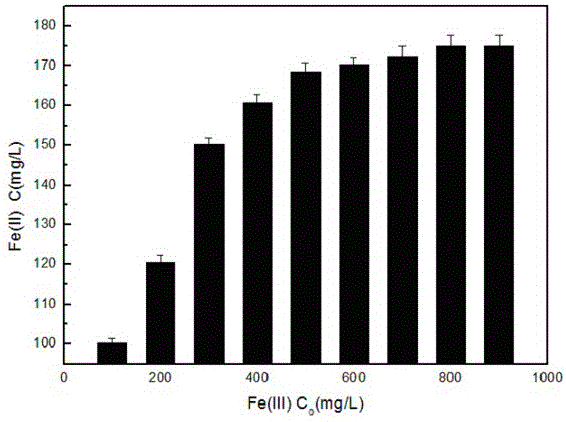
Figure 3
Abstract
Description
technical field
[0001] The invention relates to a method for preparing a reducing agent and an oxidation-reduction method, in particular to a method for reducing high-valence metal ions to low-valence metal ions, which is applied to the utilization of biomass resources, regeneration of metal ions and oxidation treatment technology of organic wastewater field. Background technique
[0002] The Fenton reaction has the advantages of fast speed, mild conditions, simple and convenient operation, high reaction efficiency, flocculation, and wide application range. It is suitable for the oxidation treatment of organic wastewater that is difficult to biodegrade or general chemical oxidation is difficult to work. Under acidic conditions, H 2 o 2 by Fe 2+ The catalysis of the catalyst can generate hydroxyl radical OH with strong oxidizing ability, and then trigger a series of free radical reactions, so that organic matter and some reducing substances can be oxidized faster. Its mai...
Examples
Embodiment 1
[0030] In this example, see figure 1 and figure 2 , ferric ion reduction method, comprises the following steps:
[0031] a. Raw material preparation: Wash the collected raw biomass with distilled water, air-dry it, and then dry it in a blast drying box at 105°C, then pulverize it with a pulverizer, and sieve it to obtain Carbon biomass dry powder;
[0032] b. Preparation of hydrothermal biochar: Weigh 10g of the carbon-containing biomass dry powder sieved in the above step a, mix it with 50ml of distilled water and place it in a high-pressure reactor, and pass nitrogen at a rate of 100ml / min for 10 minutes to remove oxygen After sealing, control the hydrothermal temperature in the autoclave to 240°C. After heating the reactants in the autoclave for 4 hours, take out the hydrothermal carbonization product from the autoclave, let it cool at room temperature, and then carbonize the hydrothermal The product was repeatedly washed with absolute ethanol and distilled water until ...
Embodiment 2
[0038] This embodiment is basically the same as Embodiment 1, especially in that:
[0039] In the present embodiment, the ferric ion reduction method comprises the following steps:
[0040] a. raw material preparation: same as embodiment one;
[0041] b. Preparation of hydrothermal biochar: same as Example 1;
[0042] c. Reduction process: Weigh the hydrothermal biochar powder prepared in the above step b, and add Fe with a concentration of 100 mg / L and pH=2±0.1 to the hydrothermal biochar powder at a dosage of 1 g / L. 3+ In the solution, the reduction reaction was carried out for 120h, and Fe was obtained after the reduction reaction 2+ solution, get the solution after the reaction of the present embodiment that detects required amount and carry out rapid filtration, adopt o-phenanthroline spectrophotometry to measure its Fe 3+ and Fe 2+ Concentration, by comparing and calculating the test results, the Fe of the present embodiment 3+ The reduction rate is 100%, see imag...
Embodiment 3
[0044] This embodiment is basically the same as Embodiment 1, especially in that:
[0045] In the present embodiment, the ferric ion reduction method comprises the following steps:
[0046] a. raw material preparation: same as embodiment one;
[0047] b. Preparation of hydrothermal biochar: same as Example 1;
[0048] c. Reduction process: Weigh the hydrothermal biochar powder prepared in the above step b, and add Fe with a concentration of 300 mg / L and pH=2±0.1 to the hydrothermal biochar powder at a dosage of 1 g / L. 3+ In the solution, the reduction reaction was carried out for 120h, and Fe was obtained after the reduction reaction 2+ solution, get the solution after the reaction of the present embodiment that detects required amount and carry out rapid filtration, adopt o-phenanthroline spectrophotometry to measure its Fe 3+ and Fe 2+ Concentration, by comparing and calculating the test results, the Fe of the present embodiment 3+ 50% reduction, see image 3 .