
Polymer solar cell based on AZO/ZnO cathode and manufacturing method of polymer solar cell
A technology of solar cells and polymers, applied in the field of solar cells, can solve problems such as incompatibility and high cost, and achieve the effects of reducing energy loss, improving light transmittance, and improving energy conversion efficiency
Patent Information
- Authority / Receiving Office
- CN · China
- Patent Type
- Applications(China)
- Current Assignee / Owner
- Publication Date
- 2014-09-17
- Estimated Expiration
- Not applicable · inactive patent
Smart Images
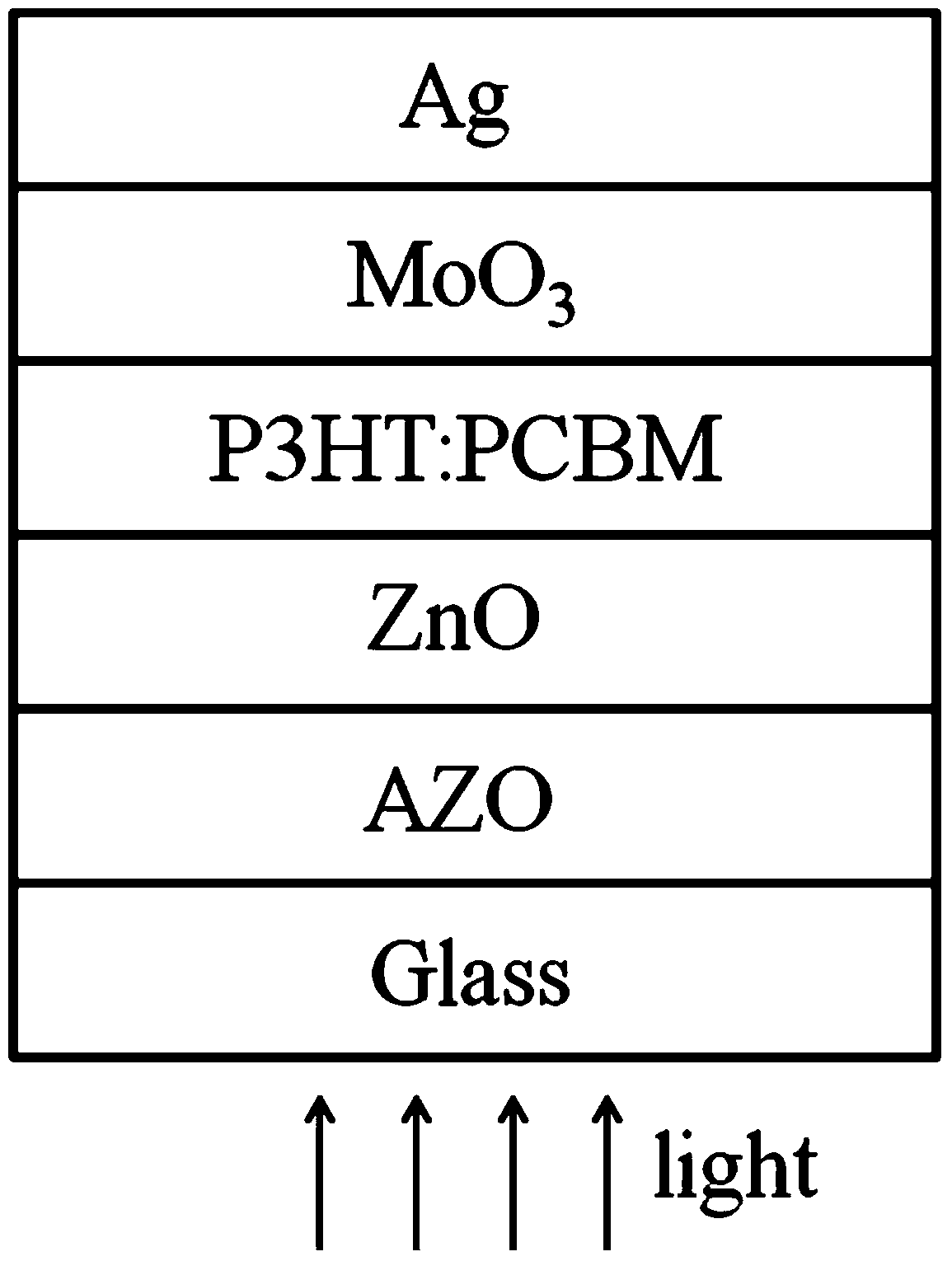
Figure 1
Abstract
Description
technical field
[0001] The invention relates to the field of solar cells, in particular to a polymer solar cell based on an AZO / ZnO cathode and a preparation method thereof. Background technique
[0002] In today's society, the rapid economic development has brought serious problems such as energy crisis and global warming. The development and utilization of renewable clean energy has attracted widespread attention from all over the world. Different from traditional energy sources such as coal, oil, and natural gas, solar energy is a green, clean, and renewable energy source that is inexhaustible and has the potential to become an important part of future energy supply. As a photoelectric conversion device, solar cells have received more and more attention in their research and application. Compared with expensive silicon-based solar cells, polymer solar cells use organic semiconductor materials as the photoactive layer, which has the characteristics of low cost, high light...
Examples
Embodiment 1
[0033] Step 1: Clean the substrate substrate
[0034] The AZO glass substrate was ultrasonically cleaned in deionized water, acetone, absolute ethanol and deionized water for 15 min in turn, and dried with a nitrogen gun after cleaning. The thickness of glass is about 1.9mm, the thickness of AZO is about 980nm, and the sheet resistance is about 10Ω / □.
[0035] Step 2: Deposit ZnO electron transport layer
[0036] a) Prepare ZnO precursor solution: dissolve 150mg of ZnO powder (particle size less than 5 microns) in 15ml of ammonia water (concentration 25%wt), put it in the refrigerator after ultrasonic vibration for 3-5min, the temperature is 0-10℃, time Be 24h, obtain the ZnO precursor solution that concentration is 0.125M;
[0037] b) Spin-coat the ZnO precursor solution on the AZO, the spin-coating speed is 3000r / min, and the time is 40s; then anneal in an oven for 30min, the temperature is 150°C, and the thickness of the obtained ZnO electron transport layer is about 10nm...
Embodiment 2
[0050] Step 1: Clean the substrate substrate
[0051] The AZO glass substrate was ultrasonically cleaned in deionized water, acetone, absolute ethanol and deionized water for 15 min in turn, and dried with a nitrogen gun after cleaning. The thickness of glass is about 2mm, the thickness of AZO is about 980nm, and the sheet resistance is about 10Ω / □.
[0052] Step 2: Deposit ZnO electron transport layer
[0053] a) Prepare ZnO precursor solution: dissolve 150mg of ZnO powder (particle size less than 5 microns) in 15ml of ammonia water (concentration 25%wt), put it in the refrigerator after ultrasonic vibration for 3-5min, the temperature is 0-10℃, time Be 24h, obtain the ZnO precursor solution that concentration is 0.125M;
[0054] b) Spin-coat the ZnO precursor solution on the AZO, the spin-coating speed is 3000r / min, and the time is 40s; then anneal in an oven for 60min, the temperature is 100°C, and the thickness of the obtained ZnO electron transport layer is about 10nm; ...