
Recombinant yeast strain, construction method and application thereof
A yeast strain and yeast technology, applied in the field of genetic engineering, can solve problems such as gaps and achieve the effect of increasing synthetic yield
Patent Information
- Authority / Receiving Office
- CN · China
- Patent Type
- Applications(China)
- Current Assignee / Owner
- Publication Date
- 2017-04-19
Smart Images

Figure 1 
Figure 2 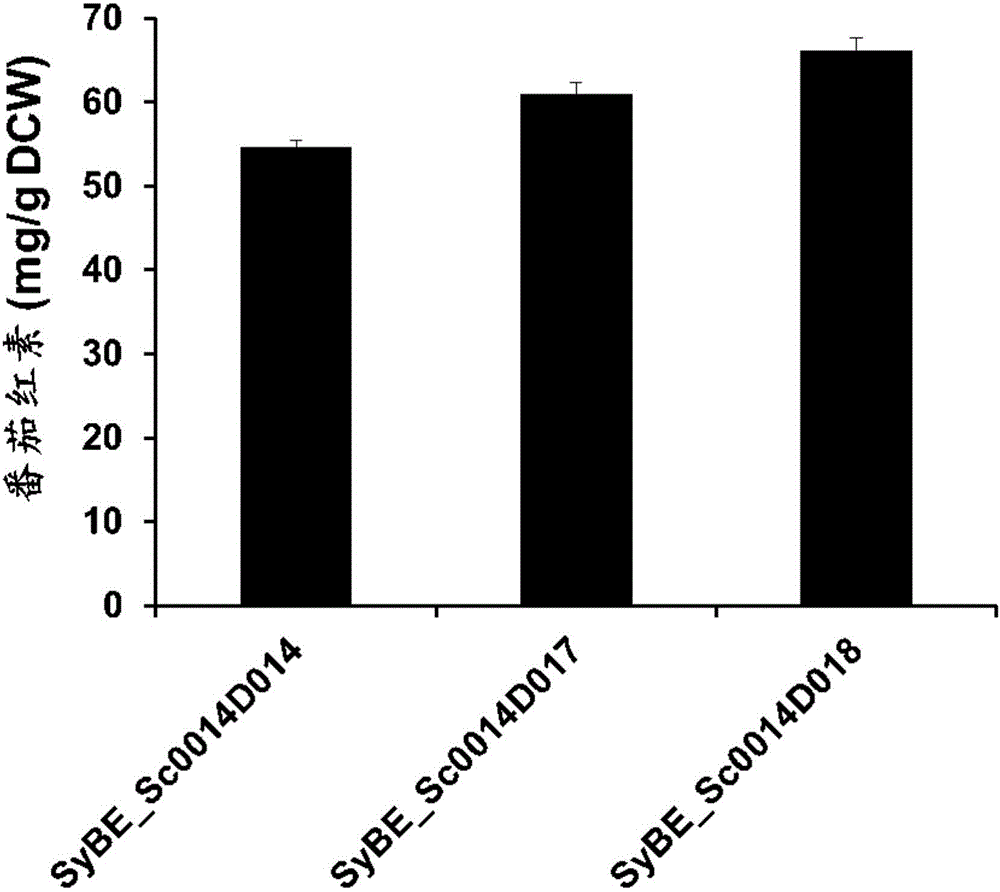
Figure 3
Abstract
Description
technical field
[0001] The invention relates to the technical field of genetic engineering, and more specifically relates to a recombinant yeast strain and its construction method and application. Background technique
[0002] Worldwide, with the improvement of the economic level and the demand for health, more and more attention has been paid to the safety, nutrition and functionality of food. Therefore, functional nutritional chemicals have become a development trend, representing the development of contemporary food. A new trend with broad market prospects. Lycopene is a fat-soluble natural food coloring, which belongs to carotenoids in chemical structure and has strong antioxidant capacity. It has become a hot spot in the research of functional food ingredients in the world in recent years.
[0003] The preparation of lycopene mainly depends on plant extraction, chemical synthesis and microbial synthesis. The first two methods have their own shortcomings. Microbial synt...
Examples
Embodiment 1
[0092] Example 1: Construction of gene knockout strains
[0093] Using Saccharomyces cerevisiae CEN.PK2-1D as the starting strain, a four-gene knockout strain CEN.PK2-1C△gal1,△gal7,△gal10::DR,△ypl062w::kanMX was constructed. The specific process is as follows:
[0094] First construct △gal1, △gal7, △gal10::DR-Kl URA3-DR knockout cassettes, that is, knockout cassette fragment 1, and use plasmid pWJ1042 as a template to design upstream and downstream primers for PCR amplification with the same 40 bp upstream and downstream of the gene. The knockout box fragment of the source arm and the DR-K1 URA3-DR nutritional label was integrated into the yeast genome by using the homologous recombination mechanism of yeast itself through yeast transformation with lithium acetate method. After transformation, SD-URA solid plate (synthetic Yeast nitrogen source YNB 6.7g / L, glucose 20g / L, mixed amino acid powder 2g / L lacking uracil, 2% agar powder) were screened, and the obtained transformants...
Embodiment 2
[0096] Embodiment 2: Construction of gene fragment 1
[0097] Amplify the CYC1 terminator, Bt crtI, GAL10 promoter, GAL1 promoter, Pa crtB, PGK1 terminator and splice them sequentially by OE-PCR to obtain a fragment T containing HindIII and XhoI restriction sites at both ends CYC1 -crtI-P GAL10 -P GAL1 -crtB-T PGK1 ;
[0098] At the same time, the homologous 631bp sequence upstream of the yeast trp1 site and the 733bp homologous sequence downstream of the yeast trp1 site were amplified and spliced sequentially by OE-PCR to obtain SacI and ApaI restriction sites at both ends, and in yeast trp1 The fragment containing the HindIII and XhoI restriction sites between the upstream and downstream homologous sequences of the site was then ligated into the vector pRS405 through the SacI and ApaI restriction sites to obtain the TRP1 integration plasmid pRS405-TRP. The fragment obtained above was T CYC1 -crtI-P GAL10 -P GAL1 -crtB-T PGK1 Ligate with the pRS405-TRP plasmid throug...
Embodiment 3
[0101] Embodiment 3: the construction of gene fragment 2
[0102] The ACT1 terminator, the truncated HMG-CoA reductase gene tHMGR1, the GAL10 promoter, the GAL1 promoter, the TMcrtE, and the GPM1 terminator were sequentially spliced together by OE-PCR, and both ends contained BamHI and XhoI restriction sites Fragment T ACT1 -tHMGR1-P GAL10 -P GAL1 -crtE-T GPM1 At the same time, the upstream homologous 561bp sequence of the yeast leu2 site, the LEU2 marker, the TDH2 terminator, and the downstream homologous 584bp sequence of the yeast leu2 site were spliced sequentially by OE-PCR method to obtain SacI and ApaI restriction sites at both ends point, and the fragment containing the BamHI and XhoI restriction sites between the TDH2 terminator and the downstream homologous sequence of the yeast leu2 site, was connected into the vector pRS405 through the SacI and ApaI restriction sites to obtain the LEU2 integration plasmid pRS405-LEU. will result in the above fragment T ACT...