
A low-formaldehyde-content environmentally friendly density fiberboard and a manufacturing method thereof
A density board, environmental protection technology, applied in pulp beating/refining method, fiberboard, textiles and papermaking, etc., can solve the problems of ecological environment damage and inefficient utilization, so as to reduce the application amount, improve product quality grade, The effect of reducing formaldehyde emission
Patent Information
- Authority / Receiving Office
- CN · China
- Patent Type
- Applications(China)
- Current Assignee / Owner
- Publication Date
- 2019-03-29
- Estimated Expiration
- Not applicable · inactive patent
Smart Images
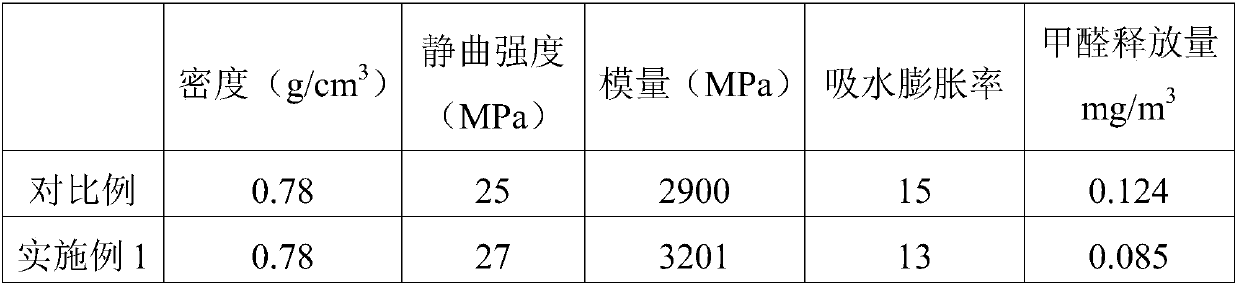
Figure 1 
Figure 2
Abstract
Description
technical field
[0001] The invention relates to the technical field of density board manufacturing, in particular to a low-aldehyde environment-friendly density board and a manufacturing method thereof. Background technique
[0002] The wood-based panel industry is an important industry that efficiently utilizes wood resources and an important means to achieve sustainable development strategies. In the current situation of dwindling forest resources, making full use of forestry "residues" to replace large-diameter timber products plays an irreplaceable role in rationally utilizing forest resources, protecting the environment, and meeting the needs of economic and social development for forestry.
[0003] my country is a big country in the papermaking industry. A large amount of residues in the papermaking process - most of the papermaking waste is burned as fuel or entered into the sewage system, which not only cannot be used efficiently, but also causes great damage to the ...
Examples
Embodiment 1
[0027] Raw materials and dosage: 55 parts of pine wood, 30 parts of papermaking waste, and 15 parts of urea-formaldehyde glue.
[0028] The pine wood is cut into wood chips that meet the production specifications, providing better conditions for its fiber separation, and the papermaking waste is crushed into papermaking waste particles of a certain particle size;
[0029] The obtained wood chips are preheated and cooked, and mechanically separated to obtain fibers;
[0030] The obtained paper-making waste particles are put into a thermal mill, and mixed evenly with the cooked wood chips in proportion, the gap between the grinding discs is controlled at 0.6 mm, the steam pressure is controlled at 0.65 MPa, and the mixture of fibers and paper-making waste is obtained through mechanical separation;
[0031] Use steam spray glue for the obtained fiber papermaking waste mixture, so that the glue is more evenly sprayed on the fiber surface;
[0032] Drying: The mixture of fibrous a...
Embodiment 2
[0037] Raw materials and dosage: 55 parts of pine wood, 35 parts of papermaking waste, and 10 parts of urea-formaldehyde glue.
[0038] The wood is cut into wood chips that meet the production specifications to provide better conditions for its fiber separation, and the papermaking waste is crushed into papermaking waste particles of a certain particle size;
[0039] The obtained wood chips are preheated and cooked, and mechanically separated to obtain fibers;
[0040] The obtained paper-making waste particles are put into a thermal mill, and mixed evenly with the cooked wood chips in proportion, the gap between the grinding discs is controlled at 0.6mm, the steam pressure is controlled at 0.75MPa, and the fiber and paper-making waste mixture is obtained through mechanical separation;
[0041] Use steam spray glue for the obtained fiber papermaking waste mixture, so that the glue is more evenly sprayed on the fiber surface;
Embodiment 3
[0047] Raw materials and dosage: 50 parts of pine wood, 30 parts of papermaking waste, 20 parts of urea-formaldehyde glue.
[0048] The pine wood is cut into wood chips that meet the production specifications, providing better conditions for its fiber separation, and the papermaking waste is crushed into papermaking waste particles of a certain particle size;
[0049] The obtained wood chips are preheated and cooked, and mechanically separated to obtain fibers;
[0050] The obtained paper-making waste particles are put into a thermal mill, and mixed evenly with the cooked wood chips in proportion, the gap between the grinding discs is controlled at 0.6mm, the steam pressure is controlled at 0.75MPa, and the fiber and paper-making waste mixture is obtained through mechanical separation;
[0051] Use steam spray glue for the obtained fiber papermaking waste mixture, so that the glue is more evenly sprayed on the fiber surface;
[0052] Drying: heat-grinding fiber papermaking wa...