
Activatable aggregation-induced emission probe and application thereof in sensitive detection of carbaryl
A technique of aggregation-induced luminescence and probes, which is applied in the field of sensitive detection of carbaryl, can solve the problems that the ratio analysis of pesticides has not been reported, and achieve the effect of universality, high precision and simple operation method
Patent Information
- Authority / Receiving Office
- CN · China
- Patent Type
- Applications(China)
- Current Assignee / Owner
- Publication Date
- 2022-05-13
Smart Images
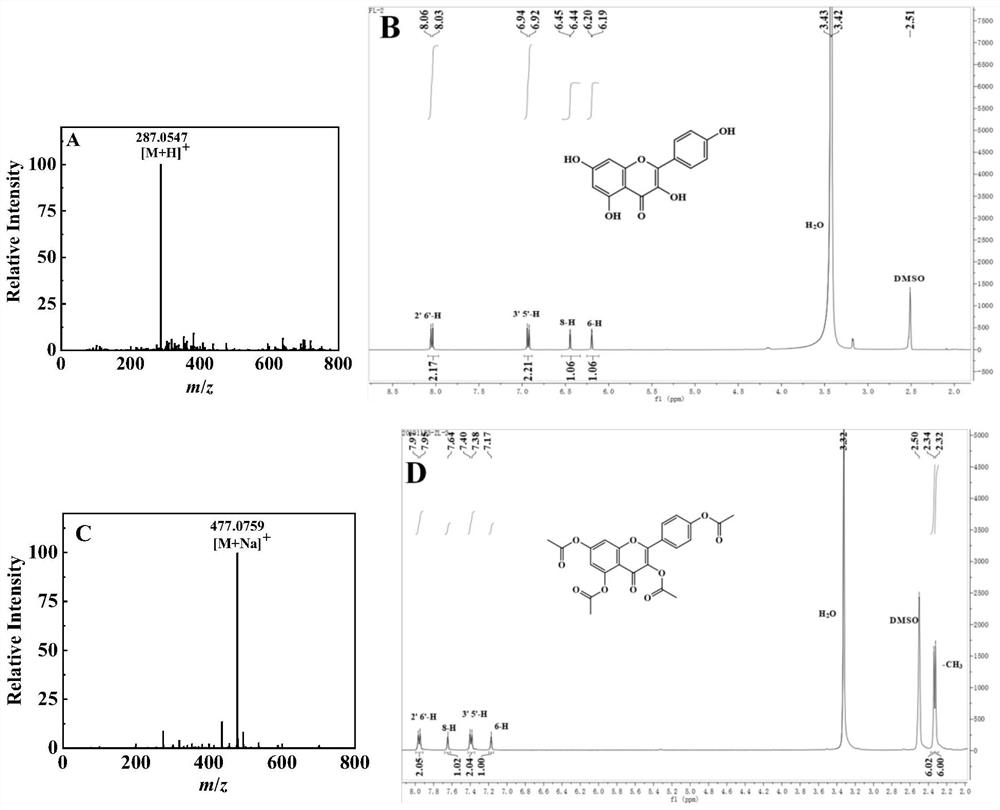
Figure 1 
Figure 2 
Figure 3
Abstract
Description
technical field
[0001] The invention belongs to the field of pesticide detection, and mainly relates to an activatable aggregation-induced luminescence probe used for sensitive detection of carbaryl. Background technique
[0002] The information disclosed in this background section is only intended to increase the understanding of the general background of the present invention, and is not necessarily taken as an acknowledgment or any form of suggestion that the information constitutes the prior art already known to those skilled in the art.
[0003] Pesticides are synthetic chemical substances used to eliminate pests and weeds and regulate plant growth. They are widely used in environmental epidemic prevention and agricultural production. However, inappropriate or excessive use of pesticides can cause environmental and ecosystem damage, food contamination, and even health-related problems worldwide. Therefore, the World Health Organization has banned the use of large pesti...
Examples
preparation example Construction
[0026] A method for synthesizing activatable aggregation-induced luminescent probes, comprising:
[0027] Mix kaempferol with acetic anhydride and pyridine for esterification reaction to obtain kaempferol tetraacetate, which can activate aggregation-induced luminescence probe.
[0028] In some embodiments, kaempferol is isolated and purified from leaves of Eucommia ulmoides. It should be noted that the raw materials for extracting kaempferol are not specifically limited in this application, and plants containing kaempferol can be used as extraction raw materials, such as: golden clematis, dodder seed, star anise lotus, tartary buckwheat bran, golden camellia tea , herringbone grass, aster, willow buckthorn leaves, etc.
[0029] In some embodiments, the mass ratio of kaempferol to acetic anhydride and pyridine is 143:27~30:48×10 -3 ~50×10 -3 .
[0030] In some embodiments, the condition of the esterification reaction is reflux at 70-75° C. for 1.5-2 hours.
[0031] In some...
Embodiment 1
[0040] 1. Experimental process
[0041] 1.1 Extraction of kaempferol
[0042] Eucommia leaves were collected from Cili Eucommia Forestry Center (Zhangjiajie, China), and the Eucommia leaves were dried, pulverized and extracted (350 g of Eucommia leaves, 2 L of 95% ethanol, reflux extraction 3 times, 2 h each time). The crude extract (39.50g) was dissolved in water and extracted with petroleum ether (400mL×3 times), ethyl acetate (400mL×3 times), n-butanol (400mL×3 times) (solvent polarity gradually increased). The ethyl acetate fraction (2.20 g) was crystallized by gradient elution of ethyl acetate / methanol, followed by repeated silica gel chromatography to obtain kaempferol (163.72 mg). Kaempferol:ESI-MS[M+H] + :m / z287.0547(C 15 h 11 o 6 ,-1.1ppm error)( figure 1 A); 1 H NMR (400MHz, DMSO-d 6 )δ(ppm)8.05(d, J=8.8Hz, 2H, H-2'and H-6'), 6.93(d, J=8.8Hz, 2H, H-3'and H-5'), 6.45 (d, J=2.0Hz, 1H, H-8), 6.19 (d, J=2.0Hz, 1H, H-6).
[0043] 1.2 Synthesis of kaempferol este...