
Antimicrobial fiber and its production method, and antimicrobial fiber product comprising the antimicrobial fiber, its production method and regeneration method
Patent Information
- Authority / Receiving Office
- US · United States
- Current Assignee / Owner
- Publication Date
- 2010-05-06
- Estimated Expiration
- Not applicable · inactive patent
Smart Images
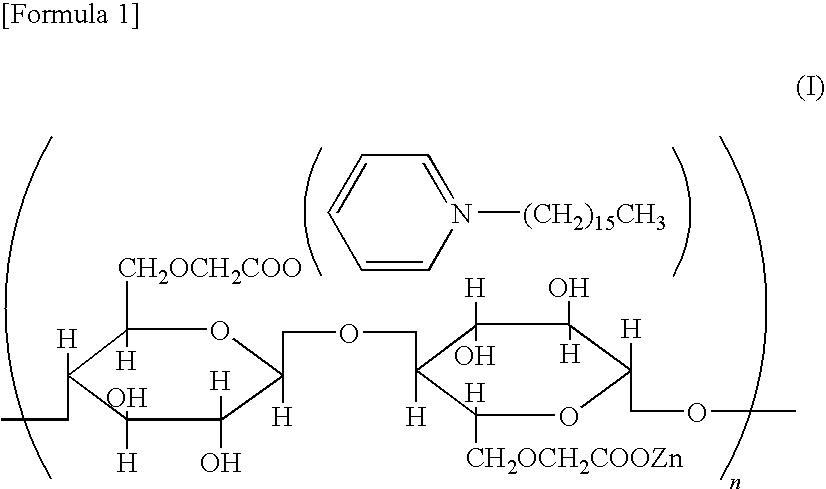
Figure 1
Abstract
Description
TECHNICAL FIELD
[0001] The present invention relates to an antimicrobial fiber having excellent antimicrobial potency, its production method, an antimicrobial fiber product comprising the antimicrobial fiber and its production method. More precisely, the invention relates to a fiber that bears an anionic functional group and a specific structure to exhibit an antimicrobial function and exhibits excellent antimicrobial potency, its production method, an antimicrobial fiber product comprising the antimicrobial fiber and its production method.
[0002] The invention also relates to a regeneration method for antimicrobial fiber products, and an antimicrobial fiber product regenerated by it.BACKGROUND ART
[0003] In the medical field, etc., a lot of studies of antimicrobially-processed fiber products are made for preventing infection and for keeping hygienic conditions.
[0004] Patent Reference 1 discloses a sheet prepared by incorporating a carboxymethyl cellulose quaternary ammonium salt or a carb...
Examples
example 1
[0138]A bandage of a spun-bond nonwoven fabric formed of a continuous fiber of cuprammonium rayon was dipped in an aqueous solution of sodium monochloroacetate and sodium hydroxide dissolved therein, then dewatered to a suitable dewatering ratio, and dried to be in an absolute dry condition, thereby obtaining a bandage in which a part of the hydroxy group of the cellulose fiber was sodium carboxymethylated.
[0139]Subsequently, the bandage was dipped and neutralized in an aqueous solution of zinc sulfate heptahydrate, acetic acid and sodium acetate dissolved therein, and simultaneously the sodium carboxymethyl group was converted into a zinc-carboxymethyl group. Afterwards, the remaining zinc sulfate, acetic acid and sodium acetate were removed by washing with water, and this was dried to give a bandage in which a part of the hydroxy group of the cellulose fiber was zinc-carboxymethylated.
[0140]Next, the above zinc-carboxymethylated bandage was dipped in an aqueous cetylpyridinium chl...
example 2
[0142]In the same manner as in Example 1 but using a nonwoven fabric of a lyocell fiber in place of the cuprammonium rayon nonwoven fabric and using silver nitrate in place of zinc sulfate heptahydrate, obtained was a bandage in which a part of the carboxy group bonding to the cellulose fiber (carboxy group of the carboxyalkylated cellulose fiber) was silver-carboxymethylated and another part was cetylpyridinium-carboxymethylated. The bandage was evaluated for various characteristics. The results are shown in Table 1.
example 3
[0143]In the same manner as in Example 1 but using a nonwoven fabric of a viscose rayon fiber in place of the cuprammonium rayon nonwoven fabric and using copper sulfate pentahydrate in place of zinc sulfate heptahydrate, obtained was a bandage in which a part of the carboxy group bonding to the cellulose fiber (carboxy group of the carboxyalkylated cellulose fiber) formed a copper salt and another part formed a cetylpyridinium salt. The bandage was evaluated for various characteristics. The results are shown in Table 1.