
Production method of connection structure
Patent Information
- Authority / Receiving Office
- US · United States
- Current Assignee / Owner
- Publication Date
- 2012-10-11
Smart Images
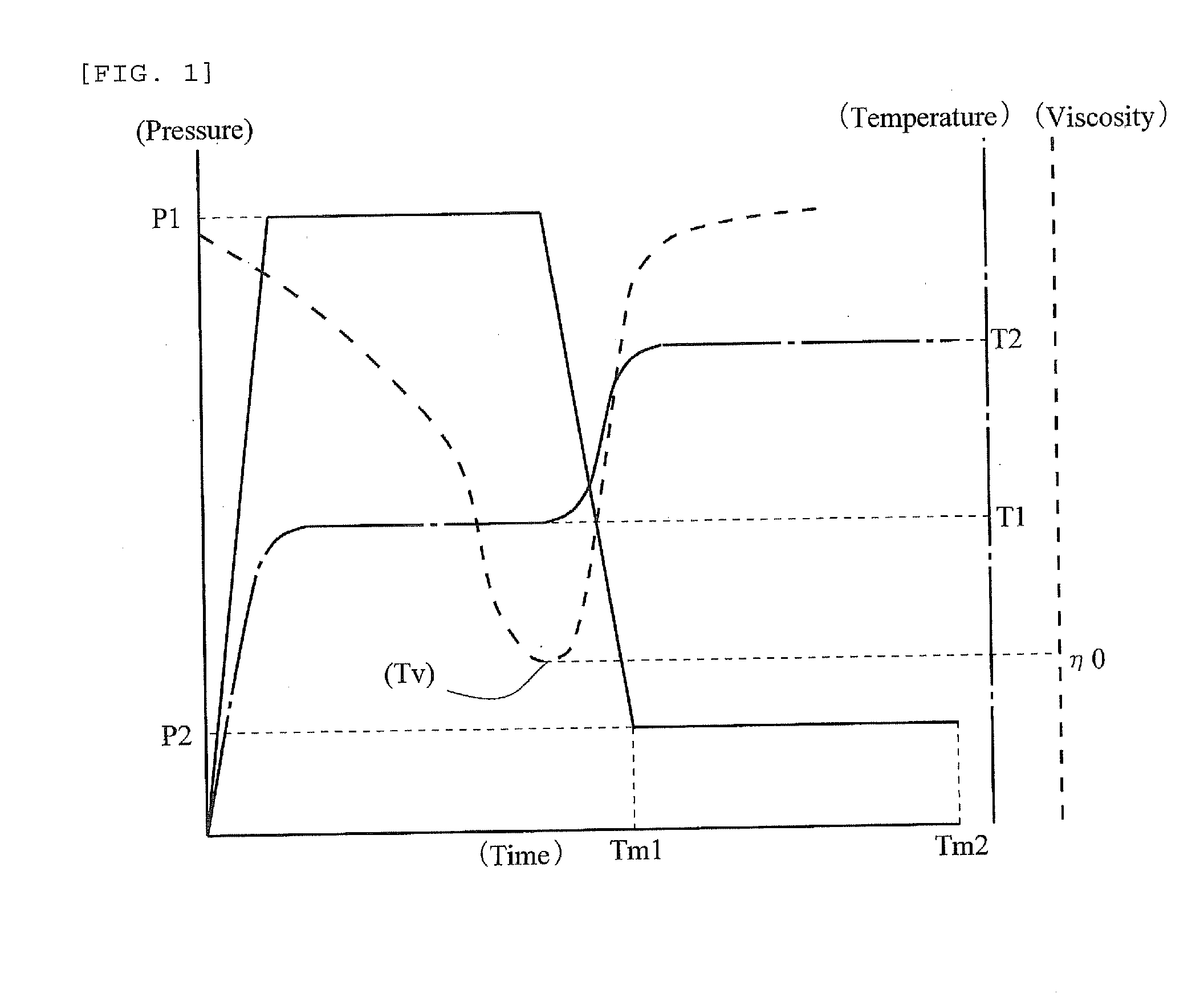
Figure 1
Abstract
Description
TECHNICAL FIELD
[0001] The present invention relates to a method for producing a connection structure in which an electrode of a circuit board and an electrode of an electrical element are connected to each other by anisotropic conductive connection.BACKGROUND ART
[0002] It has been proposed that, when a bump of an electrical element such as a semiconductor chip is connected to an electrode of a circuit board by anisotropic conductive connection, an anisotropic conductive film, in which solder particles having a melting temperature of 180 to 185° C. are dispersed in an epoxy-based thermosetting adhesive having a curing temperature of 195 to 200° C., is disposed between the bump of the semiconductor chip and the electrode of the circuit board, and then the obtained product is heated and pressurized so that the solder particles are melted, thereby metallically bonding the bump of the semiconductor chip and the electrode of the circuit board (Patent Literature 1). In this case, preheating ...
Examples
examples
[0046]The present invention will be specifically described below by way of examples.
examples 1 and 2
, and Comparative Examples 1 to 5
[0047]First, anisotropic conductive adhesives A and B were prepared as described below.
(Anisotropic Conductive Film A)
[0048]30 parts by mass of a bis-A type phenoxy resin (YP50 manufactured by Nippon Steel Chemical Co., Ltd.), 30 parts by mass of a liquid acrylic compound (EB3701 manufactured by DAICEL-CYTEC Company LTD.), an organic peroxide curing agent (Perocta O manufactured by NOF CORPORATION), 1 part by mass of an acrylic-based silane coupling agent (A-172 manufactured by Momentive Performance Materials Inc.) were mixed. Furthermore, an eutectic SnBi solder having an average particle size of 10 μm and a melting temperature of 138° C. was added so that an amount of the solder becomes 20% by mass in a resin solid component. Then, toluene was added to prepare an anisotropic conductive composition having a solid amount of 50 wt %. The prepared anisotropic conductive composition was coated on a release treated PET by using a bar coater, and dried in...