
Wavelength conversion member and method for manufacturing the same, and light-emitting device, illuminating device, and headlight
a technology of wavelength conversion and wavelength, which is applied in the direction of non-metal conductors, fixed installations, lighting and heating apparatus, etc., can solve the problems of low thermal conductivity of light-emitting sections, inability to directly apply the constitution described in patent literature 1, and inability to achieve direct application of wavelength conversion techniques. , to achieve the effect of reducing the luminous efficiency of wavelength conversion members, and increasing luminous efficiency
Patent Information
- Authority / Receiving Office
- US · United States
- Patent Type
- Applications(United States)
- Current Assignee / Owner
- Publication Date
- 2014-01-02
- Estimated Expiration
- Not applicable · inactive patent
Smart Images
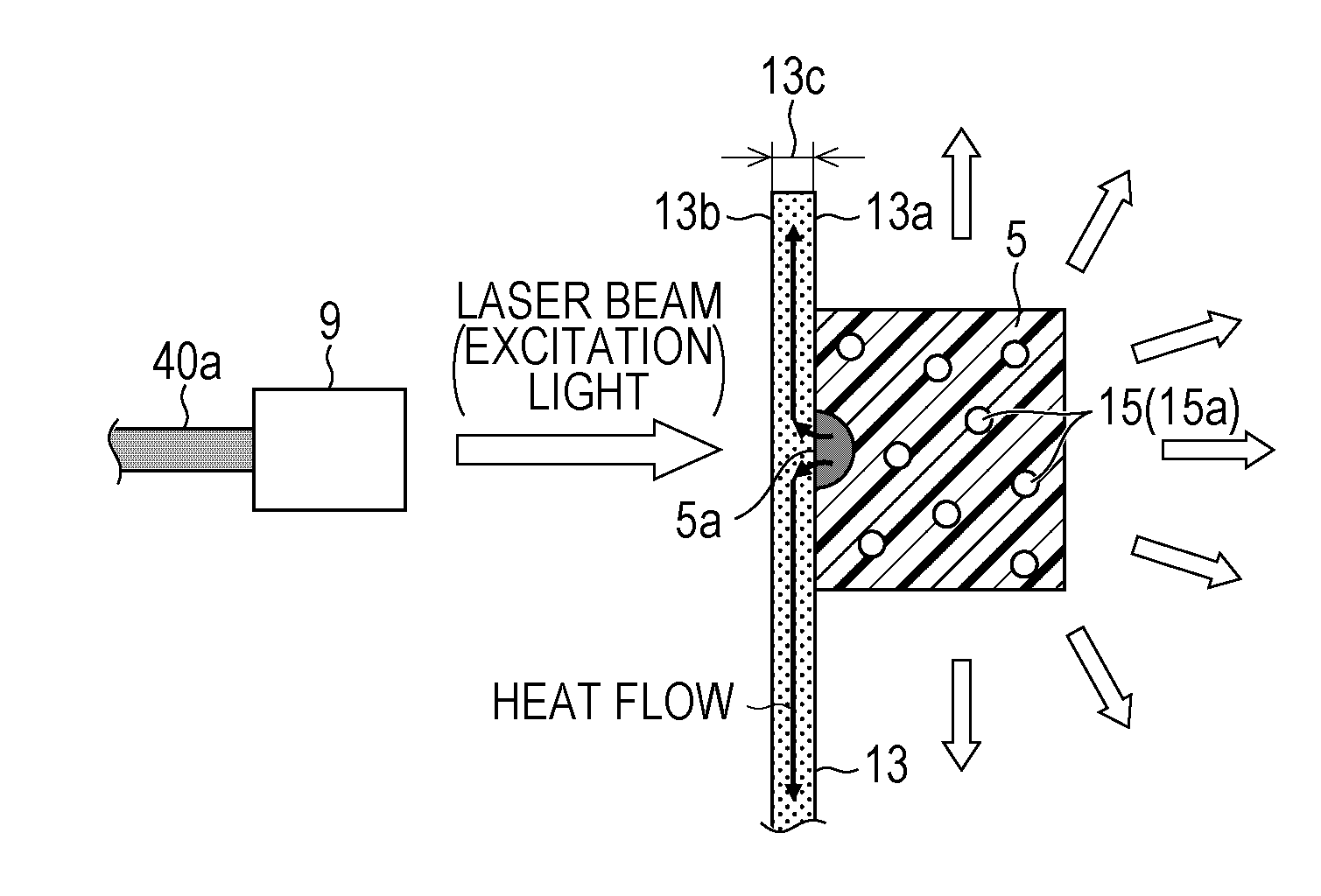
Figure 1 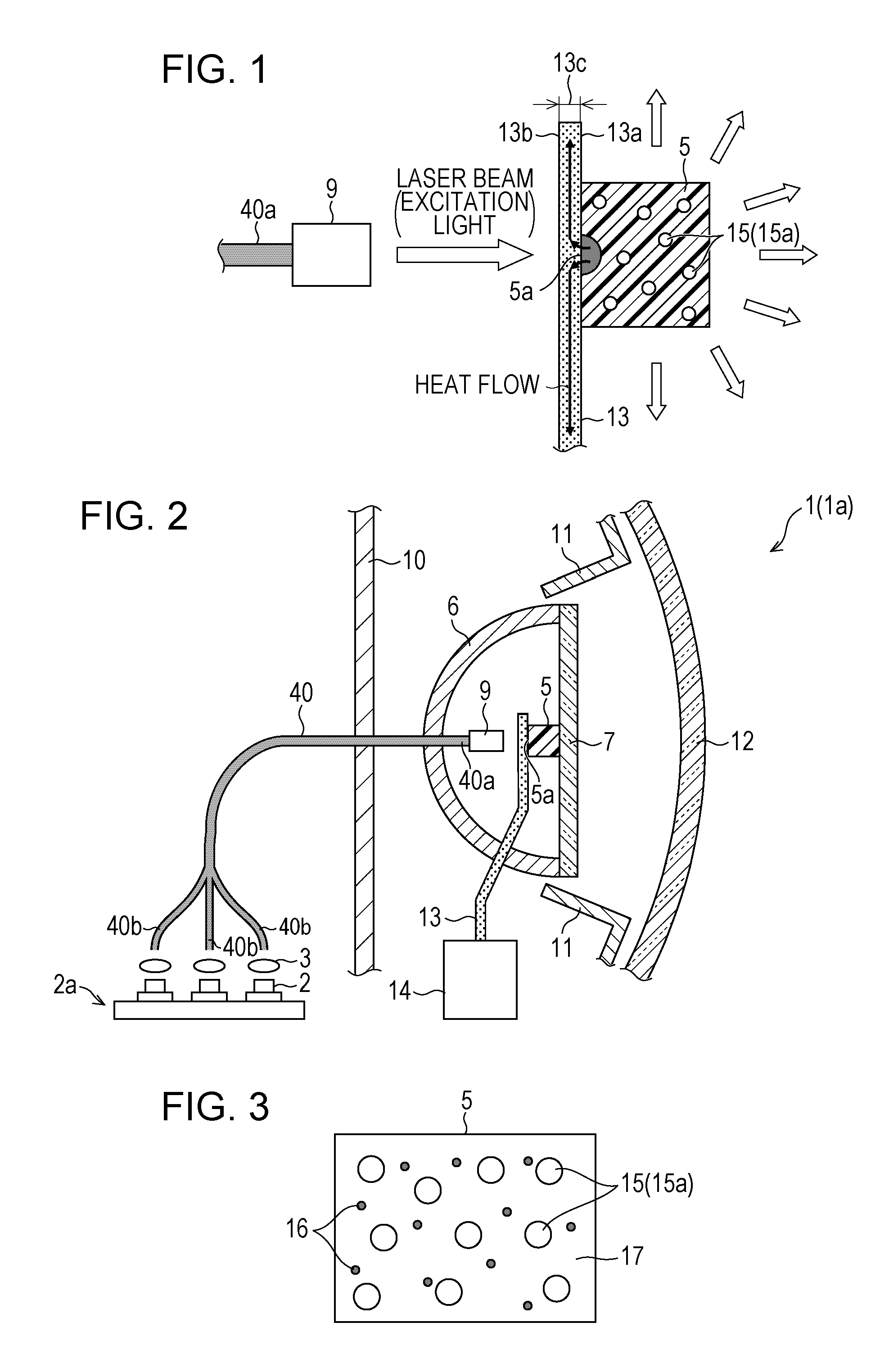
Figure 2 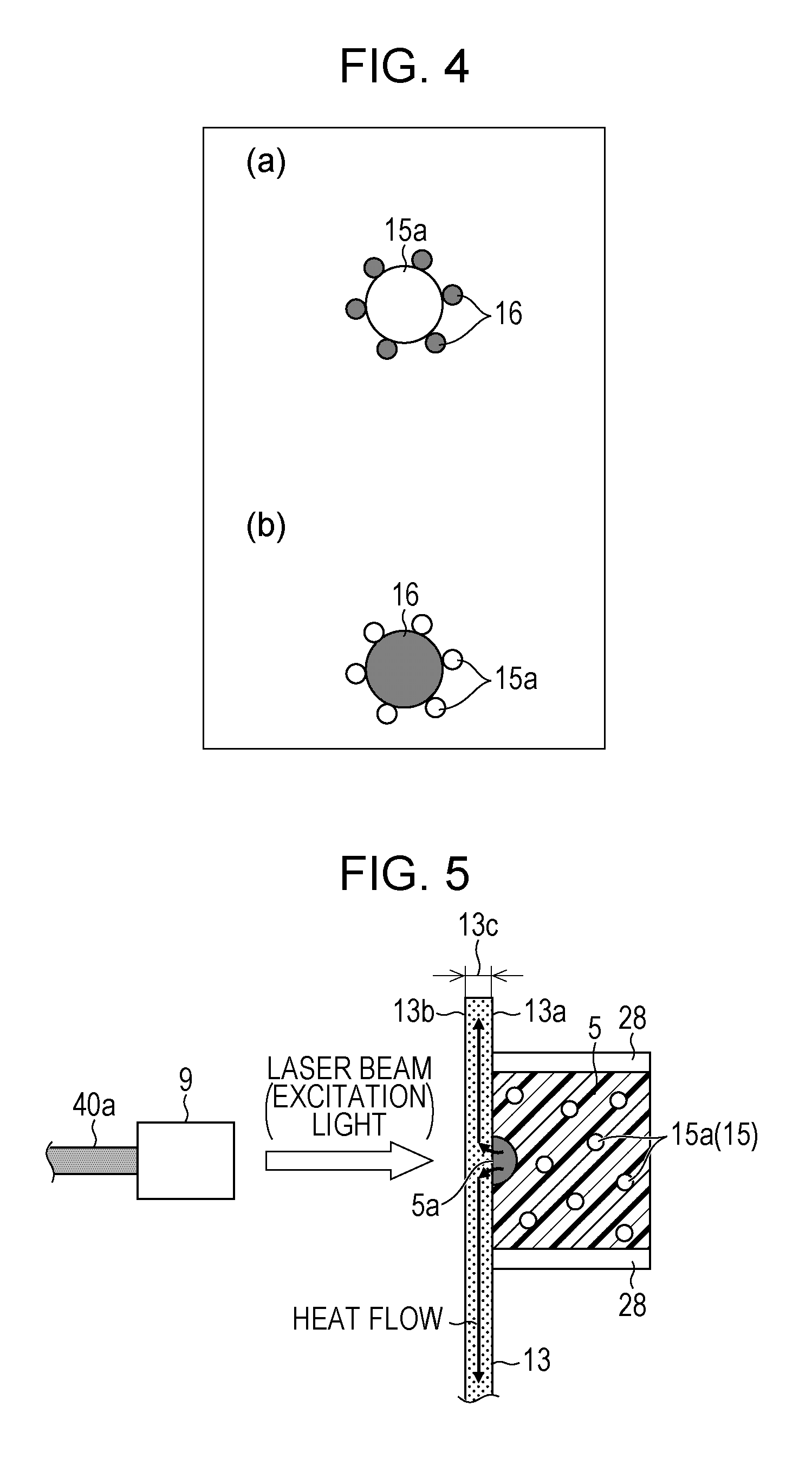
Figure 3
Abstract
Description
REFERENCE TO RELATED APPLICATIONS
[0001] This application is a national stage application under 35 USC 371 of International Application No. PCT / JP2012 / 055928, filed Mar. 8, 2012, which claims the priority of Japanese Patent Application Nos. 2011-058471, filed Mar. 16, 2011, 2011-062461, filed Mar. 22, 2011, 2011-066132, filed Mar. 24, 2011, and 2011-137844, filed Jun. 21, 2011, the entire contents of which are incorporated herein by reference.FIELD OF THE INVENTION
[0002] The present invention relates to a wavelength conversion member (a light-emitting section or a light-emitting member) and a method for manufacturing the wavelength conversion member, as well as a light-emitting device including the wavelength conversion member, and an illuminating device and a headlight (for example, vehicle headlight) each including the light-emitting device.BACKGROUND OF THE INVENTION
[0003] Studies are being actively carried out on light-emitting devices that use, as illumination light, fluorescence g...
Examples
first embodiment
[0109]An automobile headlamp (light-emitting device, illuminating device, headlight) 1 will be described below as an embodiment of an illuminating device according to the present invention. An illuminating device according to the present invention may be a headlamp for vehicles and moving objects other than automobiles (for example, humans, ships, aircrafts, submarines, and rockets) or another illuminating device. Examples of other illuminating devices include searchlights, projectors, household lighting fixtures, interior lighting fixtures, and exterior lighting fixtures.
[0110]The headlamp 1 may satisfy the light distribution characteristic standard of a main-beam headlight (high beam) or the light distribution characteristic standard of a dipped-beam headlight (low beam).
[0111]The headlamp 1 is a headlamp that functions as a high-intensity light source and ensures eye safety.
(Structure of Headlamp 1)
[0112]The structure of the headlamp 1 will be described below with reference to FI...
first example
[0202]In a first example described below, synthetic diamond particles are used as the diffusing particles 15, and a green-light-emitting fluorescent material (Caα-SiAlON:Ce3+) and a red-light-emitting fluorescent material (CASN:Eu2+) are used as fluorescent materials. An excitation light source used in combination with the light-emitting section 5 containing these fluorescent materials is a laser diode that emits light at 405 nm.
[0203]First, a glass powder and a fluorescent material powder are weighed at a predetermined ratio and are uniformly mixed (a mixing step). For example, a glass powder and the green-light-emitting fluorescent material (Caα-SiAlON:Ce3+) and the red-light-emitting fluorescent material (CASN:Eu2+) are mixed at a weight ratio of glass powder:green-light-emitting fluorescent material:red-light-emitting fluorescent material=100:6:2. Synthetic diamond particles (having a particle size of 1 μm) are then added to the mixture. The synthetic diamond particles constitut...
second example
[0208]The fluorescent material to be dispersed in the light-emitting section 5 that contains an inorganic glass as a sealant may be a yellow-light-emitting fluorescent material exemplified by a YAG fluorescent material. The weight ratio of the inorganic glass to the fluorescent material is 10:1. Zirconium oxide is then added to the mixture of the inorganic glass powder and the fluorescent material powder. Zirconium oxide constitutes 3% by weight of the mixture. The mixture is then sintered to form a light-emitting section.
[0209]When a YAG fluorescent material is used, a sealant having a particularly low melting point of (500° or less) among low-melting glasses is preferably used. For example, low-melting glasses containing lead oxide or phosphate glasses have particularly low melting points among low-melting glasses and are suitable for the sealant for the YAG fluorescent material.
[0210]An excitation light source used for the YAG fluorescent material is preferably a blue laser diode...