
Kinase inhibitors
a technology of kinase inhibitors and inhibitors, applied in the field of kinase inhibitors, can solve the problems of multiple off-target effects, high toxicity, and discontinuation of development of a substantial number of inhibitors, and achieve the effect of enhancing the therapeutic profile and low affinity
Patent Information
- Authority / Receiving Office
- US · United States
- Patent Type
- Applications(United States)
- Current Assignee / Owner
- Publication Date
- 2014-02-27
- Estimated Expiration
- Not applicable · inactive patent
Smart Images
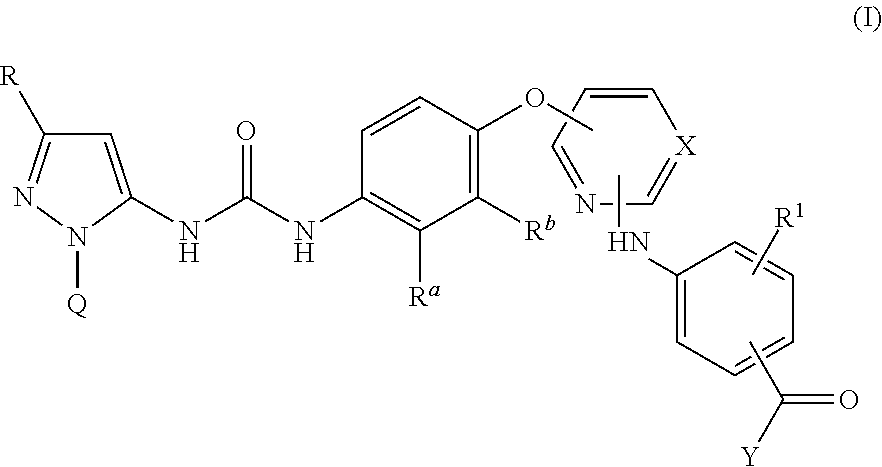
Figure 1 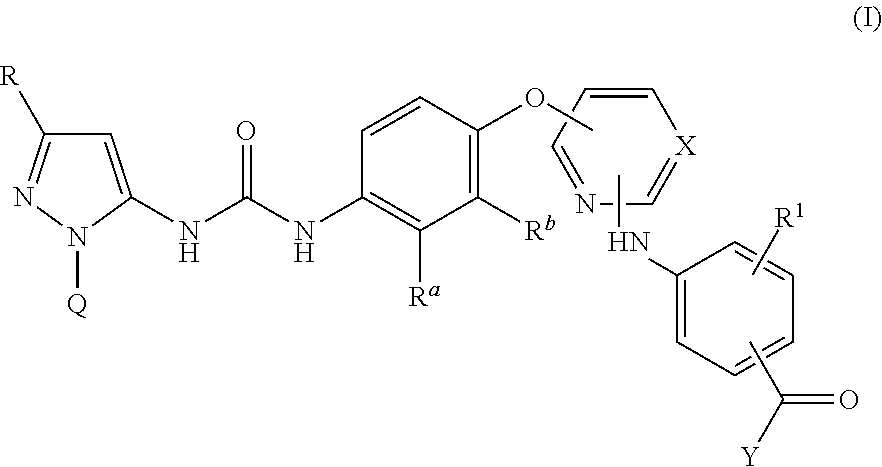
Figure 2 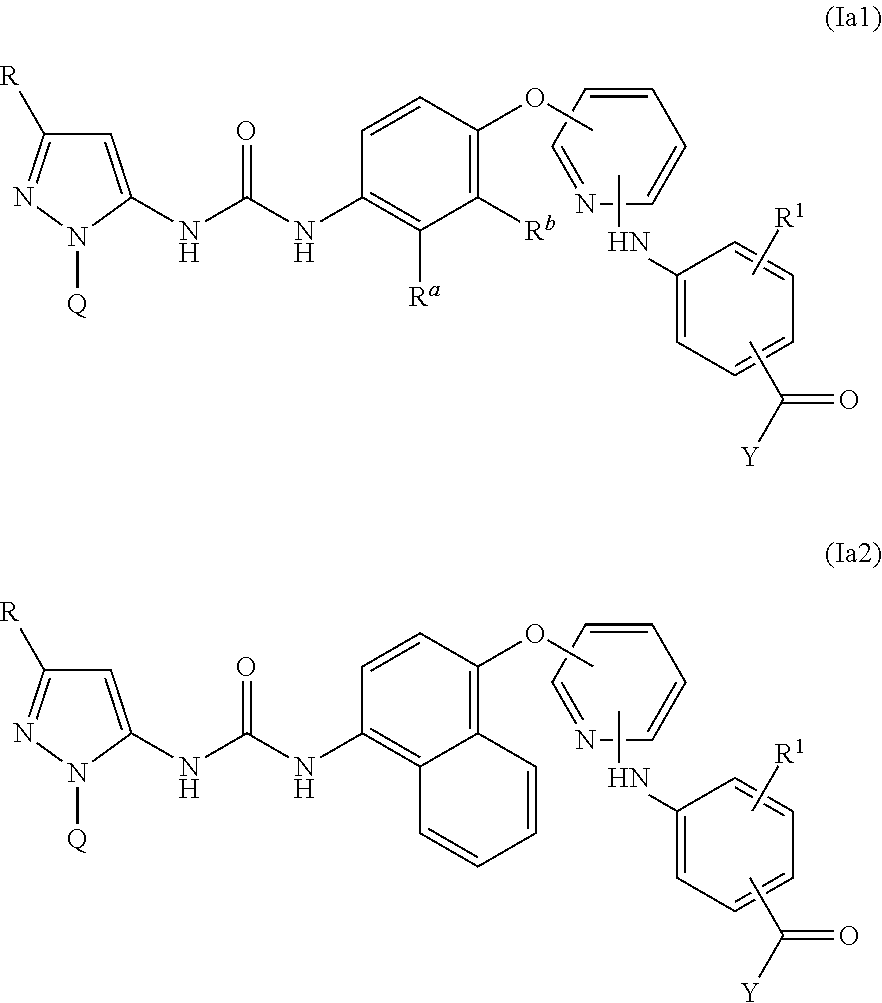
Figure 3
Abstract
Description
FIELD OF THE INVENTION
[0001] The invention relates to compounds which are inhibitors of the family of p38 mitogen-activated protein kinase enzymes (referred to herein as p38 MAP kinase inhibitors), for example the alpha and gamma sub-types thereof, and of Syk kinase and the Src family of tyrosine kinases, and to their use in therapy, including in pharmaceutical combinations, especially in the treatment of inflammatory diseases, in particular inflammatory diseases of the lung, such as asthma and COPD, as well as those of the gastrointestinal tract, such as ulcerative colitis and Crohn's disease, and of the eye, such as uveitis.BACKGROUND OF THE INVENTION
[0002] The listing or discussion of an apparently prior-published document in this specification should not necessarily be taken as an acknowledgement that the document is part of the state of the art or is common general knowledge.
[0003] Four p38 MAPK isoforms (alpha, beta, gamma and delta respectively), each displaying different patter...
Examples
example 1
3-((4-((4-(3-(3-(tert-Butyl)-1-(p-tolyl)-1H-pyrazol-5-yl)ureido)naphthalen-1-yl)oxy)pyridin-2-yl)amino)-5-methoxy-N-(2-morpholinoethyl)benzamide
[0680]
[0681]To a solution of Intermediate A8 (74 mg, 0.32 mmol) in DCM (1.0 mL) was added CDI (54 mg, 0.34 mmol) and the reaction mixture kept at 40° C. for 2 hr. An aliquot of this solution (310 μL, 0.099 mmol), containing the pre-formed pyrazole CDI adduct, was added to a solution of Intermediate B1 (50 mg, 0.078 mmol) in THF (1.0 mL) at RT and the resulting mixture maintained at this temperature for 18 hr. A second aliquot of the pyrazole CDI adduct (160 μL, 0.05 mmol) was then added and after 3 hr at RT the reaction mixture was partitioned between EtOAc (50 mL) and saturated aq NaHCO3 (50 mL). The organic phase was separated and was washed sequentially with saturated aq NaHCO3 (2×50 mL), water (2×50 mL) and brine (2×50 mL) and then dried and evaporated in vacuo. The residue was purified by preparative HPLC to afford the title compound, E...
example 2
3-((4-((4-(3-(3-(tert-Butyl)-1-(p-tolyl)-1H-pyrazol-5-yl)ureido)naphthalen-1-yl)oxy)pyrimidin-2-yl)amino)benzamide
[0682]
[0683]To a suspension of Intermediate F1 (50 mg, 0.080 mmol) in THF (1.5 mL) was added DIPEA (28 μL, 0.16 mmol) and HATU (36 mg, 0.096 mmol) and after 10 min at RT the reaction mixture was treated with NH4Cl (4.7 mg, 0.088 mmol). The resulting mixture was maintained at RT for 18 hr and was then partitioned between saturated aq NaHCO3 (3.0 mL) and EtOAc (3.0 mL). The organic phase was separated and was washed with hydrochloric acid (1.0 M, 3.0 mL) and with brine (3.0 mL) and then dried and evaporated in vacuo. The residue was purified by flash column chromatography (SiO2, 4.0 g, MeOH in EtOAc, 0-100%, gradient elution) to afford the title compound, Example 2, as a white solid (8 mg, 16%); Rt 2.30 min (Method 2 acidic); m / z 627 (M+H)+ (ES+); m / z 625 (M−H)− (ES−); 1H NMR δ: 1.29 (9H, s), 2.40 (3H, s), 6.42 (1H, s), 6.55 (1H, d), 6.99 (1H, m), 7.23 (1H, br s), 7.29 (1H...
example 3
3-((4-((4-(3-(3-(tert-Butyl)-1-(p-tolyl)-1H-pyrazol-5-yl)ureido)naphthalen-1-yl)oxy)pyrimidin-2-yl)amino)-N-(2-morpholinoethyl)benzamide
[0684]
[0685]To a suspension of Intermediate F1 (680 mg, 1.08 mmol) in DCM (10 mL) at 0° C. was added oxalyl chloride (110 μL, 1.30 mmol) and DMF (1 drop) and the resulting red mixture maintained at 0° C. for 20 min and then warmed to RT. After 1 hr a second aliquot of oxalyl chloride (110 μL, 1.30 mmol) was added and the resulting mixture kept at RT for 2 hr and then evaporated in vacuo to afford a red solid (800 mg). This material was used in the subsequent amide coupling without purification or characterization. To a suspension of a portion of the solid obtained above (60 mg, 0.080 mmol) in DCM (1.5 mL) was added DIPEA (32 μL, 0.19 mmol) and 2-morpholinoethanamine (13 μL, 0.10 mmol) and the reaction mixture maintained at RT for 3 hr. The resulting mixture was washed sequentially with saturated aq. NaHCO3 (5.0 mL), water (5.0 mL) and with brine (5....