
Sheet composed of exfoliated clay mineral and method for producing same
Patent Information
- Authority / Receiving Office
- US · United States
- Current Assignee / Owner
- Publication Date
- 2016-07-07
Smart Images
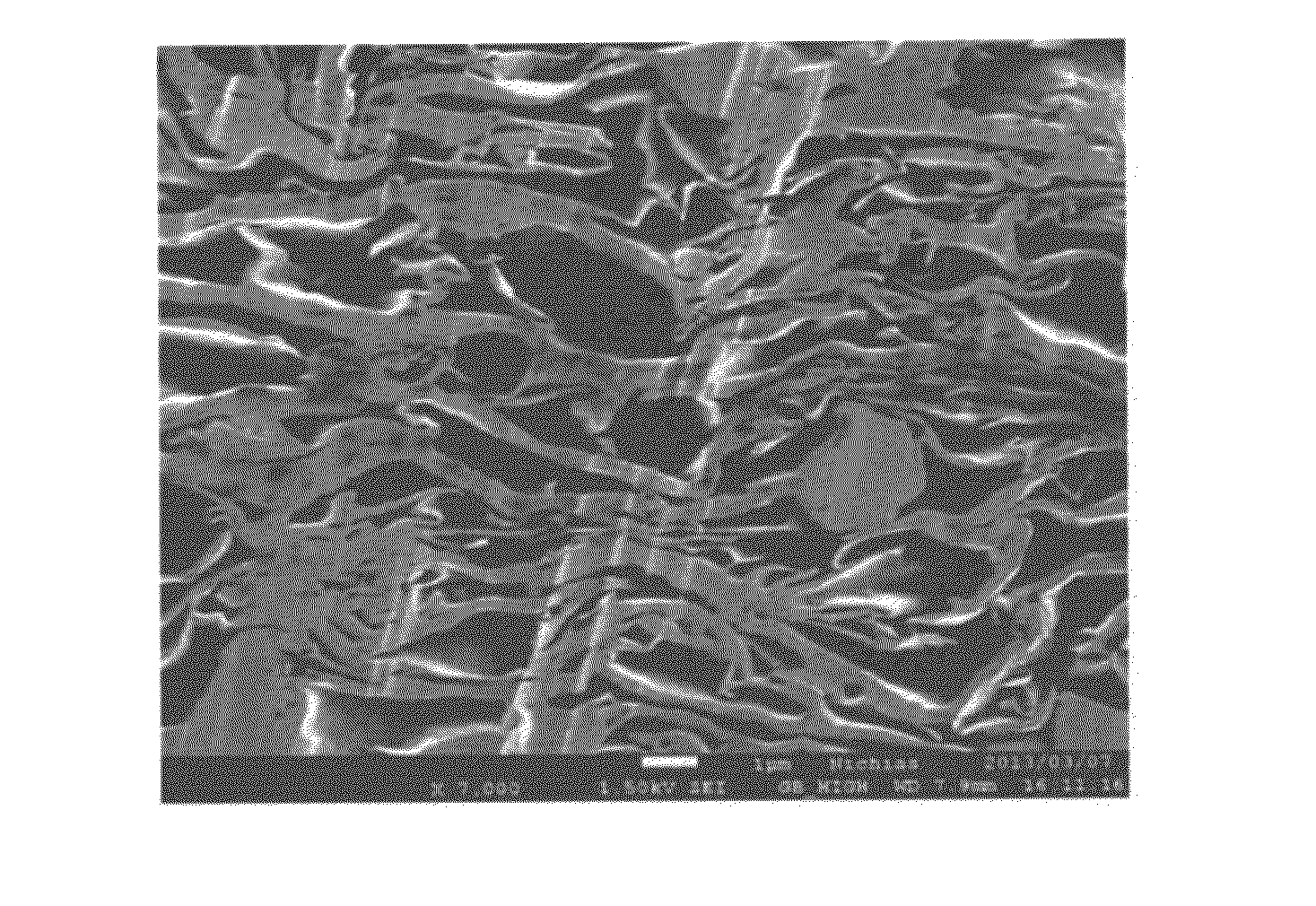
Figure 1 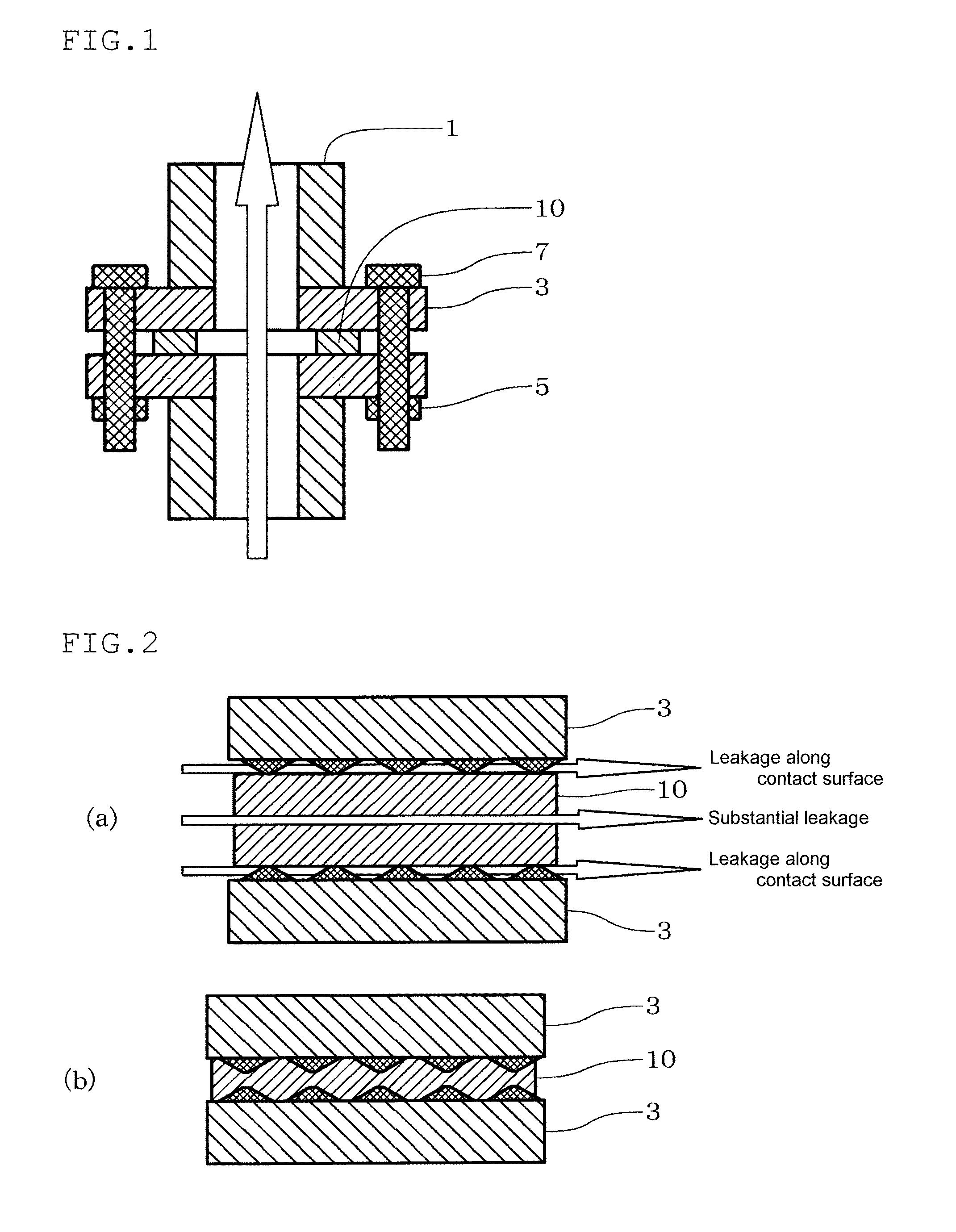
Figure 2 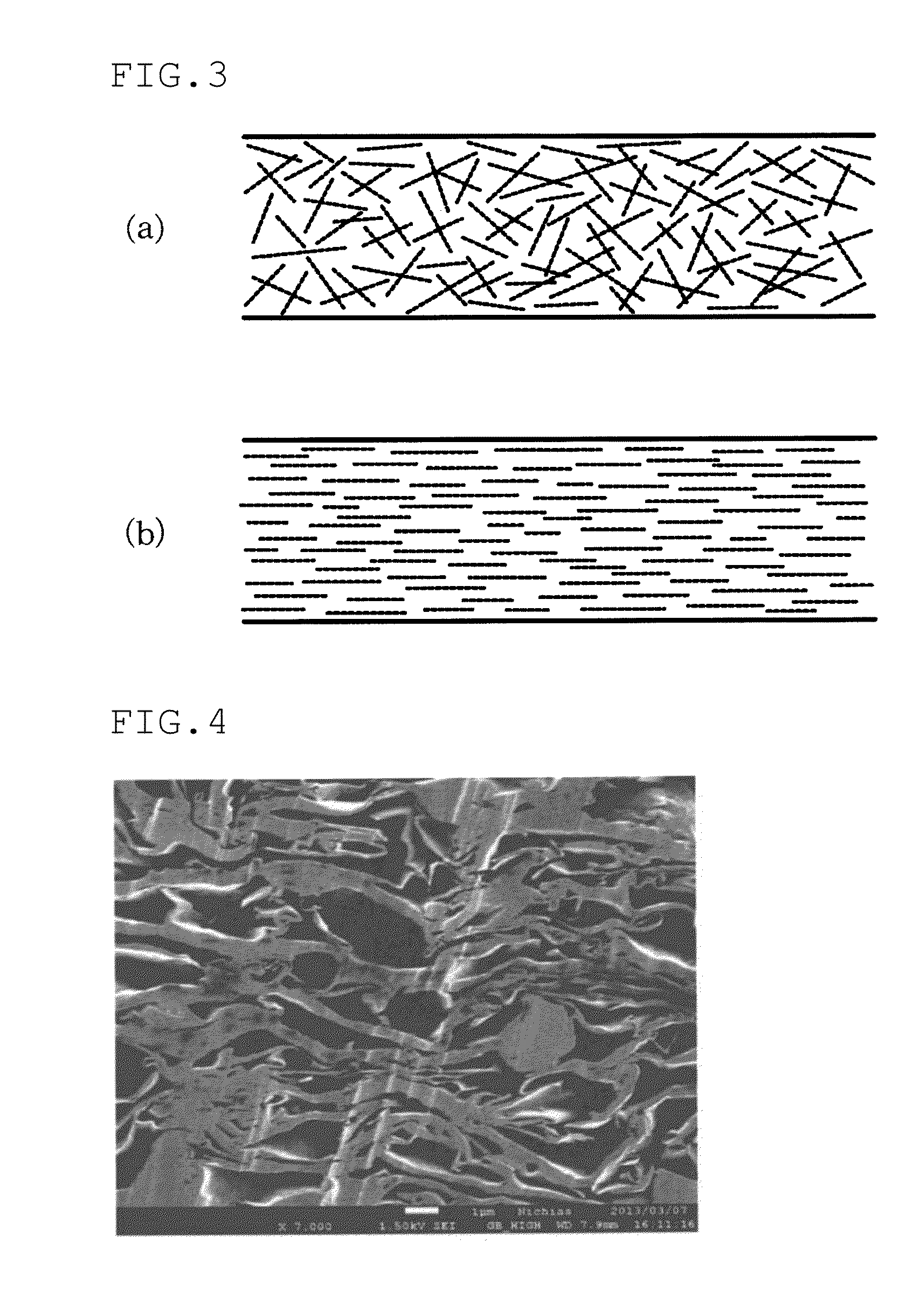
Figure 3
Abstract
Description
TECHNICAL FIELD
[0001] The invention relates to a sheet suitable for use as a sealing material and a method for producing the same.BACKGROUND ART
[0002] A sealing material such as a gasket and a packing is used in a pipe flange or the like in various industries.
[0003] A sealing material is required to have the properties mentioned below. Since pipes are frequently exposed to high temperatures, it is required to have heat resistance sealing properties. Further, since a sealing material is cut off from a sheet at the time of production, it is required to have a strength enough to resist punching with a Thomson blade. Further, a sealing material is required to have a large compression amount in order to be in imitate contact with a flange having concave and convex on the surface thereof.
[0004] Various materials have been proposed as a sealing material. For example, as a sealing material used in a high temperature range, a sealing material made of expanded graphite is known (for example, see ...
Examples
example 1
(1) Preparation of a Montmorillonite Nanosheet
[0051]As clay, 2 g of “Kunipia M” (manufactured by Kunimine Industries, Co., Ltd.) as natural montmorillonite was added to 98 g of distilled water. The resultant was put in a glass-made beaker together with a stirrer chip made of Teflon (registered trademark), and stirred by means of a magnetic stirrer, whereby a homogenous clay dispersion was obtained. The resulting clay dispersion was frozen by using liquid nitrogen. The frozen clay was then freeze-dried by means of a freeze drier “FDU-2110” (manufactured by Tokyo Rika Kikai Co., Ltd.), whereby exfoliated strips of montmorillonite (montmorillonite nanosheet) (exfoliated clay materials) were obtained.
[0052]The bulk density of the exfoliated strips was measured by the following method. The results are shown in Table 1.
[0053]The bulk density was measured by using an electronic balance “MC-1000” (manufactured by A&D Company, Ltd.) at room temperature of 23° C. First, the weight of a metal ...
example 2
[0058]Exfoliated strips of montmorillonite were obtained in the same manner as in Example 1, except that 30 g of “Kunipia M” (manufactured by Kunimine Industries, Co., Ltd.) as natural montmorillonite was added to 70 g of distilled water. A sheet was prepared in the same manner as in Example 1 by using 0.853 g of the exfoliated strips of montmorillonite.
example 3
[0059]Exfoliated strips of vermiculite were obtained in the same manner as in Example 1, except that, as clay, one obtained by pulverizing chemically-treated vermiculite “Micro Light Powder (registered trademark)” (manufactured by Specialty Vermiculite Corporation) in a mortar such that the median diameter D50 became 4 μm was used. A sheet was prepared in the same manner as in Example 1 by using 0.898 g of the exfoliated strips of vermiculite.