

Method of treating actinic keratosis
a technology of actinic keratosis and treatment method, which is applied in the direction of heterocyclic compound active ingredients, biocide, drug compositions, etc., can solve the problems of unfavorable topically applied irm compound treatment, poor penetration, and inability to provide therapeutic benefit via topical application of irm compound for treating a particular condition at a particular location, so as to reduce the degradation of irm compound and sorbic acid, improve stability and stability
Patent Information
- Authority / Receiving Office
- US · United States
- Patent Type
- Patents(United States)
- Current Assignee / Owner
- Publication Date
- 2013-01-15
- Estimated Expiration
- Not applicable · inactive patent
Smart Images
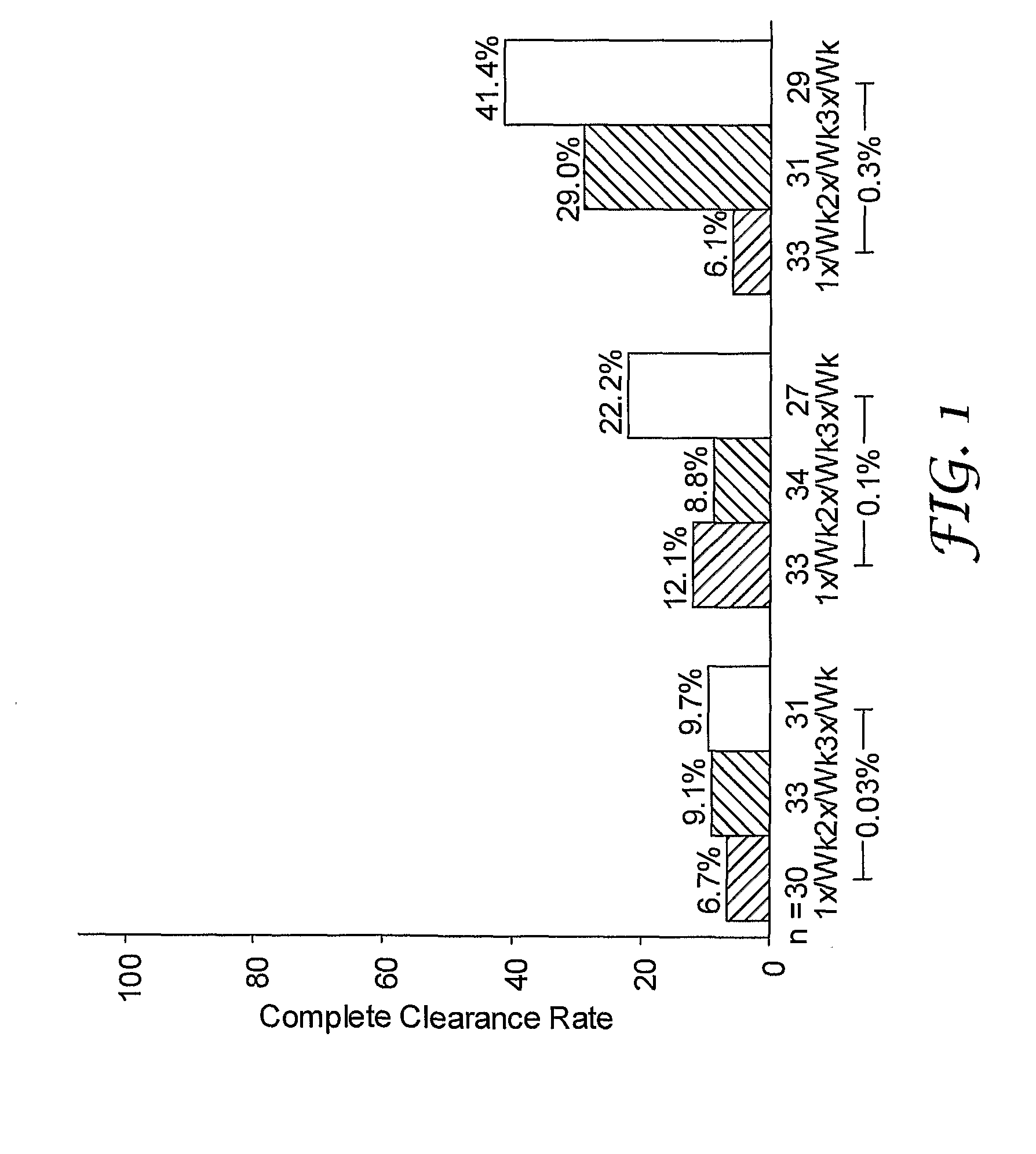
Figure 1 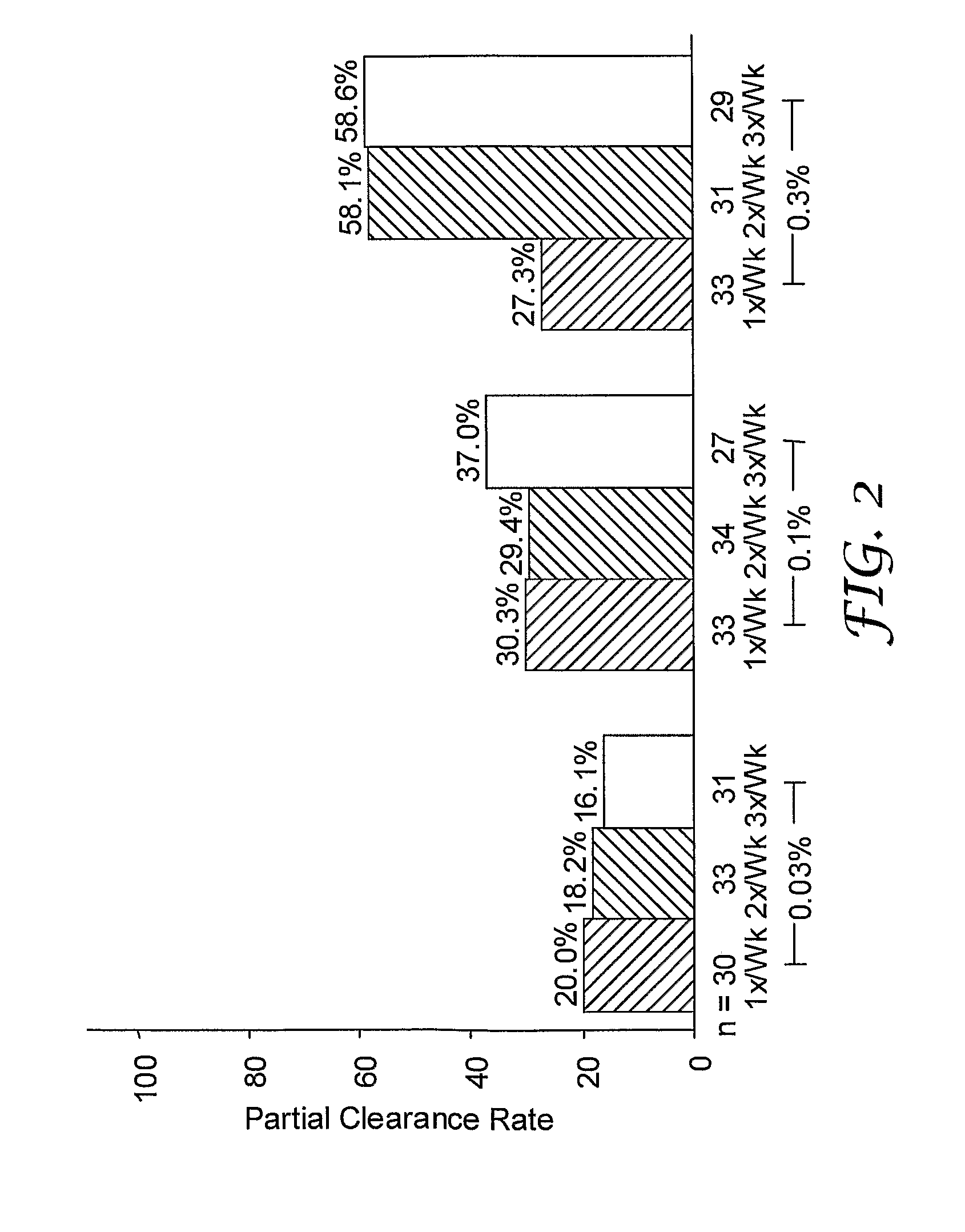
Figure 2 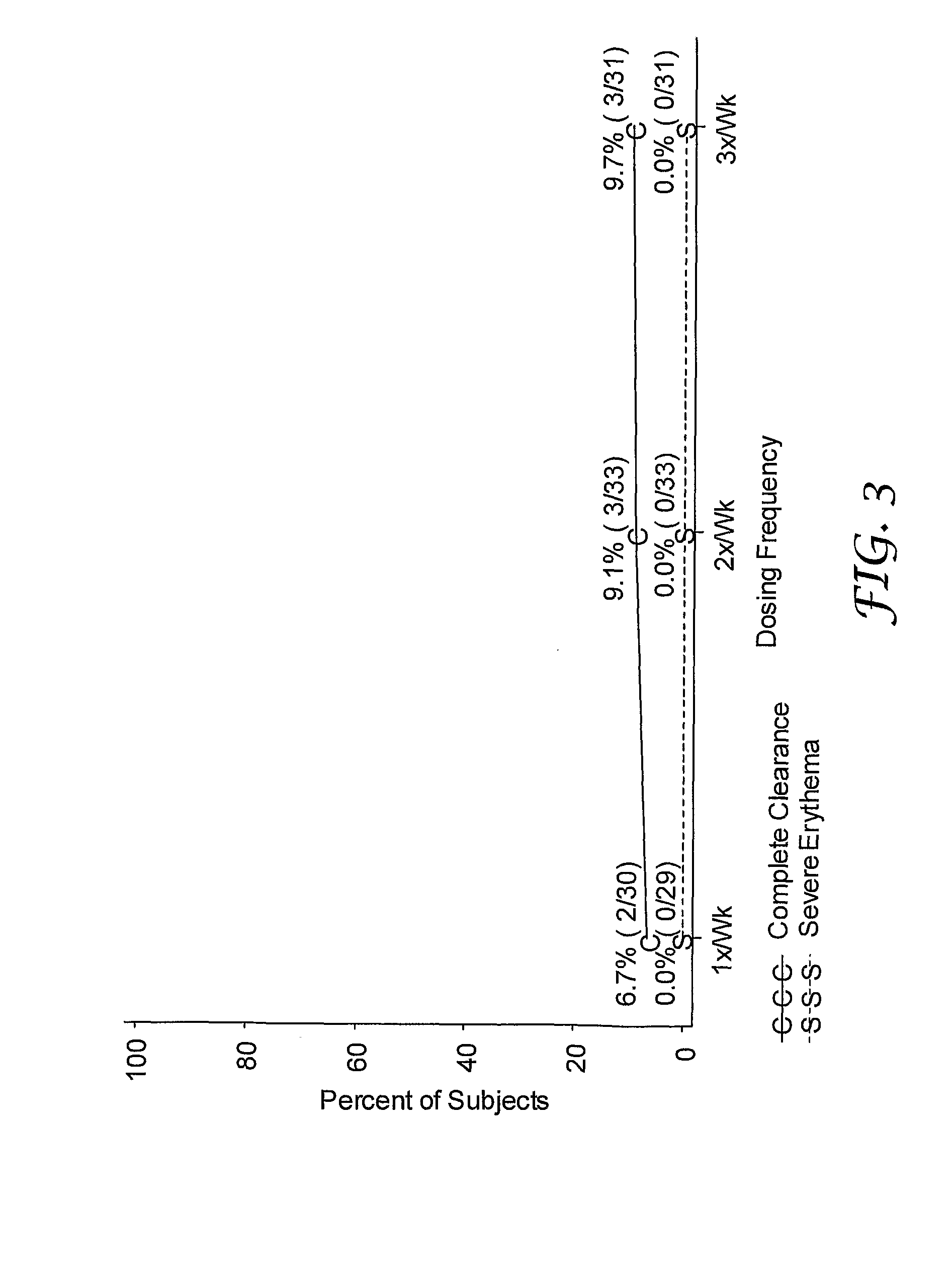
Figure 3
Abstract
Description
CROSS-REFERENCES TO RELATED APPLICATIONS
[0001] This application is a 35 U.S.C. §371 national stage of PCT application PCT / US2006 / 008868, filed Mar. 14, 2006, which claims benefit of priority to U.S. provisional application 60 / 661,661, filed Mar. 14, 2005, the entire contents of each of these applications being hereby incorporated by reference.FIELD
[0002] The present invention relates to topical treatment of actinic keratosis lesions using immune response modifier compounds.BACKGROUND
[0003] In the 1950's the 1H-imidazo[4,5-c]quinoline ring system was developed, and 1-(6-methoxy-8-quinolinyl)-2-methyl-1H-imidazo[4,5-c]quinoline was synthesized for possible use as an antimalarial agent. Subsequently, syntheses of various substituted 1H-imidazo[4,5-c]quinolines were reported. For example, 1-[2-(4-piperidyl)ethyl]-1H-imidazo[4,5-c]quinoline was synthesized as a possible anticonvulsant and cardiovascular agent. Also, several 2-oxoimidazo[4,5-c]quinolines have been reported.
[0004] Certain 1H-i...
Examples
examples
[0109]The following Examples are provided to further describe various IRM formulations and methods according to the invention. The examples, however, are not intended to limit the formulations and methods within the spirit and scope of the invention.
Test Methods
IRM Compound 1 Content
[0110]A gradient reversed phase high performance liquid chromatography (HPLC) method was used to determine the amount of 2-methyll(2-methylpropyl)1H-imidazo[4,5-c][1,5]naphthyridin-4-amine (IRM Compound 1) in cream formulations using BHA and BHT as the antioxidants.
[0111]HPLC parameters: Analytical column: ZORBAX Bonus RP, 3.5 micron particle, 150×4.6 mm (available from Agilent Technologies, Wilmington, Del., USA); Column temperature: 35° C.; Detector: UV at 240 nm; Flow Rate: 1.0 mL / min; Injection volume: 30 μL; Mobile phase A: 0.05% trifluoroacetic acid in water; Mobile Phase B: 0.05% trifluoroacetic acid in acetonitrile; Data acquisition time: 25 minutes; HPLC run time: 35 minutes. Gradient program: 0...
examples 1-3
[0121]Table 1 summarizes topical formulations made in accordance with the present invention in a percentage weight-by-weight basis. The formulations were packaged in aluminum tubes with an epoxy phenolic lacquer liner.
[0122]
TABLE 1Ex 1Ex 2Ingredient(Comparative)(Comparative)Ex 32-methyl-1-(2-0.030.100.30methylpropyl)-IH-imidazo[4,5-c][1,5]naphthyridin-4-amineIsostearic acid5.005.007.00*Medium-chain4.004.004.00TriglyceridesCARBOPOL 9801.001.001.00POLOXAMER 1883.503.503.50Propylene gylcol5.005.005.00Methylparaben0.200.200.20Sorbic acid0.150.150.15BHA0.100.100.10Edetate disodium0.050.050.05dihydrateSodium hydroxide0.800.800.80Solution 20% w / wPurified water80.1780.1077.90*Caprylic / capric triglyceride available under the trade names CRODAMOL GTCC-PN (Croda, Inc) and MIGLYOL 812N (Sasol).
example 1
Four-Week Treatment Period
[0123]A randomized, double-blind study was performed to evaluate single and multi-weekly doses of the formulations prepared above topically applied to actinic keratosis lesions on the head.
[0124]Otherwise healthy white (n=280) and one American Indian (n=1) subjects (17% female, 83% male) ranging in ages 33 to 88 years of age (median age of 66.3), inclusive, with actinic keratosis lesions on the head were enrolled in the study. Subjects had a baseline count of four to nine (median of six) actinic keratosis lesions to qualify for enrollment into the study. The actinic keratosis lesions areas were on the scalp (26%) and face (74%).
[0125]The study included a four-week treatment period followed by an eight-week post-treatment period. Subjects were randomized into either 0.03%, 0.1%, or 0.3% 2-methyl-1-(2-methylpropyl)-1H-imidazo[4,5-c][1,5]naphthyridin-4-amine formulations as described in Table 1 in one of three treatment regimens: (1) once per week (1× / Wk), two...