
Method for moderate trimming wood sided branches in forest
A pruning method and side branch technology, applied in gardening methods, botanical equipment and methods, forestry, etc., can solve problems such as insufficient sunlight, slow effect, and affecting forest growth
- Summary
- Abstract
- Description
- Claims
- Application Information
AI Technical Summary
Problems solved by technology
Method used
Image

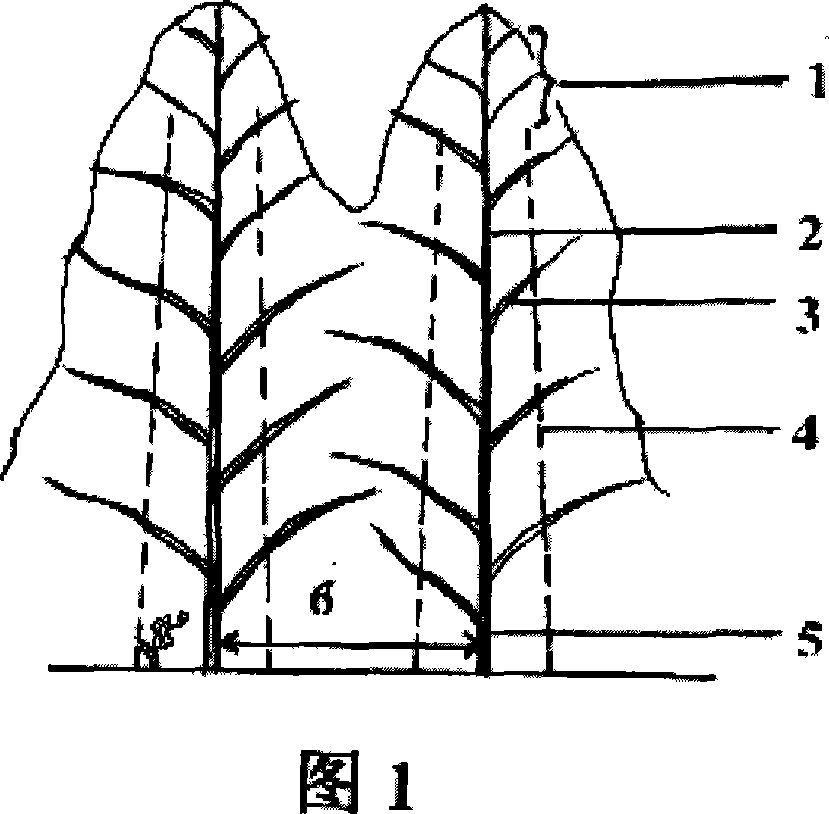
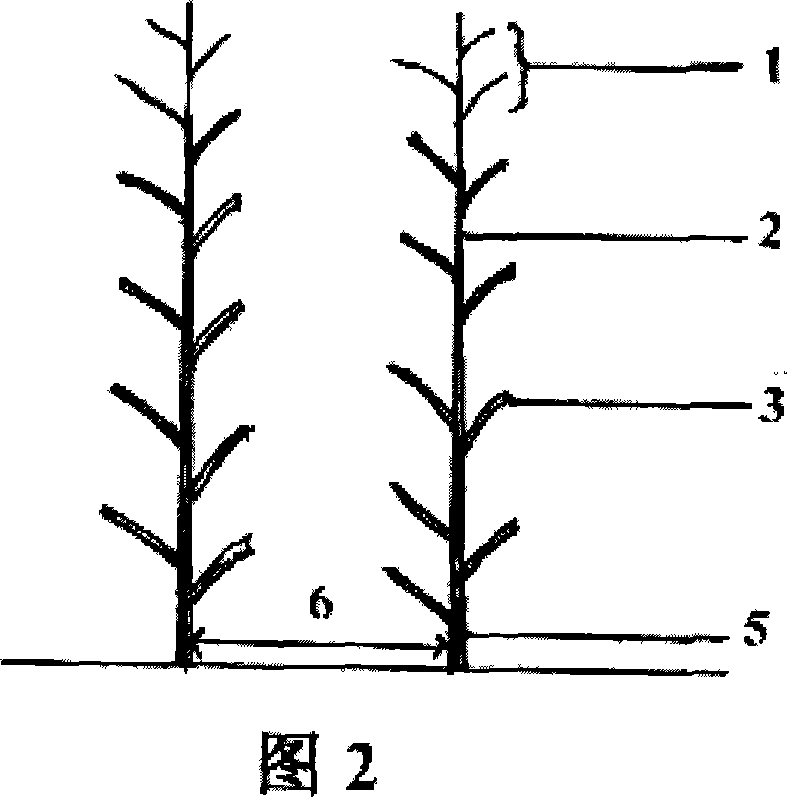
Examples
Embodiment 1
[0026] Moderate pruning was carried out on Kudingcha (I. latifolia) ecological public welfare forest.
[0027] 1. General situation of trees: 10-year-old Kudingcha ecological public welfare forest, canopy density 0.9, density 240 trees / mu.
[0028] 2. Pruning In late March, moderate pruning was carried out on the tree. Except for the tip of the tree (1 meter), all the thicker side branches were cut off by about 1 / 2 from the upper end on average. After pruning, the longitudinal section of the canopy is trapezoidal, and the intersection angle at the bottom is about 85°.
[0029] 3. Thinning Cut off the weak branches and overly dense overlapping branches of pests and diseases.
[0030] 4. Tendency management Normal tending measures should not be less (including thinning tending), and fertilizer and water management should be strengthened.
[0031] The Kudingcha ecological public welfare forest has been moderately pruned twice in a row. When it is 16 years old, the average growt...
Embodiment 2
[0033] Moderate pruning of side branches of Chinese fir (C.lanceolata) timber forest.
[0034] 1. Tree general situation 8-year-old Chinese fir timber forest, afforestation density 300 trees / mu, canopy density 0.85.
[0035] 2. Pruning In late February, cut off about 1 / 3 of all first-level side branches (except the one-year-old part of the treetop) from the top on average.
[0036] 3. Cultivation management is the same as embodiment one.
[0037] After two times of moderate pruning, the standing stock volume per mu of the Chinese fir forest increased by 18.5% compared with the control group when it was 14 years old.
[0038] Notes:
[0039] 1. Canopy light-receiving area The area outside the canopy (surface) that receives sunlight.
[0040] 2. Canopy daylighting coefficient The ratio of the canopy light-receiving area to the land area. It can be expressed by the following formula:
[0041] R=As / al
[0042] Among them, R-canopy lighting coefficient, As-canopy light-receiv...
PUM
 Login to View More
 Abstract
Description
Claims
Application Information
 Login to View More