
Method for extracting multiple metals from manganese nodule industrial residues
A technology of industrial waste slag and manganese nodules, applied in the direction of improving process efficiency, etc., can solve problems such as polluting the environment and losing rare metals
- Summary
- Abstract
- Description
- Claims
- Application Information
AI Technical Summary
Problems solved by technology
Method used
Image


Examples
Embodiment 1
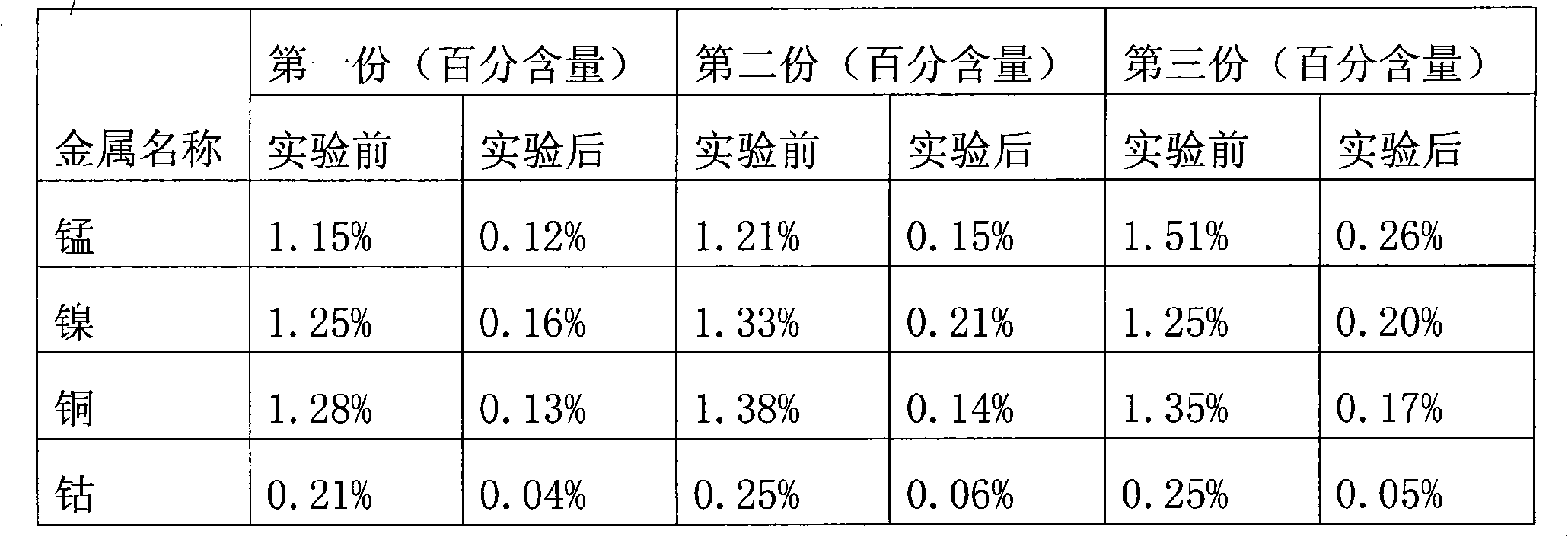
[0017] Example 1: A method for extracting various metals from manganese nodule industrial waste residues. One part of manganese nodule industrial waste residue from three regions was taken, and experiments were carried out according to this method.
[0018] Put the manganese nodule industrial waste into three acid-resistant reactors, and then add enough dilute nitric acid to fully react, let stand, precipitate, separate and filter to obtain solutions and waste residues containing manganese nitrate, nickel nitrate, cobalt nitrate and copper nitrate .
[0019] Heat the solution containing manganese nitrate, nickel nitrate, cobalt nitrate and copper nitrate to 70°C, add a sufficient amount of ammonium oxalate solution at 75°C to fully react, stand, precipitate, filter, and separate to obtain a precipitate and a red filtrate. The precipitate is detected to be nickel oxalate and copper oxalate, the precipitate containing nickel oxalate and copper oxalate is fully heated, and sufficient...
Embodiment 2
[0025] Example 2: The treatment method of this example is basically the same as that of example 1, except that the solution containing manganese ions is added to a sufficient amount of ammonium oxalate solution at 60°C-80°C to fully react, then stand, precipitate and filter , Obtain the precipitate, wash the precipitate with clean water, add a sufficient amount of ammonium oxalate solution to fully react, concentrate, crystallize, and dry to obtain permanganate. Although the original metal of manganese is not extracted, the manganese ion in the waste residue is reduced, and the obtained permanganate can be used as a reagent.
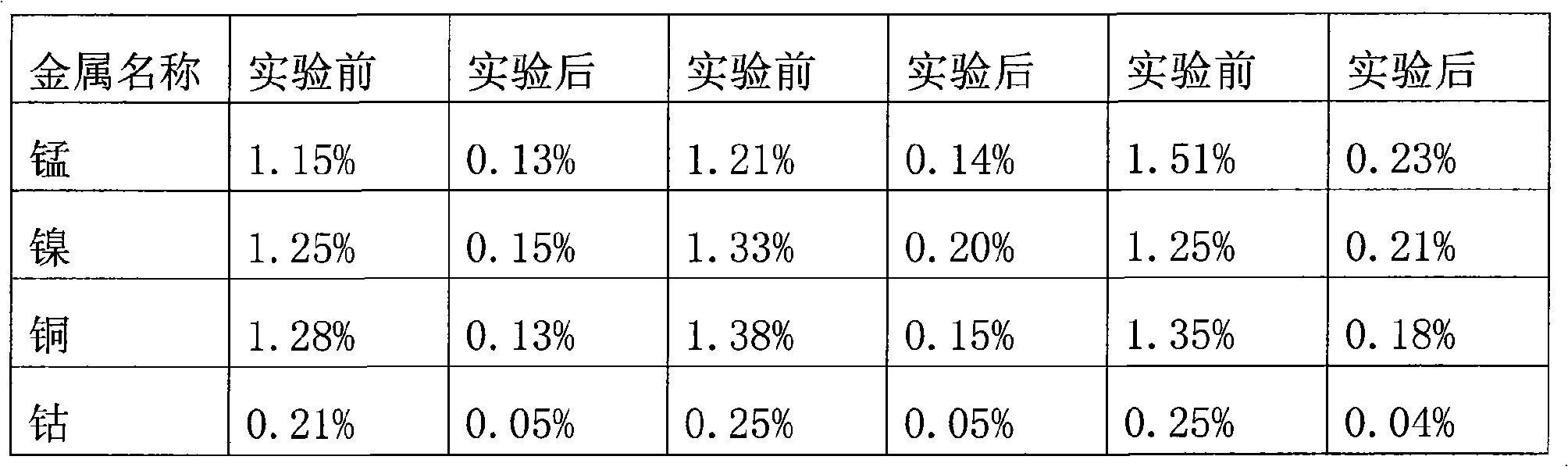
[0026] Similarly, 3 parts of waste manganese nodules in the above-mentioned Example 1 were taken, and the experiment was carried out according to this method. The experimental data is shown in Table 2.
[0027] Table II
[0028]
[0029]
[0030] To sum up, it can be seen from the treatment results before and after the experiment of the two examples that...
PUM
 Login to View More
 Abstract
Description
Claims
Application Information
 Login to View More