Data buffering system with load balancing function

A technology of data caching and load balancing, which is applied in digital data processing, special data processing applications, memory address/allocation/relocation, etc. It can solve problems such as unquantifiable program execution efficiency, waste of memory, waste of memory space, etc., to achieve Improve the memory addressing speed, reduce the number of I/O, and realize the effect of dynamic balance

CN101576918BInactive Publication Date: 2012-11-28YONYOU NETWORK TECH CO LTD
5 Cites 2 Cited by

Patent Information

Authority / Receiving Office
CN · China
Patent Type
Patents(China)
Current Assignee / Owner
Publication Date
2012-11-28
Estimated Expiration
Not applicable · inactive patent

Smart Images

  • Figure 1
    Figure 1
  • Figure 2
    Figure 2
  • Figure 3
    Figure 3
Patent Text Reader

Abstract

The invention provides a data buffering system comprising a data buffering manager, a data buffering library and a load balancing processor, wherein the data buffering manager receives a data acquiring request from outside, and responds to the data acquiring request to send a data acquiring command to the data buffering library to judge if the data buffering library preserves corresponding data, if the data buffering library preserves the corresponding data, the data buffering manager gets the corresponding data back, and if the data buffering library does not preserve the corresponding data,the data buffering manager sends a database server acquiring request to the load balancing processor; the data buffering library responds to a data storage command to store data which need to be buffered in blocks and pages and also responds to the data acquiring command to send the corresponding data to the data buffering manager; the load balancing processor responds to the database server acquiring request to provide a database server which processes fewest request to the data buffering manager, and the load balancing processor acquires data and returns the data to be stored into the data buffering library according to the information of the database server. The invention enhances the memory utilization factor, reduces the interactive communication capacity, decreases the using inquirytimes and the magnetic disc access times and enhances the system stability and the system operation efficiency.
Need to check novelty before this filing date? Find Prior Art

Description

technical field

[0001] The present invention relates to data cache technology, more specifically, to a data cache system with load balancing function. Background technique

[0002] At present, although there are some standard performance optimization strategies in SQL Server, Oracle and other large databases, the operating efficiency of the system can also be improved by implementing these strategies, but because these DBMSs are multi-functional applications that follow some international standards and industry standards System, data cache processing is only one of its functions, which causes the database to be the performance bottleneck of many application systems: for example, when using large-scale financial software, ERP software, or large-scale dynamic websites, sometimes there will be timeouts , slow response, etc. Most of the reasons for these problems are in the access to the database. Unless there is a problem with the program design, in most of the current applica...

Examples

Embodiment Construction

[0034] The specific implementation manners according to the present invention will be described below in conjunction with the accompanying drawings.

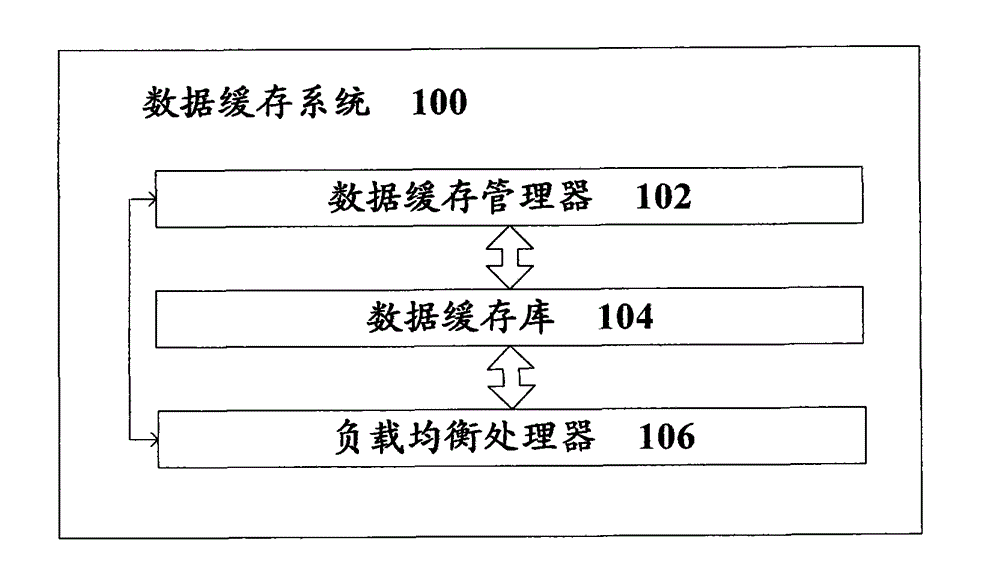
[0035] figure 1 A logical block diagram of the data caching system according to the present invention is shown.

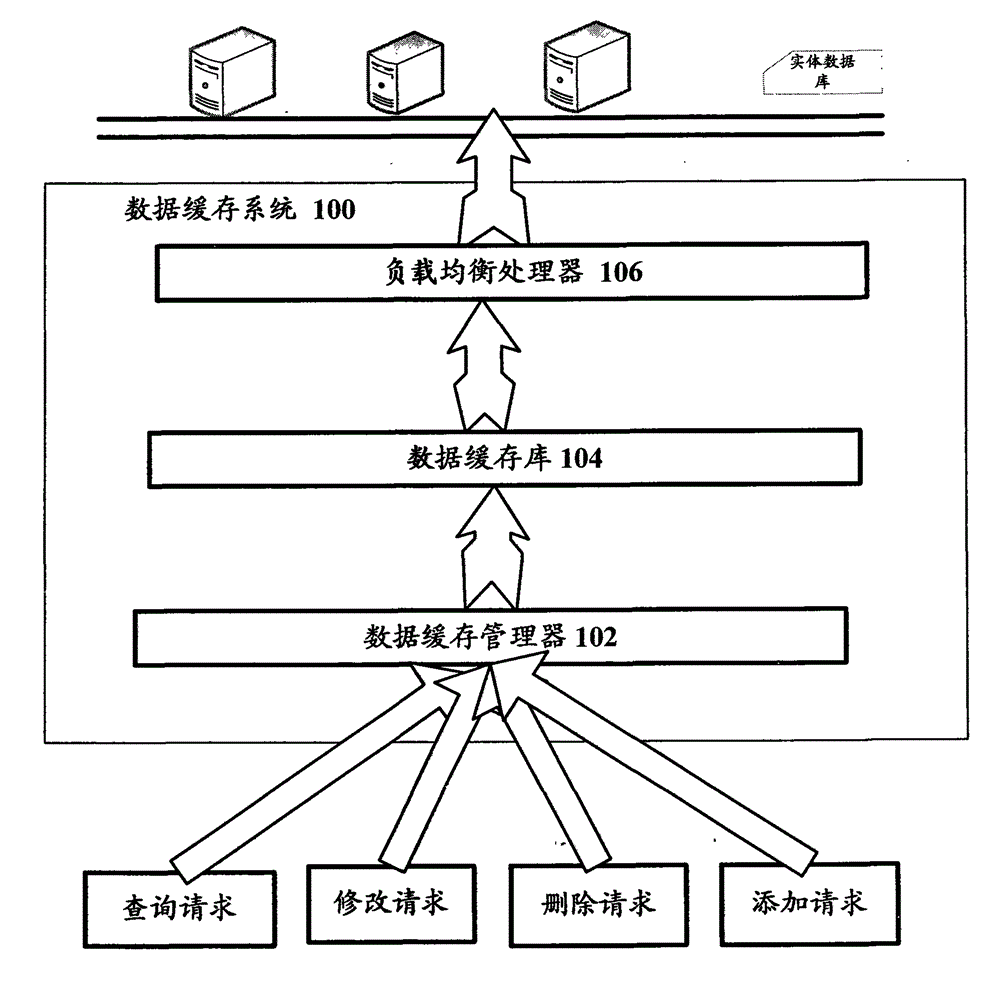
[0036] The data cache system 100 with load balancing function according to the present invention includes a data cache manager 102 , a data cache library 104 and a load balancing processor 106 . The data cache manager 102 is used to respond to a data acquisition request from the outside, and sends a data acquisition instruction to the data cache library 104 in response to the data acquisition request, and judges whether the data cache library 104 stores corresponding data, and if the judgment result is yes , then retrieve the corresponding data from the data cache library 104; if the judgment result is no, send a request to the load balancing processor 106 to obtain a database server. In response to the data storag...