Decimal carrier synchronization algorithm based on cyclic prefix

A cyclic prefix and carrier synchronization technology, applied in the direction of multi-frequency code system, etc., can solve the problems of insufficient accuracy of carrier synchronization technology and the inability to meet the development needs of modulation order, so as to improve technical efficiency and accuracy, and highlight the substantive Features, algorithm, precise and concise effect

CN103001914AInactive Publication Date: 2013-03-27UNIV OF ELECTRONICS SCI & TECH OF CHINA
4 Cites 4 Cited by

Patent Information

Authority / Receiving Office
CN · China
Patent Type
Applications(China)
Current Assignee / Owner
Publication Date
2013-03-27
Estimated Expiration
Not applicable · inactive patent

Smart Images

  • Figure 1
    Figure 1
  • Figure 2
    Figure 2
  • Figure 3
    Figure 3
Patent Text Reader

Abstract

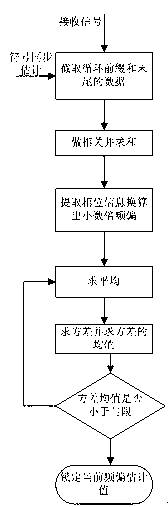
The invention discloses a decimal carrier synchronization algorithm based on cyclic prefix. The decimal carrier synchronization algorithm solves the problem in the prior art that the carrier synchronization technical precision is not high enough to meet modulation order development requirements. The decimal carrier synchronization algorithm based on the cyclic prefix includes the following steps: dividing received signals into a carrier frequency offset portion and a remaining portion, dividing the carrier frequency offset portion into decimal frequency offset and integral multiple frequency offset, calculating to obtain a single estimation value of the decimal frequency offset, and obtaining the ith estimation value according to the single estimation value of the decimal frequency offset; repeating the step (b), calculating variance of the obtained decimal frequency offset, and calculating a variance average value; arranging a threshold V, if Vf>V, executing the step (a), if Vf<V, locking a current decimal frequency offset estimation value, and conducting frequency offset compensation according to the estimation value. By means of the scheme, purposes of reducing decimal frequency estimation residual, improving system stability, and enabling a system to work in a smaller residual environment are achieved, and the algorithm has high practical value and popularization value.
Need to check novelty before this filing date? Find Prior Art

Description

technical field

[0001] The invention relates to a carrier synchronization algorithm, in particular to a fractional multiple carrier synchronization algorithm based on a cyclic prefix in high-order wired communication. Background technique

[0002] In the communication system, the synchronization algorithm is the basis of the realization of the communication receiver, and it is the research focus and difficulty of any modulation and demodulation technology, and its performance is directly related to the performance of the entire communication system. It can be said that the synchronization algorithm is the prerequisite for reliable information transmission, and only an accurate synchronization algorithm can carry out reliable data transmission.

[0003] Currently, OFDM system synchronization can be divided into frame synchronization, symbol synchronization, carrier synchronization and sampling clock synchronization. Among them, carrier synchronization is used to estimate the...

Examples

Embodiment

[0028] The carrier frequency offset is generated because the oscillation frequencies of the transmitting end and the receiving end do not match, which is represented as an accumulated phase in the time domain and as an overall offset of the subcarrier in the frequency domain. Since the OFDM system needs to ensure the orthogonality of its sub-carriers, it is very sensitive to frequency offset and has relatively high requirements for carrier synchronization. In the present invention, we divide the received signal into the carrier frequency offset part and the remaining part, therefore, suppose the kth time-domain sampling point of a certain OFDM received after complete synchronization is: r(k) =s(k)exp(j2πΔfkT s )+n(k)=s(k)exp(j2πΔfkT / N)+n(k), and some transformations can be obtained: r(k)=s(k)exp(j2πk(f I + f F ) / N)+n(k), analyzing from the digital domain, since k is an integer, so f I It has no effect on the time domain of the signal, and then it can be concluded that r(k)=...