
A high-yield and unlimited hanging method of zucchini leaves
A technology for zucchini and hanging vines, which is applied to the field of zucchini leaf control, high-yield, and infinite vine hanging, can solve the problems of unsatisfactory adjustment of vegetative growth and reproductive growth of zucchini, incomplete technology of zucchini fruit retaining and hanging vines, increasing the chance of infection with diseases and insect pests, and the like. , to achieve the effect of enhancing the overall photosynthetic capacity of the plant, good ventilation and light transmission conditions, and changing ventilation and light transmission conditions.
Active Publication Date: 2017-06-13
山东省寿光市三木种苗有限公司
View PDF5 Cites 0 Cited by
- Summary
- Abstract
- Description
- Claims
- Application Information
AI Technical Summary
Problems solved by technology
The number of fruits per zucchini plant is 22-26. With this technique of pruning and fruit retention, the cultivation time is longer, the fruit of zucchini is more uniform, the commodity is better, the leaf area is large, the leaves are thin, and pests and diseases are easy to occur. Shading, strong light competition between leaves, easy to introduce zucchini, low fruit setting rate, increased phenomenon of melon melting, reduced yield, low product value, and low economic benefits
[0005] This mainly applied zucchini fruit hanging method is not comprehensive technically, and the adjustment of vegetative growth and reproductive growth of zucchini is not ideal. The leaf area is large and the leaves are thin, which increases the chance of infection by diseases and insect pests and increases production costs.
Method used
the structure of the environmentally friendly knitted fabric provided by the present invention; figure 2 Flow chart of the yarn wrapping machine for environmentally friendly knitted fabrics and storage devices; image 3 Is the parameter map of the yarn covering machine
View moreImage
Smart Image Click on the blue labels to locate them in the text.
Smart ImageViewing Examples

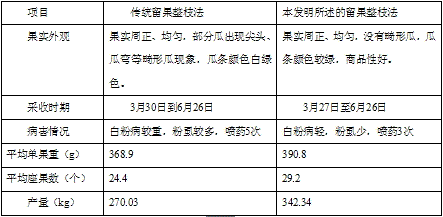
Examples
Experimental program
Comparison scheme
Effect test
Embodiment
[0018] The field experiment was carried out at the zucchini planting base in Cuijia Village, Gaoliu Town, Qingzhou City, Shandong Province. The tested zucchini variety was Custer, and it was planted on February 20.
the structure of the environmentally friendly knitted fabric provided by the present invention; figure 2 Flow chart of the yarn wrapping machine for environmentally friendly knitted fabrics and storage devices; image 3 Is the parameter map of the yarn covering machine
Login to View More PUM
 Login to View More
 Abstract
The invention relates to a summer squash leaf-control high-yield unlimited vine hanging method. The summer squash leaf-control high-yield unlimited vine hanging method comprises the steps that when the number of leaves of each summer squash ranges from 5 to 7, spraying of 15% wettable powder 500-time dilution of a growth inhibitor MET is conducted from blades to cover tops, and after field planting is accomplished, soil is kept wetting immediately when the soil is dry; when the number of the leaves of each summer squash ranges from 7 to 8, vines of the summer squashes are hung, and all male flowers and female flowers existing before the eight leaves grow are removed; when the fruit setting period begins, flower dipping processing is conducted, one fruit is reserved for every two leaves, when the first fruit grows to meet the requirement that the length is 10cm, 10kg three-element fertilizer is used per mu, and is applied along with water, and fertilizer and water irrigation is conducted every 7-15 days; when the situation that the blade area becomes large, and the blades become thin appears, processing is conducted through the 15% wettable powder 500-time dilution of the MET, and when the fruiting vigorous period begins, top application of high-nitrogen and high-potash fertilizer is conducted. According to the summer squash leaf-control high-yield unlimited vine hanging method, the summer squashes are processed through the growth inhibitor, the increase of the blade area is inhibited, the blades of the summer squashes can become thin, and light transmission and the photosynthetic capacity are enhanced; the summer squashes are promoted to be robust in the earlier stage, the fruit setting period appears in advance, the fruit setting ratio is increased, after fruit setting is accomplished, growth and development of the fruits are quick, and the frequency of pest and disease damage is low.
Description
technical field [0001] The invention relates to the technical field of vegetable planting, in particular to a method for leaf-controlling, high-yield and unlimited hanging of zucchini. Background technique [0002] In the cultivation and planting of zucchini, the leaves of zucchini have very strong growth ability, large leaf area, thin leaves, mutual shading between leaves, and shading of leaves, resulting in excessive vegetative growth of zucchini, resulting in leggy plants, low yield of zucchini, and increase of deformed melons , The commodity is reduced, resulting in a reduction in economic benefits. Therefore, zucchini leaf control is a crucial technology in the zucchini growth cycle. [0003] In the process of cultivating zucchini plants, control nutrition and reproductive growth by hanging vines of zucchini plants to promote the development of flowers and fruits, so as to obtain high yield and high quality of zucchini, that is, to tap the method of increasing yield an...
Claims
the structure of the environmentally friendly knitted fabric provided by the present invention; figure 2 Flow chart of the yarn wrapping machine for environmentally friendly knitted fabrics and storage devices; image 3 Is the parameter map of the yarn covering machine
Login to View More Application Information
Patent Timeline
 Login to View More
 Patent Type & AuthorityPatents(China)
IPC IPC(8): A01G1/00A01G7/06
CPCA01G7/06A01G22/00
Inventor张国秀高珏晓付彬刘钊耿增祥徐振宁郎丰孝刘树森焦自高王富
Owner山东省寿光市三木种苗有限公司