
Electrode device for in-situ study of atmospheric corrosion process under liquid drops
An atmospheric corrosion and electrode device technology, which is applied in weather resistance/light resistance/corrosion resistance, measuring devices, instruments, etc., can solve problems such as expensive, difficult to use reference electrodes, and complex structure of Kelvin probe reference electrodes
- Summary
- Abstract
- Description
- Claims
- Application Information
AI Technical Summary
Problems solved by technology
Method used
Image

Examples
Embodiment 1
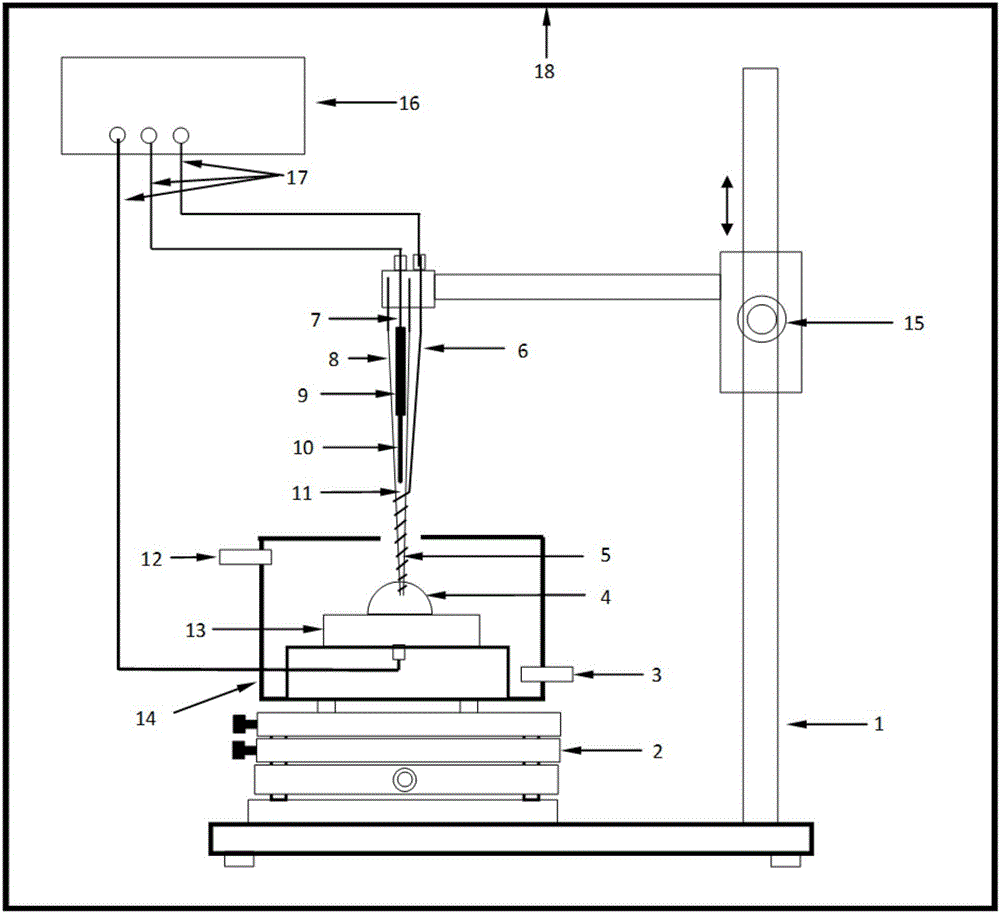
[0017] The invention relates to an electrode device for in-situ research on the atmospheric corrosion process under liquid droplets, such as figure 1 As shown, it mainly consists of operating frame 1, 3D operating table 2, gas inlet 3, liquid drop 4, capillary salt bridge of saturated KCl agar 5, platinum wire counter electrode 6, silver wire 7, glass tube 8, silica gel 9, chloride Silver (AgCl) 10, saturated KCl solution 11 containing AgCl, gas outlet 12, working electrode 13, test chamber 14, knob 15 for adjusting the height up and down, electrochemical workstation 16, lead wire 17, and thermostat 18. The end of the reference electrode is a capillary salt bridge 5 filled with saturated KCl agar, the platinum wire counter electrode 6 is wound around the end of the capillary salt bridge 5, and fixed together on the 3D console 2, and the knob 15 on the 3D console 2 for adjusting the vertical height is rotated The relative positions of the capillary salt bridge 5 and the working...
Embodiment 2
[0020] According to the conditions described in Example 1, the length of the capillary salt bridge 5 filled with saturated KCl agar was controlled at 0.5 mm.
Embodiment 3
[0022] According to the conditions described in Example 1, the length of the capillary salt bridge 5 filled with saturated KCl agar was controlled at 0.3 mm.
PUM
| Property | Measurement | Unit |
|---|---|---|
| Diameter | aaaaa | aaaaa |
Abstract
Description
Claims
Application Information
 Login to View More