
Method of determining boundary of drag acceleration corridor of glide vehicle
A technology of acceleration and aircraft, applied in the field of data processing, can solve the problem that the drag acceleration corridor cannot be expressed analytically
- Summary
- Abstract
- Description
- Claims
- Application Information
AI Technical Summary
Problems solved by technology
Method used
Image



Examples
Embodiment Construction
[0056] In order to make the technical problems, technical solutions and advantages to be solved by the present invention clearer, the following will describe in detail with reference to the accompanying drawings and specific examples.
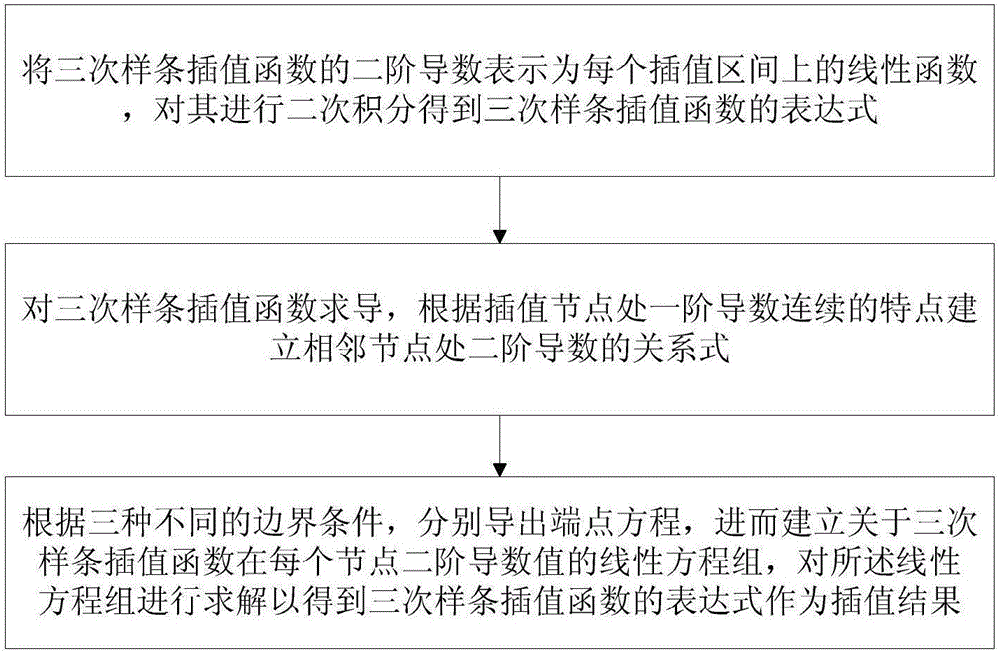
[0057] The flow process of the embodiment of the present invention is as figure 1 shown, including:
[0058] Express the second-order derivative S″ (x) of the cubic spline interpolation function S (x) as a linear function on each interpolation interval, carry out quadratic integration to it and obtain the expression of the cubic spline interpolation function S (x);
[0059] Deriving the cubic spline interpolation function S(x), according to the continuous characteristics of the first-order derivative at the interpolation node, the relational expression of the second-order derivative at the adjacent node is established;
[0060] According to three different boundary conditions, the endpoint equations are derived respectively, and then the secon...
PUM
 Login to View More
 Abstract
Description
Claims
Application Information
 Login to View More