
Herbicide
A herbicide and glyphosate technology, applied in the field of pesticides, can solve the problems of incomplete weed killing, high transportation costs, and low active ingredients, and achieve the goals of reducing weeding time and tillage intervals, reducing labor intensity, and enhancing weeding effects Effect
- Summary
- Abstract
- Description
- Claims
- Application Information
AI Technical Summary
Problems solved by technology
Method used
Image

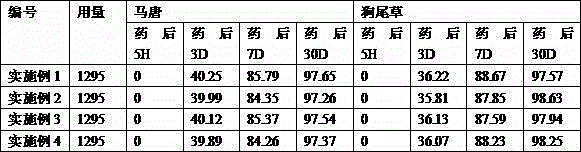
Examples
Embodiment 1
[0010] 671 grams of glyphosate with a purity of 95%, 95 grams of 2-methyl-4 sodium chloride with a purity of 95%, 20 grams of sodium lauryl sulfate, 50 grams of modified polycarboxylate (LBD-1), naphthalene sulfonate Acid (dispersant NNO) 30 grams, white carbon black 37 grams. Gravityless mixing is then carried out in a conical mixer for approximately 30-70 minutes. All percentages in this example are mass percentages.
Embodiment 2
[0012] 586 grams of glyphosate with a purity of 95%, 60 grams of 2-methyl-4 sodium chloride with a purity of 95%, 20 grams of sodium lauryl sulfate, 50 grams of modified polycarboxylate (LBD-1), naphthalene sulfonate Acid (dispersant NNO) 30 grams, white carbon black 195 grams. Gravityless mixing is then carried out in a conical mixer for approximately 30-70 minutes. All percentages in this example are mass percentages.
Embodiment 3
[0014] 316 grams of glyphosate with a purity of 95%, 6 grams of 2 methyl 4 sodium chloride with a purity of 95%, 10 grams of sodium lauryl sulfate, 10 grams of modified polycarboxylate (LBD-1), naphthalene sulfonate Acid (dispersant NNO) 10 grams, white carbon black 650 grams. Gravityless mixing is then carried out in a conical mixer for approximately 30-70 minutes. All percentages in this example are mass percentages.
PUM
 Login to View More
 Abstract
Description
Claims
Application Information
 Login to View More