
Indirect ELISA method for detecting Xinxiang babesiosis of sheep
A technology for babesiosis and babesia, applied in the field of ELISA diagnostic kits, can solve problems such as cross-reaction and achieve good immunogenicity
- Summary
- Abstract
- Description
- Claims
- Application Information
AI Technical Summary
Problems solved by technology
Method used
Image

Examples
Embodiment 1
[0035] Example 1 Cloning of RAP-1 gene
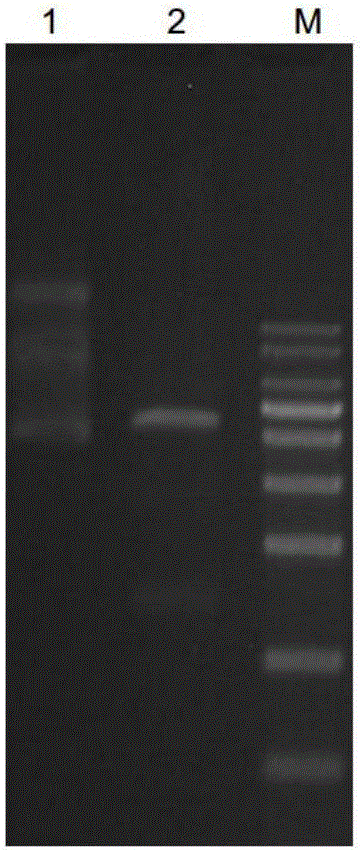
[0036] 1. PCR amplification: Using Babesia Xinjiang unspecified cDNA as template, upstream primer (rRAP-1aα-CT-F): 5'-CGCATATGATCGCCATTCCAACAAAAGA-3' (SEQ ID NO.1); downstream primer (rRAP-1aα) -R): 5'-GCCAAGCTTTTCTTGAGATACCTCATCCT-3' (SEQ ID NO. 1) for PCR amplification. The reaction system is 50μL, namely: 10× buffer 5μL, dNTPs (2.5mmol / L) 4μL, upstream primer 1μL, downstream primer 1μL, template (cDNA) 2μL, sterilized water 36.5μL, Taq enzyme (Takara, RR001A) ( 5U / μL) 0.25μL.
[0037] After centrifugation and mixing, it was placed in a PCR automatic amplification instrument, and pre-denatured at 94°C for 5 minutes, and the following cycles were carried out: 94°C for 1 minute, 55°C for 30s, 72°C for 45s, after 35 cycles, 72°C for 10 minutes. Load 5 μL of the PCR product and perform electrophoresis in an agarose gel (80-100V). If the size of the amplified product fragment is consistent with the expected target fragment size, it can be use...
Embodiment 2
[0075] Example 2 Construction of recombinant expression vector
[0076] Enzyme digestion and recovery of the target fragment and pET30a-RAP vector:
[0077] The sequenced pGEM-rap-1 plasmid and pET30a plasmid were digested with Nde I and Hind Ⅲ respectively.
[0078] The digestion system (50μL) is as follows, the target gene tube is 10×buffer K 5μL, BSA 1μL, Hind Ⅲ 2.5μL, Nde I 2.5μL, H 2 O 24μL, pGEM-rap-1 plasmid 15μL. The carrier tube is 10×buffer K 5μL, BSA 1μL, Nde I 2.5μL, Hind III 2.5μL, H 2 O 24μL, pET30a vector 15μL.
[0079] ② After the enzyme digestion mixture is centrifuged and mixed, it is digested in a 37℃ water bath for 3 hours. ③Take 3uL digestion mixture for electrophoresis observation. After digestion is complete, incubate the endonuclease in a water bath at 65°C for 15min. Use 1% agarose gel electrophoresis of the recombinant plasmid and vector digestion products to cut the desired bands. , Use Agarose Gel DNA Extraction Kit to recover and purify the target fragme...
Embodiment 3
[0087] Example 3 Induced expression of recombinant expression plasmid
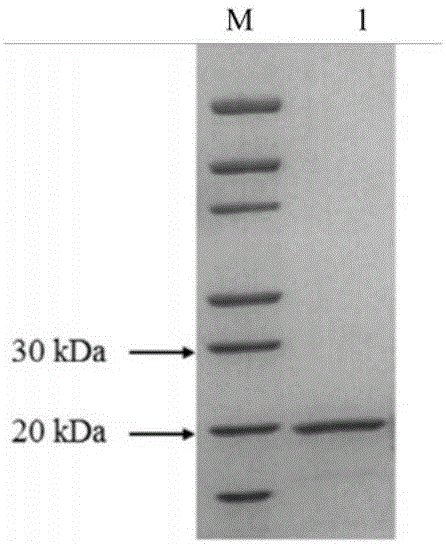
[0088] 5 μL of the recombinant bacteria after sequence analysis was inoculated into 3 mL of LB culture medium (containing 50 μg / mL carbenicillin), and shaken overnight at 37°C. Take 200μL of the overnight culture and inoculate it in 20mL of LB broth (containing 50μg / mL carbenicillin), shake vigorously to OD 600 When it was 0.6-1.0, IPTG was added to a final concentration of 1mmol / L, and expression was induced at 37°C. The bacterial solution was collected at the 4th hour, and analyzed by polyacrylamide gel electrophoresis (SDS-PAGE) and Western blotting to detect the expression product. At the same time, the uninduced bacterial liquid was used as a negative control.
PUM
 Login to View More
 Abstract
Description
Claims
Application Information
 Login to View More