Method for identifying salt tolerance of sweet potatoes in seedling stage

An identification method and salt tolerance technology are applied in the field of salt tolerance identification in sweet potato seedling stage, which can solve the problems of slow seedling return and difficult survival in sweet potato seedling stage, and achieve the effects of accurate and credible results, easy mastery and high efficiency.

CN108241043APending Publication Date: 2018-07-03CROP RES INST SHANDONG ACAD OF AGRI SCI
3 Cites 9 Cited by

Patent Information

Authority / Receiving Office
CN · China
Current Assignee / Owner
Publication Date
2018-07-03

Smart Images

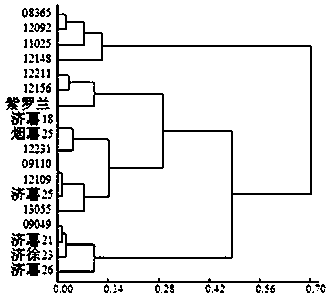
  • Figure 1
    Figure 1
  • Figure 2
    Figure 2
  • Figure 3
    Figure 3
Patent Text Reader

Abstract

The invention belongs to the technical field of agricultural production, and particularly relates to a method for identifying the salt tolerance of sweet potatoes in the seedling stage. The method comprises the following steps: (1) salt stress treatment for sweet potatoes in the seedling stage; (2) physiological indicator detection for sweet potatoes in the seedling stage; (3) data analysis and salt tolerance division; (4) salt tolerance mathematical evaluation equation and salt tolerance index screening, namely stepwise regression analysis by using the salt tolerance comprehensive evaluationvalue D value as a dependent variable and the salt tolerance coefficient of each single index as an independent variable to establish a regression equation, and salt tolerance division according to the comprehensive salt tolerance D value. According to the method, the standard equation result is accurate and reliable, the operation is simple and convenient and is easy to grasp, the method is lessinfluenced by the outdoor environment, the condition is controllable, the comprehensive salt tolerance of sweet potatoes in the seedling stage can be overall reflected, and the result is reliable. Themethod can be used for quickly evaluating the salt tolerance of sweet potato varieties in the seedling stage, has small blindness and high efficiency, and provides germplasm materials to sweet potatosalt tolerance variety seedling and salty land development and utilization in the Yellow River Delta.
Need to check novelty before this filing date? Find Prior Art

Description

technical field

[0001] The invention belongs to the technical field of agricultural production, and in particular relates to a method for identifying the salt tolerance of sweet potato seedlings. Background technique

[0002] There are nearly 8 million mu of unused saline-alkali land and more than 11 million mu of low-yield fields in the Yellow River Delta. Soil salinization is the main factor limiting agricultural production in this region. Sweet potato is an important food, feed, industrial raw material and new energy crop in China. Cultivating and screening salt-tolerant sweet potato varieties and realizing large-scale planting of sweet potato in saline-alkali land will produce better economic and ecological benefits. Predecessors have done some research on the selection of salt-tolerant sweet potato varieties. For example, Guo Xiaoding et al., based on the yield, screened out 14 salt-tolerant varieties such as Lushu No. 1 and Shanshu No. 1 under field conditions; Dong Ji...

Examples

Embodiment 1

[0034] (1) Salt stress treatment at sweet potato seedling stage

[0035] Potato seedlings with a uniform length of 25 cm were selected for each variety (line) and planted in a nutrient pot with a diameter of 16 cm. The substrate in the pot was soil, vermiculite and humus (v / v / v=1:1:1 ), one potato seedling was planted in each pot; the control and salt stress treatments were set up, the control treatment was cultured with 1 / 2 Hoagland nutrient solution, and the salt stress treatment was cultured with 200 mmol·L -1 1 / 2 Hoagland nutrient solution culture with NaCl, in which the NaCl concentration was increased by 50 mmol·L per day -1 , reached the final treatment concentration at the same time (4th day), the nutrient solution was replaced each time, and the nutrient solution was replaced every 3 days after reaching the final salt concentration, and the continuous treatment was 8 days; each treatment was repeated 12 pots and placed in 68 cm × 52 cm × 22 cm (length × width × heigh...