
An RFID tag random number synchronous updating method
An RFID tag, synchronous update technology, applied in the field of radio frequency identification, can solve the problem of high cost of tag production, achieve the effect of saving communication overhead, resisting attacks, and fast computing
- Summary
- Abstract
- Description
- Claims
- Application Information
AI Technical Summary
Problems solved by technology
Method used
Image

Examples
Embodiment Construction
[0023] The present invention will be further described below in conjunction with specific embodiment:
[0024] In the method for synchronously updating the random number of the RFID tag described in this embodiment, CRC is used as the encryption algorithm of the RFID.
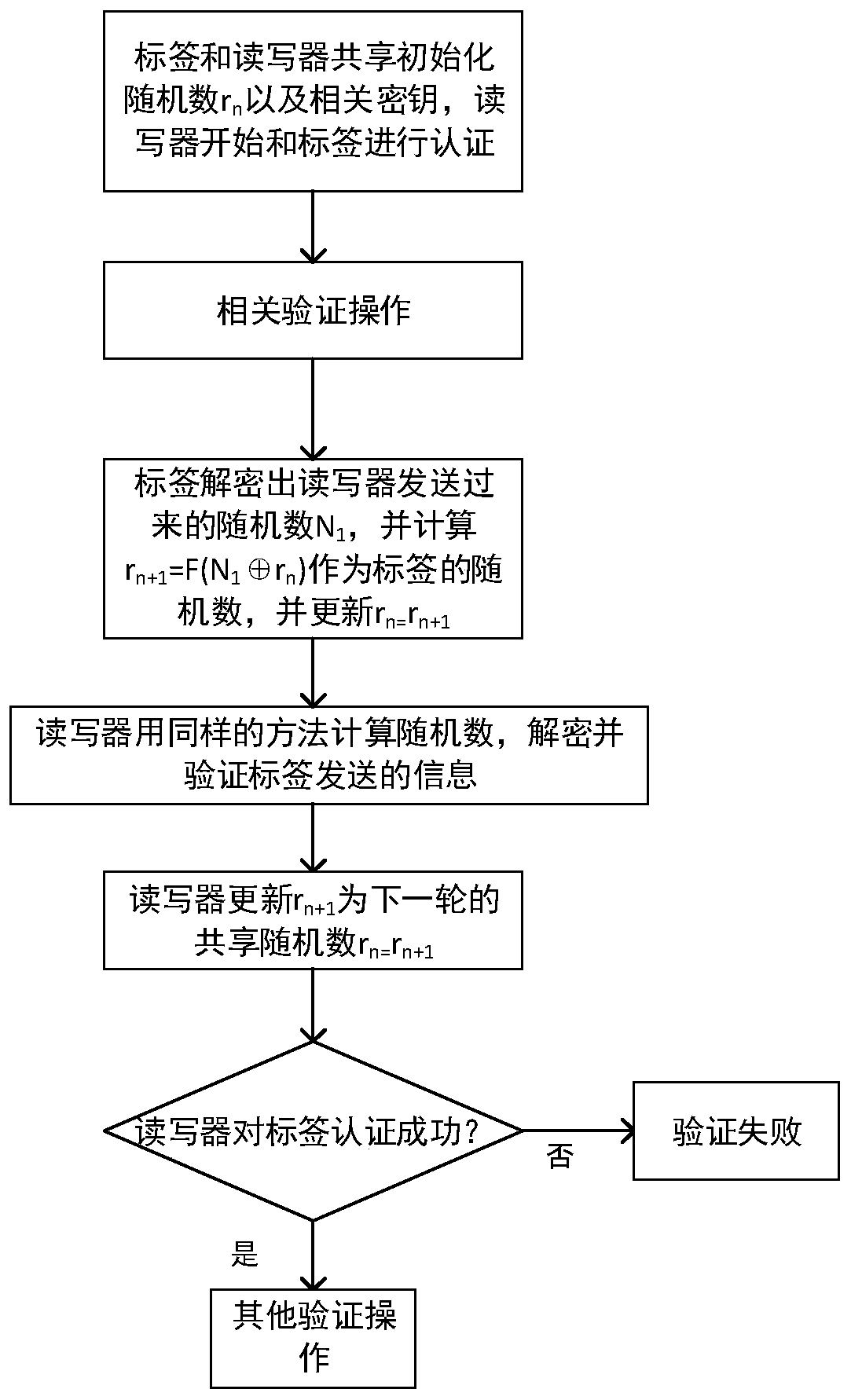
[0025] Such as figure 1 As shown, the specific steps are as follows:
[0026] S1: The tag reader first shares a random number r n and related encryption keys, and then the reader and tag perform related authentication operations;
[0027] S2: In the authentication stage of the reader to the tag, the reader first generates a random number N by itself 1 , encrypted with related information and keys and sent to the tag;
[0028] S3: The tag decrypts the random number N after receiving the information 1 , and use it for new random number generation: r n+1 =F(r n ⊕N 1 ); then r n+1 Combine the key to encrypt the verification information, send it to the reader, and update the shared random number when the tr...
PUM
 Login to View More
 Abstract
Description
Claims
Application Information
 Login to View More