
A kind of resin polymer with high modulus and high glass transition temperature and preparation method thereof
A technology with high glass transition and transition temperature, applied in the field of resin-based composite materials, can solve the problems of high polymer brittleness, low glass transition temperature, and limitations, and achieve the effect of simple process and easy promotion
- Summary
- Abstract
- Description
- Claims
- Application Information
AI Technical Summary
Problems solved by technology
Method used
Image

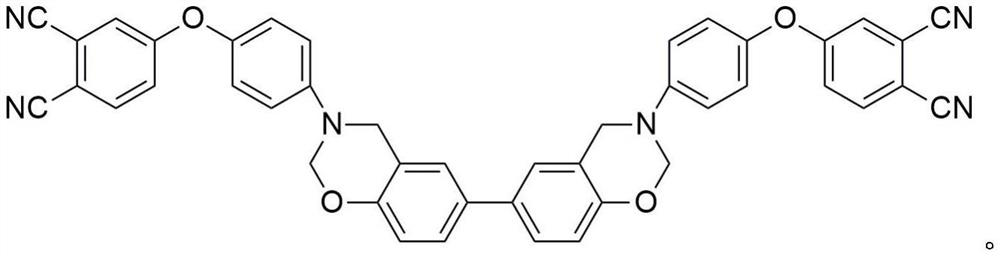
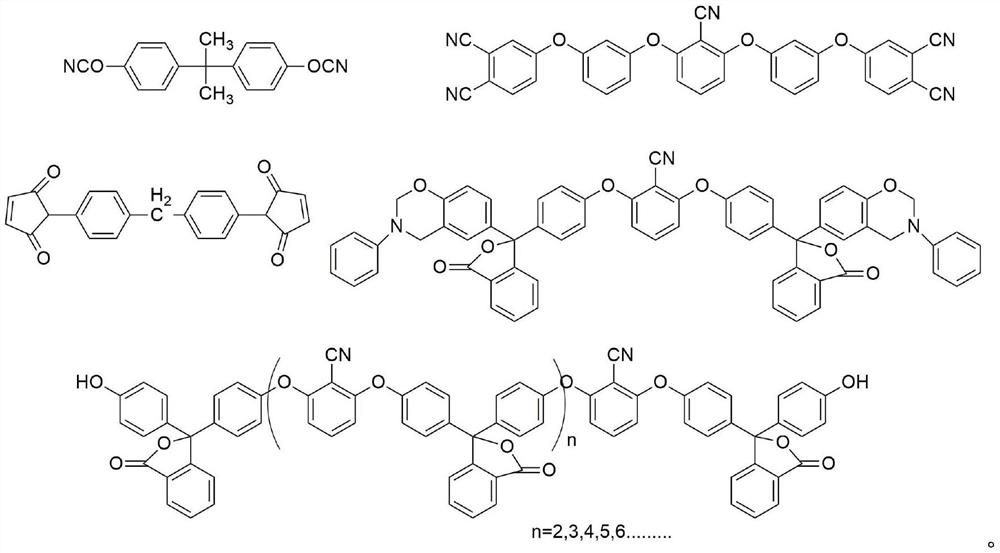
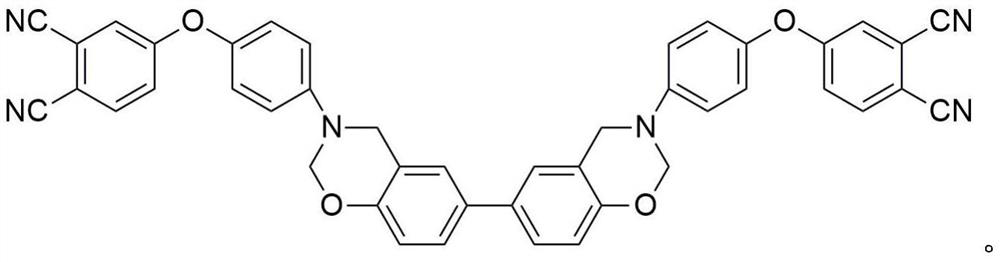
Examples
Embodiment 1
[0051] (1) 14 grams of benzide nitrile-based resin and 6 grams of expanded agent (a dominated ether) were sequentially added to 15 ml N, N-dimethylformamide, resulting in a uniform transparent solution;
[0052] (2) 2 ml of toluene solvent is added to the uniform solution in (1), and the reflux temperature of the regulatory system is in the range of 120-155 ° C;
[0053] (3) The resulting solution system was slowly warmed, and the control system temperature was stirred in the range of 130-140 ° C for 2 hours, and the viscosity was weakly lifted uniform solution;
[0054] (4) Continue to increase the temperature to 150-155 ° C in (3), stir vigorously, and maintain the system temperature stirring reaction for 2 hours to obtain a viscosity of viscosity and increased viscosity;;
[0055] (5) Maintain the stirring rate, adjust the reaction device, receive a sewer device, and slowly evaporated the mixed solvent, and the viscosity of the reaction solution is significantly increased, and ...
Embodiment 2
[0060] (1) 14 grams of benzoxazine-based resin and 5 grams of expanded agent (bisphenol C) were sequentially added to 15 mln, N-dimethylformamide, resulting in a uniform transparent solution;
[0061] (2) 2 ml of toluene solvent is added to the uniform solution in (1), and the reflux temperature of the regulatory system is in the range of 120-155 ° C;
[0062] (3) The resulting solution system is slowly warmed, and the control system temperature is stirred in the range of 130-140 ° C for 1 hour, resulting in a uniform solution having a weak increase in viscosity;
[0063] (4) Continue to increase the temperature to 150-155 ° C in (3), stir vigorously, and maintain the system temperature stirring reaction for 3 hours to obtain a viscosity of viscosity and increased viscosity;;
[0064] (5) Maintain the stirring rate, adjust the reaction device, receive a sewer device, and slowly evaporated the mixed solvent, and the viscosity of the reaction solution is significantly increased, and...
Embodiment 3
[0069] (1) 14 grams of phenylphenylzanitrile-based resin and 4 grams of expansion agent (phenolphthalene aromatic ether nitrile) were sequentially added to 20 mL N, N-dimethylformamide to obtain a uniform transparent solution;
[0070] (2) 3 ml of toluene solvent is added to the homogeneous solution in (1), and the reflux temperature of the regulatory system is in the range of 120-155 ° C;
[0071] (3) The resulting solution system was slowly warmed, and the control system temperature was stirred in the range of 130-140 ° C for 2 hours, and the viscosity was weakly lifted uniform solution;
[0072] (4) Continue to increase the temperature to 150-155 ° C in (3), stir vigorously, and maintain the system temperature stirring reaction for 3 hours to obtain a viscosity of viscosity and increased viscosity;;
[0073] (5) Maintain the stirring rate, adjust the reaction device, receive a sewer device, and slowly evaporated the mixed solvent, and the viscosity of the reaction solution is s...
PUM
| Property | Measurement | Unit |
|---|---|---|
| modulus | aaaaa | aaaaa |
| storage modulus | aaaaa | aaaaa |
| glass transition temperature | aaaaa | aaaaa |
Abstract
Description
Claims
Application Information
 Login to View More