Method for detecting nanovolt-level weak sinusoidal signals by chaotic system based on principal component analysis

A principal component analysis and chaotic system technology, applied in the field of chaotic system detection of nanovolt-level weak sinusoidal signals, can solve the problems of large difference in magnitude of eigenvalues ​​and limited detection ability of weak signals, etc., to improve detection ability and simple operation Effect

CN111190049AActive Publication Date: 2020-05-22LUOYANG NORMAL UNIV
4 Cites 3 Cited by

Patent Information

Authority / Receiving Office
CN · China
Current Assignee / Owner
Publication Date
2020-05-22

Smart Images

  • Figure 1
    Figure 1
  • Figure 2
    Figure 2
  • Figure 3
    Figure 3
Patent Text Reader

Abstract

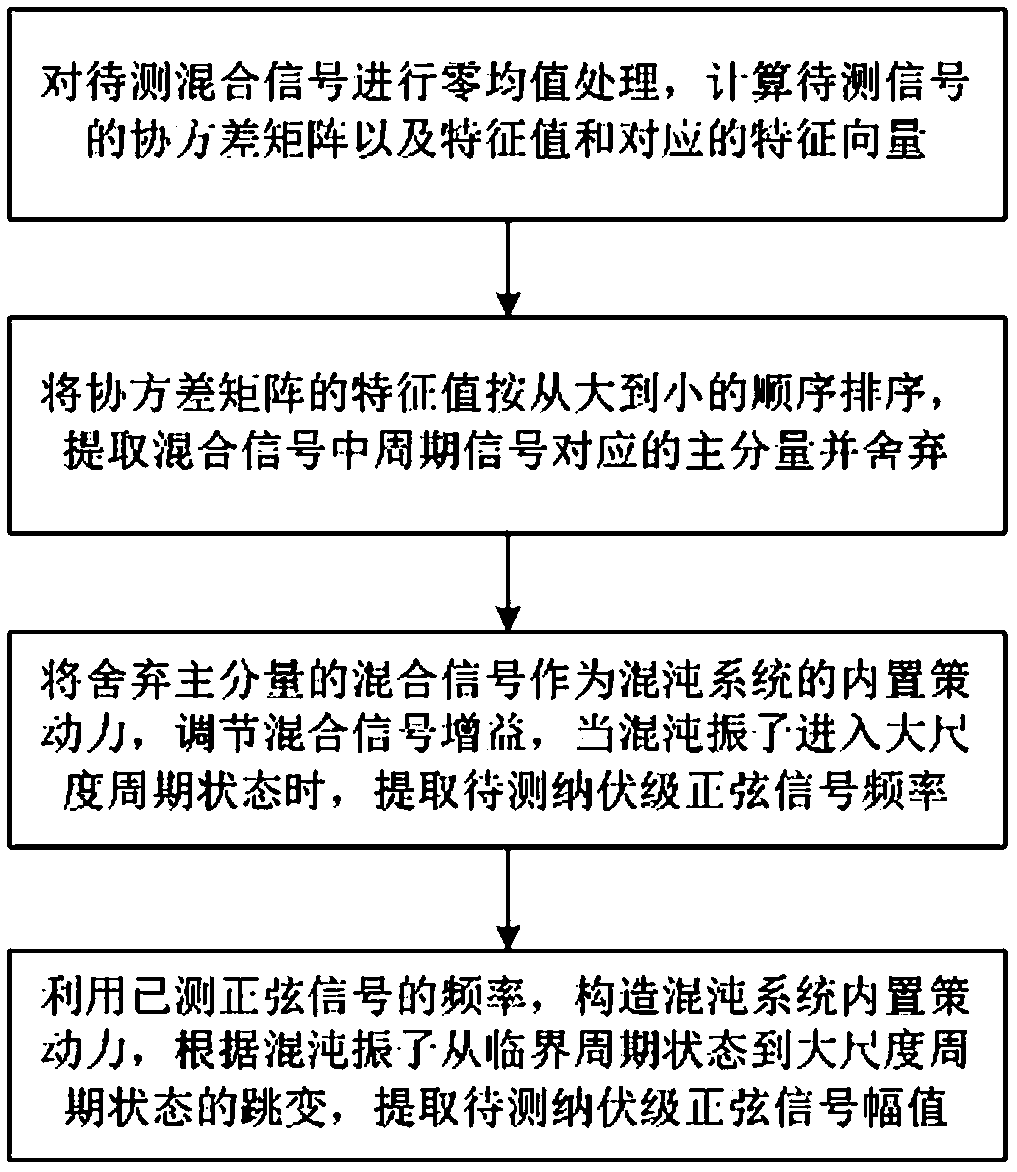
The invention relates to a method for detecting nanovolt-level weak sinusoidal signals by a chaotic system based on principal component analysis, and a principal component analysis technology is introduced to overcome the limitation that an existing chaotic system detects the nanovolt-level weak sinusoidal signal in a mixed signal. The method comprises carrying out zero-mean preprocessing on the to-be-measured mixed signal, and solving a covariance matrix, a characteristic value and a corresponding characteristic vector of the to-be-measured signal; arranging the characteristic values of the covariance matrix from large to small, extracting a main component corresponding to a periodic signal in the mixed signal, and abandoning the main component; taking the mixed signal of the abandoned principal component as a built-in driving force of the chaotic system, and detecting the frequency of a weak sinusoidal signal according to the phase state change of a chaotic oscillator; and extractingthe amplitude of the nanovolt sinusoidal signal to be measured according to the jump of the chaotic oscillator from the critical periodic state to the large-scale periodic state. According to the method, influence of other periodic signals in the mixed signals on weak sinusoidal signal detection of the chaotic system is reduced, the detection capability of the chaotic system is improved, and theoperation is simple and feasible.
Need to check novelty before this filing date? Find Prior Art

Description

technical field

[0001] The invention belongs to the technical field of measurement, and relates to a method for detecting nanovolt-level weak sinusoidal signals by a chaotic system of principal component analysis. Background technique

[0002] At present, weak signal detection technology is a comprehensive technology and frontier field in signal processing. Due to the universality of Fourier series, the detection of sinusoidal signals in the background of strong noise has attracted much attention. At present, the research on the theory and method of nanovolt-level weak sinusoidal signal detection not only has great theoretical significance, but also has urgent needs and important practical significance in the fields of remote sensing measurement, fault diagnosis, system identification, physics, and biomedicine.

[0003] The sensitivity of chaotic system to periodic signal and immunity to noise make it play an important role in many weak signal detection techniques. The wea...

Examples

Embodiment

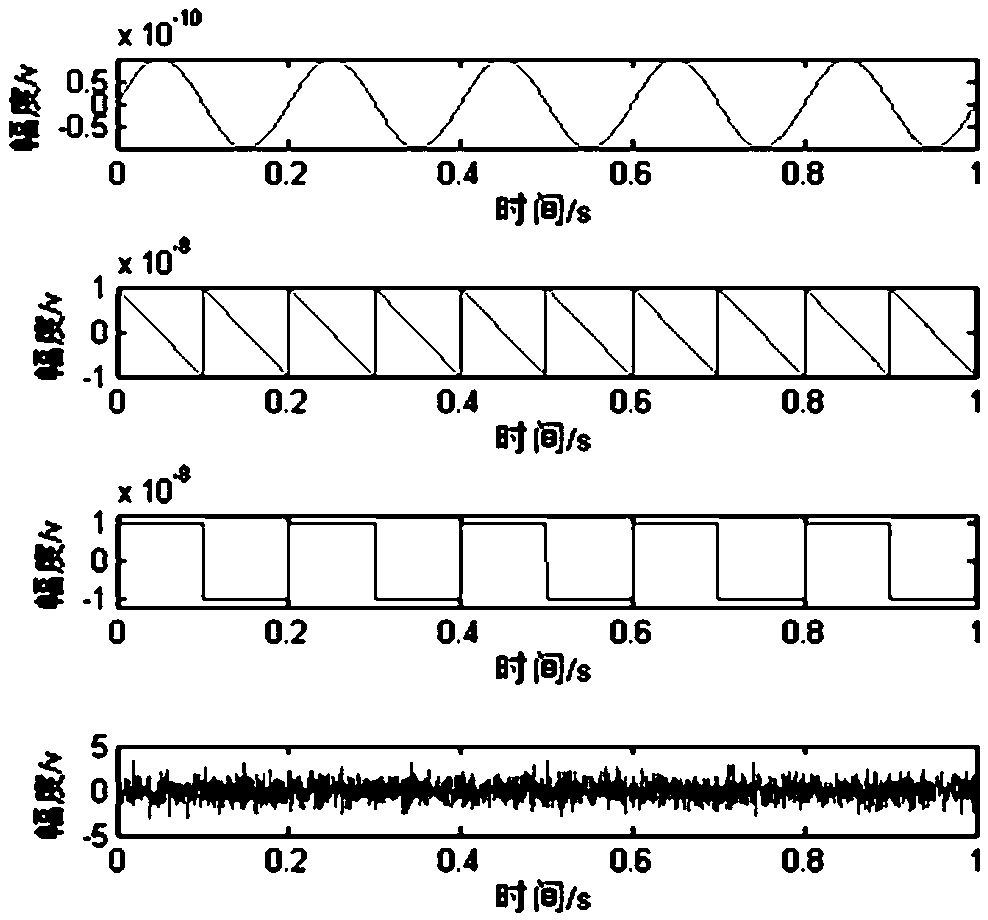
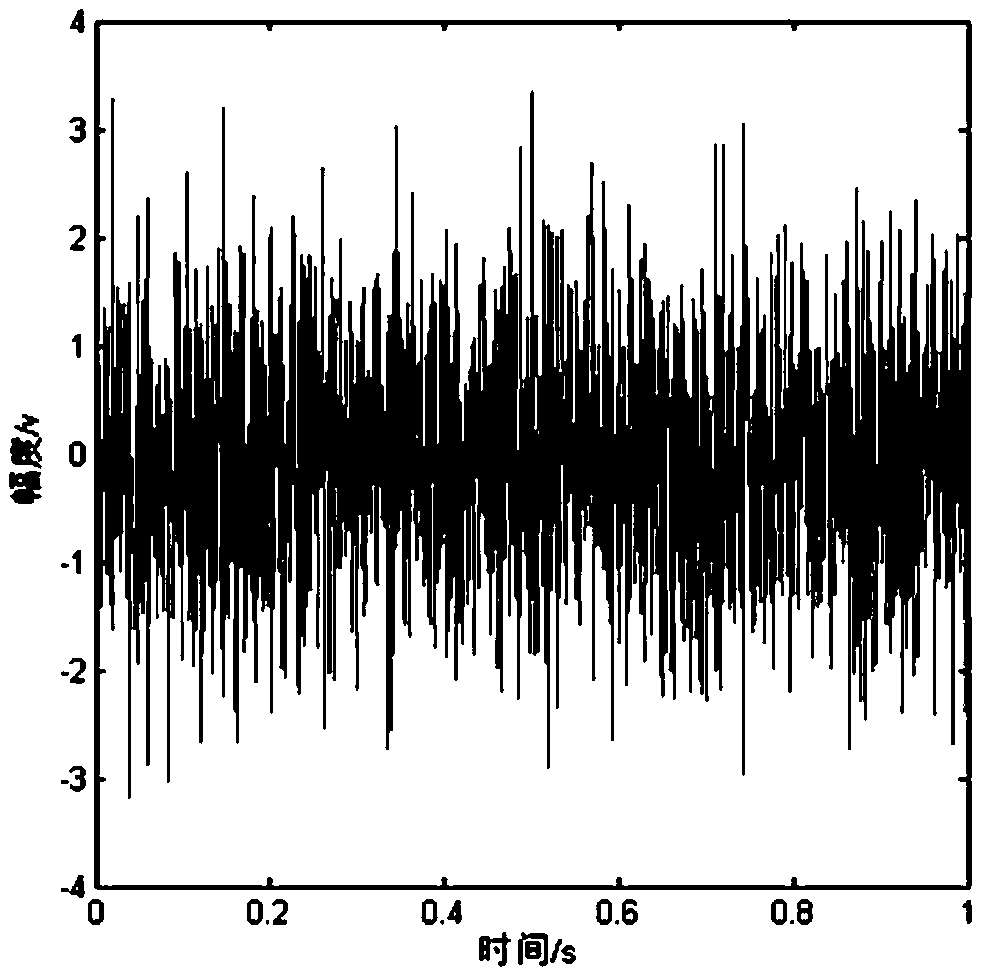
[0068] Suppose the nanovolt level weak sinusoidal signal to be measured is s(t)=msin(10πt), where the amplitude m=10 -10 V, the frequency is 5Hz; the background noise is composed of three signal sources, that is, the amplitude is 10 -9 V, a periodic triangular wave signal with a frequency of 10Hz; the amplitude is 10 -8 V, a periodic square wave signal with a frequency of 5Hz; the power is 9×10 -19 Gaussian white noise for W. The three signal sources in the nanovolt-level sinusoidal signal to be tested and the background noise are all linearly superimposed and mixed. The mixed signal to be tested and its composition are as follows figure 1 shown.

[0069] To perform principal component analysis on the mixed signal to be tested, first zero-mean the mixed signal, and calculate the corresponding covariance matrix according to formula (2); sort the eigenvalues ​​of the covariance matrix from large to small, and use the formula Sub(3) extracts the principal component of the mi...