
Medicine for preventing and treating heart failure after myocardial ischemia and application thereof
A myocardial ischemia and drug technology, applied in the field of drugs, can solve problems such as no research reports on the prevention and treatment of myocardial infarction with glucosamine.
- Summary
- Abstract
- Description
- Claims
- Application Information
AI Technical Summary
Problems solved by technology
Method used
Image

Examples
Embodiment 1
[0023] Example 1 GlcN effectively improves cardiac function after myocardial infarction
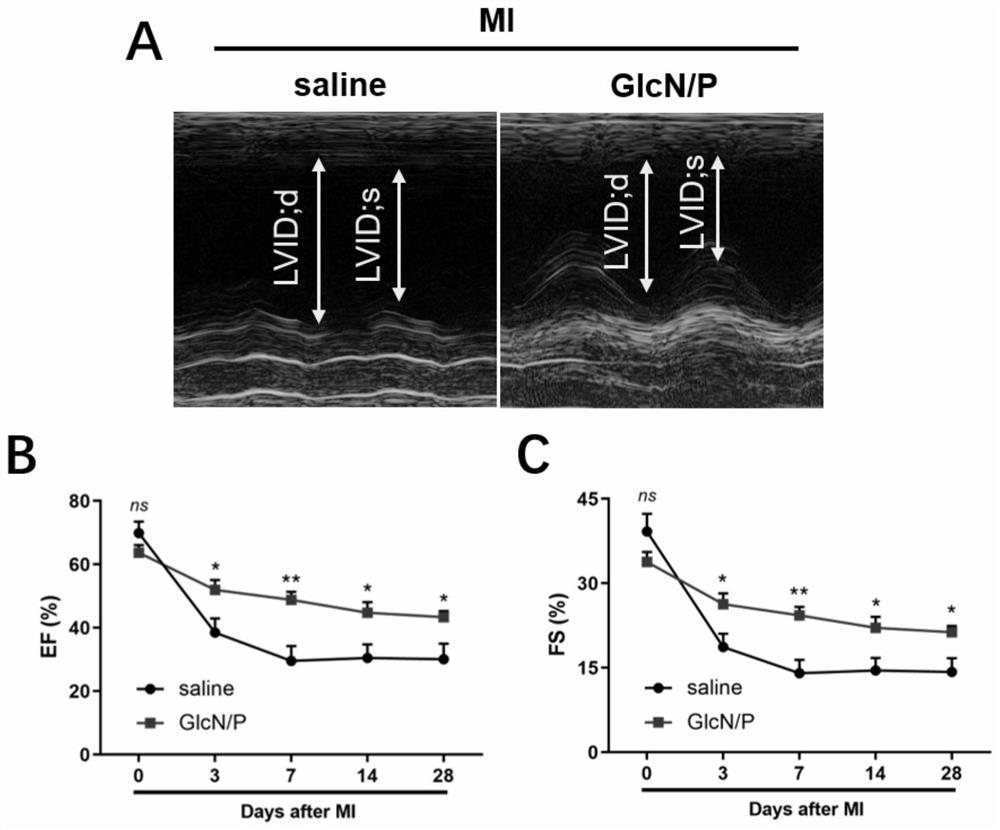
[0024] Cardiac function after myocardial infarction detected by echocardiography
[0025] Mice were anesthetized (the same method as before), placed in the left lateral position after depilation, placed the probe of the cardiac ultrasound diagnostic instrument on the anterior wall of the heart, and took a two-dimensional short-axis view of the left ventricle at the level of the papillary muscle, and recorded M-scan at the same time, for 3 consecutive Cardiac cycle measurements of left ventricular ejection fraction (EF) and fractional shortening (FS).
[0026] Experimental results: Cardiac function was detected 28 days after myocardial infarction, and the GlcN prevention and treatment group significantly improved cardiac function after myocardial infarction ( figure 1 A), ejection fraction ( figure 1 B) and minor axis shortening ( figure 1 C) Significantly improved. * P P < 0.01.
Embodiment 2
[0027] Example 2: GlcN effectively slows down ventricular dilatation after myocardial infarction
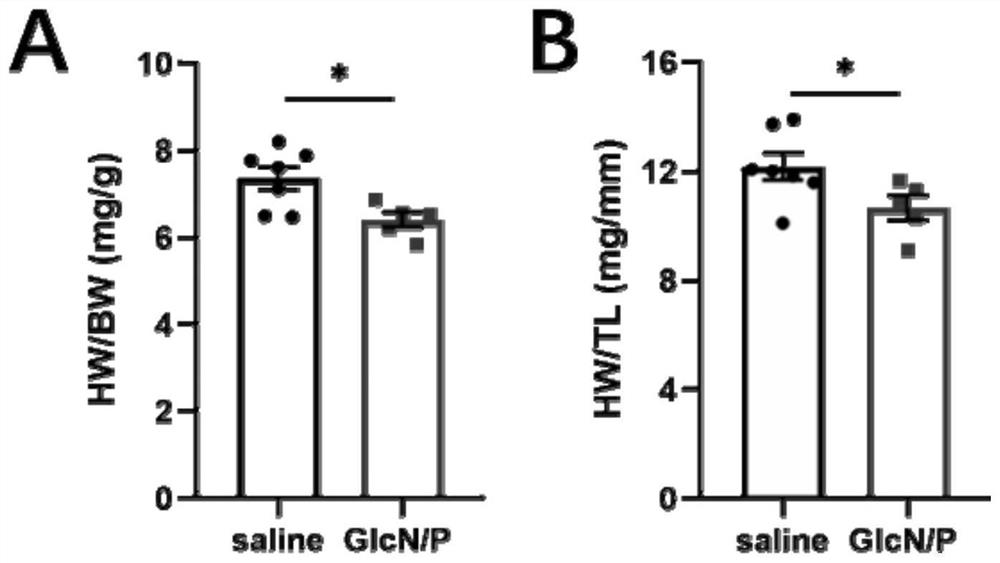
[0028] The mice were sacrificed 56 days after the operation, and the body weight (BW), heart weight (HW) and tibia length (TL) of the mice were measured; HW / BW ( figure 2 A) and HW / TL ( figure 2 B). Experimental results: the degree of heart dilation in the GlcN prevention and treatment group was relatively small ( figure 2 ); *P < 0.05.
Embodiment 3
[0029] Example 3: GlcN effectively reduces the size of myocardial infarction
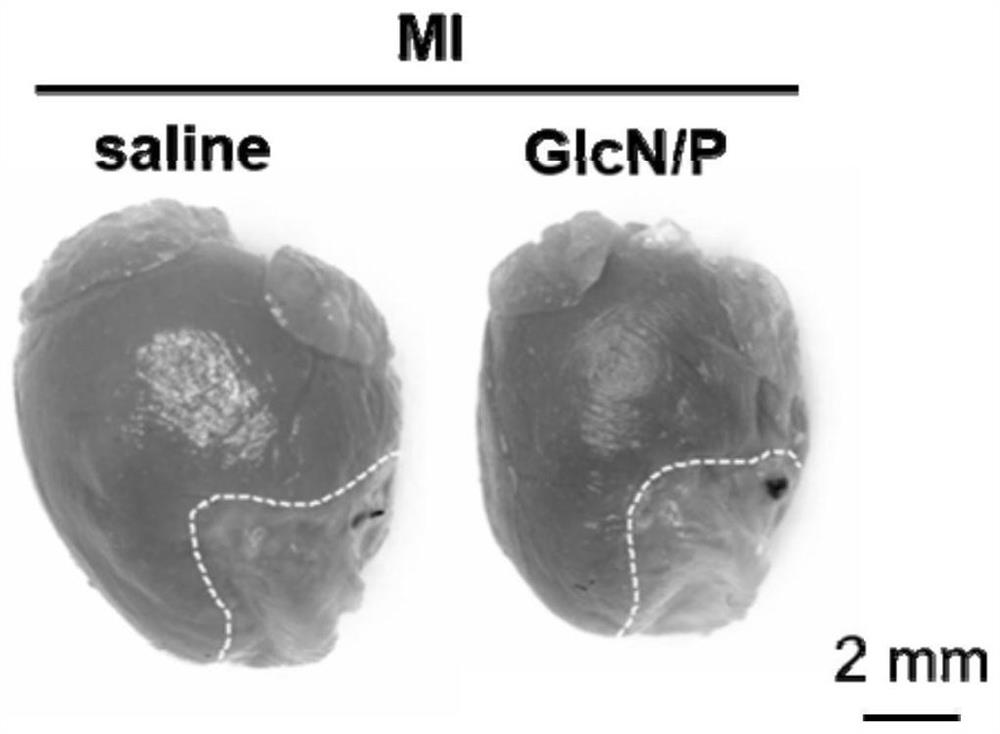
[0030] Masson staining: the mice were sacrificed 56 days after the operation, and the left ventricle tissue was taken for cardiac tissue staining to observe the therapeutic effect. Follow the routine Masson staining procedure, observe and take pictures under an ordinary light microscope. The image analysis software Image J was used to analyze the area of each part, and the myocardial infarction area / heart area was calculated. Experimental results: Holistic view of the heart ( image 3 ), location of myocardial infarction and section ( Figure 4 A), Masson staining was used to observe the myocardial infarction surface 56 days after myocardial infarction in each group ( Figure 4 B), infarct size ( Figure 4 C), it was found that the GlcN prevention and treatment group significantly reduced the size of myocardial infarction; *P < 0.05.
[0031] 【Conclusion】The results of the above experiments c...
PUM
 Login to View More
 Abstract
Description
Claims
Application Information
 Login to View More