Provision of services via an information technology network

a technology of information technology and network, applied in the direction of data switching network, wireless communication, wireless communication, etc., can solve the problems of difficult communication with or between information devices via such ports, future be appropriate, blurred distinction between different types of portable information devices,

US20020142769A1Inactive Publication Date: 2002-10-03HEWLETT-PACKARD ENTERPRISE DEV LP
11 Cites 21 Cited by

Patent Information

Authority / Receiving Office
US · United States
Current Assignee / Owner
Publication Date
2002-10-03
Estimated Expiration
Not applicable · inactive patent

Smart Images

  • Figure 1
    Figure 1
  • Figure 2
    Figure 2
  • Figure 3
    Figure 3
Patent Text Reader

Abstract

Information services may be provided to a user of a personal digital assistant (PDA) via an infra red wireless communication port. The PDA recruits communication with a peer, such as a beacon, via this link, and the PDA and peer exchange messages containing the URLs of their proxies within the Internet. The proxies contact each other and negotiate, via the exchange of XML documents, parameters governing exchange of messages via the infra red link, such parameters being related inter alia to technical aspects of communication (e.g. file size, software compatibility etc.), encryption (e.g. public key information), and policy, which determines what the IR wireless link may be employed for, such as what content is sought. Negotiation between proxies is relatively rapid due to the higher bandwidth of the link between them in comparison to the IR link.
Need to check novelty before this filing date? Find Prior Art

Description

BACKGROUND TO THE INVENTION

[0001] 1. Field of the Invention

[0002] The present invention relates to the provision of services via an information technology network, such as the internet, and to the provision of services from such a network to information devices, such as portable information devices, including personal digital assistants ("PDA"), mobile telephones or portable computers.

[0003] 2. Description of Related Art

[0004] In recent years there has been a substantial commercial uptake in the use of portable information devices. Mobile telephones are now ubiquitous in most technologically developed countries, and increasingly provide information processing capability beyond that associated directly with the making of telephone calls, with some mobile telephones now incorporating an electronic personal organiser. Similarly PDAs have evolved from simply being an electronic personal organiser to incorporate capabilities such as the ability to play MP3 music files. Notebook computers...

Examples

Embodiment Construction

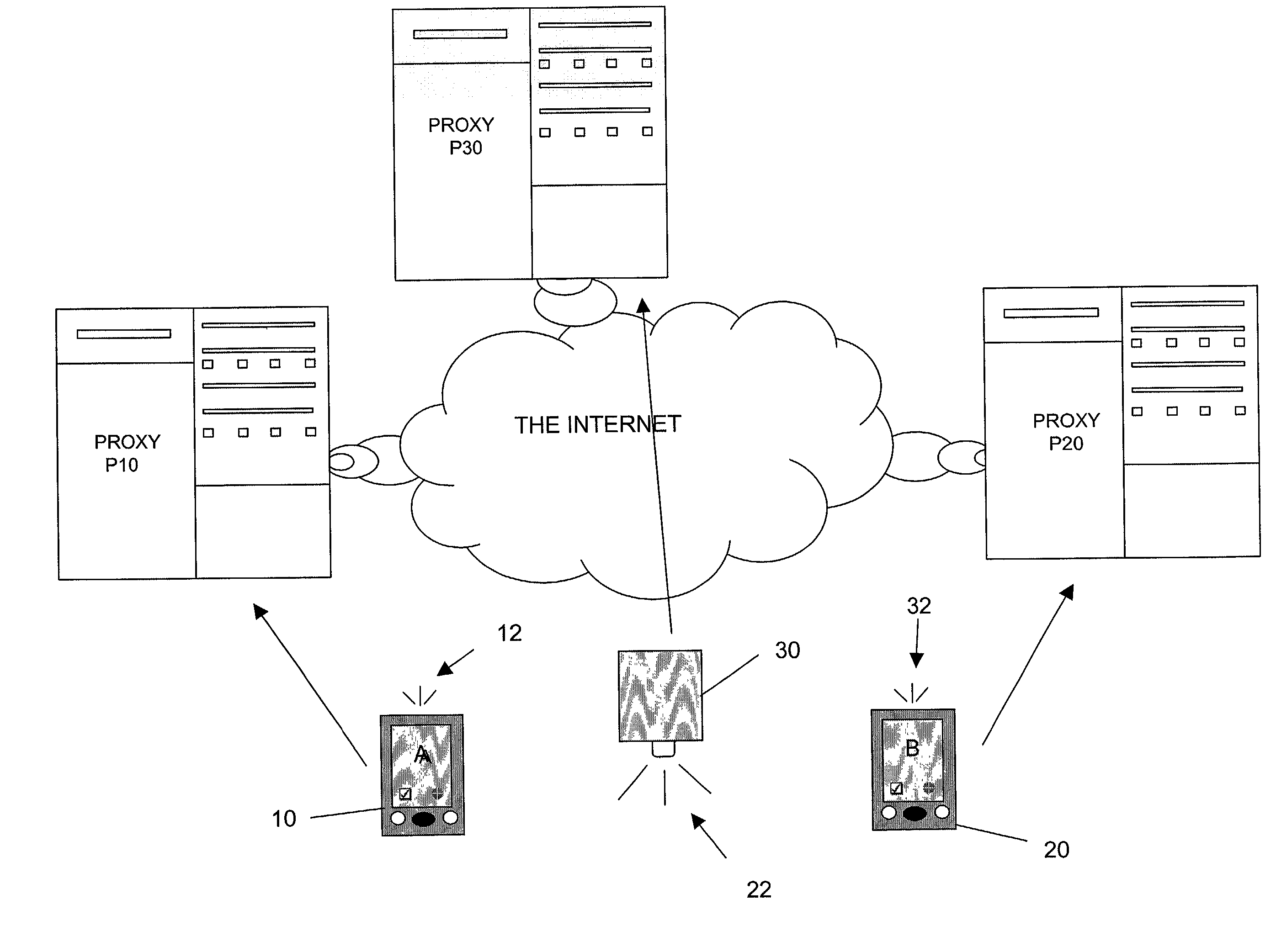
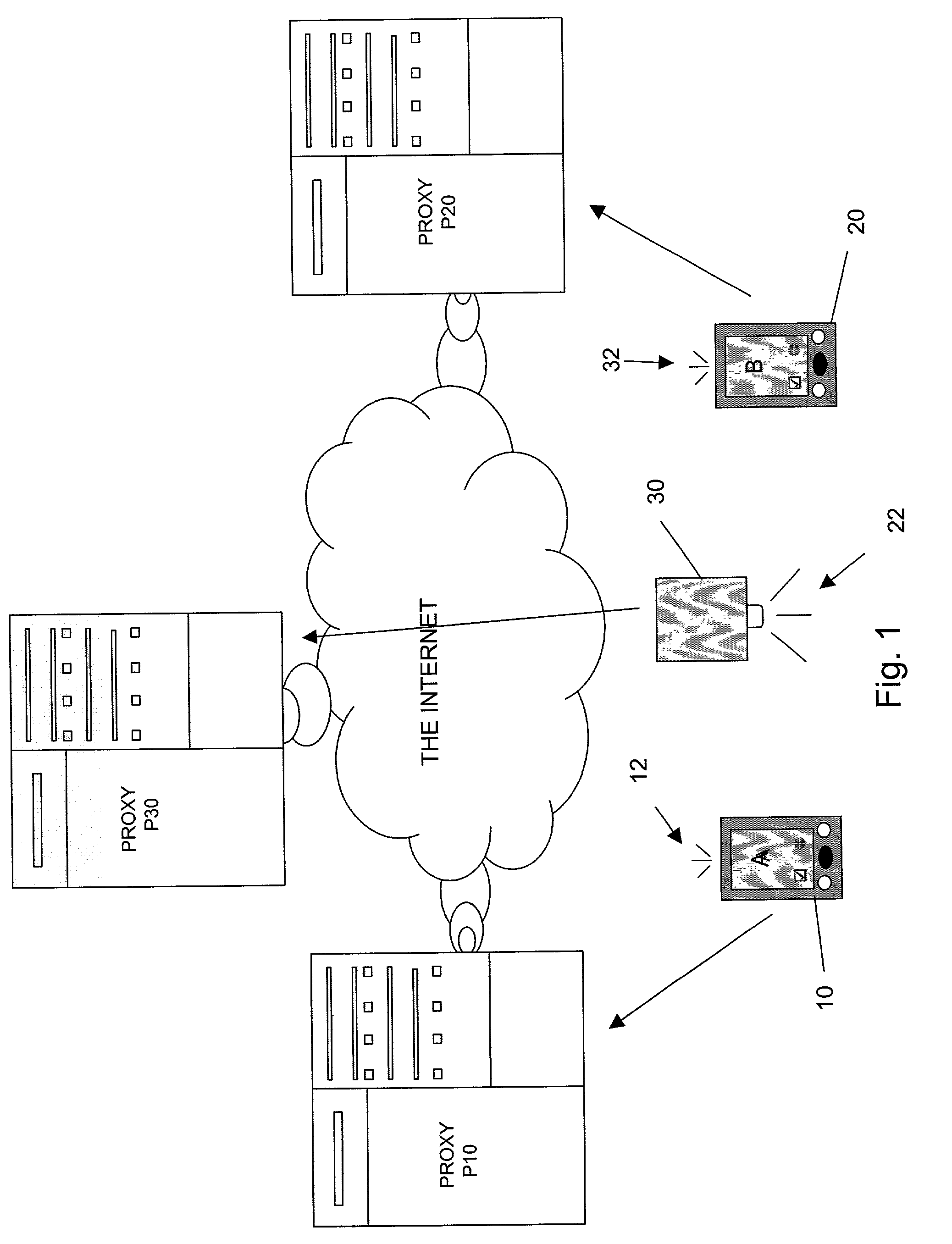
[0034] Referring now to FIG. 1, a simple scenario contemplated by the present invention has three information devices 10, 20, 30, two of which, 10 and 20, are portable, while the third, 30, has a fixed location. A first user, who is the owner of portable information device 10, here having the form of a personal digital assistant ("PDA") 10, encounters a second user, the owner portable device 20, which in the present example is also a PDA. Both users are also within range of the fixed information device 30, here having the form of a beacon 30. Each of the information devices 10, 20, 30 have a wireless communication port 12, 22, 32, which in this example is an infra red communication port. Typically all such ports conform to a standard known as IRDA, and so accordingly the protocol governing the manner in which communications using such ports are to be established, maintained and then terminated is well understood, meaning that the transmission and receipt per se of data between two s...