[0022] In view of the foregoing disadvantages inherent in the known types of water treatment systems and methods now present in the prior art, the present invention provides an improved system and method to treat water using
nitrogen gas that is injected though an injector means, preferably but optionally a venturi injector, to facilitate
deoxygenation of the water and overcomes the disadvantages and drawbacks noted in the prior art. As such, the
general purpose of the present invention, which will be described subsequently in greater detail, is to provide a new and improved system and method for water treatment which has all the advantages of the prior art mentioned heretofore and many novel features that result in a system and method for water treatment which is not anticipated, rendered obvious, suggested, or even implied by the prior art, either alone or in any combination thereof.
[0027] It is therefore an object of the present invention to provide a new and improved system and method for water treatment that has the advantages of the prior art water treatment apparatuses and methods plus additional advantages and benefits.
[0028] Still another object of the present invention is to provide a new system and method of water treatment that provides in the systems and methods of the prior art some of the advantages thereof, while simultaneously overcoming some of the disadvantages normally associated therewith.
[0029] Still yet another object of the present invention is a system that provides for the use of nitrogen and thus offers more efficient nitrogen delivery than other traditional sparging or bubble
diffusion nitrogen
delivery methods. This allows for an economically favorable and efficient manner by which to limit the environmentally adverse effects that may result when the untreated water is released into an environment that is ecologically different from that in which the water was originally obtained.
[0030] Even still another object of the present invention is to provide a system and method of water treatment for allowing a vessel to treat water with nitrogen gas that is injected into a
stream of the water, preferably but optionally, by a venturi injector. This makes it possible to efficiently treat water, preferably but optionally ballast water, while providing corrosion inhibition, thereby decreasing the overall maintenance and costs associated with the water treatment.
[0032] It is a further object of the present invention to provide a new and
improved method for deoxygenating water, preferably but not limited to the purposes of inhibiting the survival of
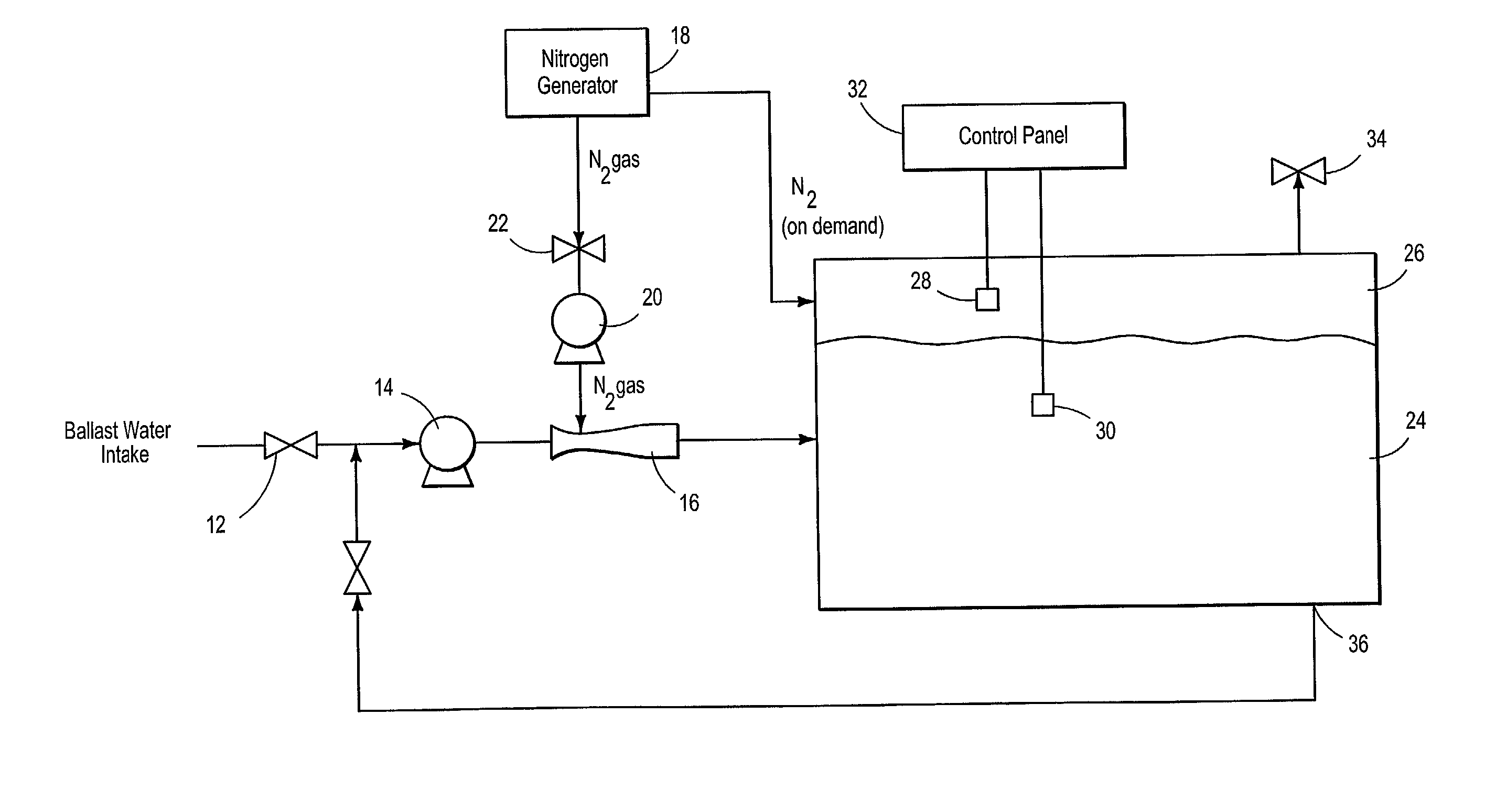
aquatic organisms and / or corrosion inhibition. The method comprises utilizing an injector means, preferably but optionally a venturi injector, having an inlet port that is adapted to receive water, an injector port that is adapted to receive nitrogen gas, and an outlet port that is adapted to expel the water where water to be treated is supplied to the inlet port and nitrogen gas, preferably but optionally comprised of at least 90% nitrogen, is supplied to the injector port, thereby inducing within the water a myriad of micro-fine bubbles wherein oxygen in the water diffuses from an aqueous phase to a gaseous phase within said micro-fine bubbles. The method further involves expelling the water and the micro-fine bubbles from the outlet port of the injector means to a receptacle, which is preferably but optionally a
ballast tank, wherein the micro-fine bubbles are released from the water and the oxygen is thereby diffused from the water. The method for deoxygenating water may further comprise re-circulating said water through the injector means to provide further deoxygenation, and may also include re-oxygenating the water before releasing the water to the surrounding waterways from the receptacle, which is preferably but optionally a
ballast tank, or alternatively, but not exclusively, a closed tank or a water conduit connecting to surrounding waterways.
[0034] Lastly, it is an object of the present invention is to provide a new and improved system and method for water treatment that has a relatively low cost of manufacture with regard to both materials and labor, and which accordingly is then capable of relatively low prices of sale to the consuming public and industries.


 Login to View More