
Gene delivery system and methods of use
a technology of gene delivery and retrovirus, applied in the field of viral vectors, can solve the problems of insufficient transduction in vivo, vectors are incapable of secondary horizontal infections of adjacent cells, and cannot encapadate their own wild type virus genome, so as to reduce or eliminate the native pathogenic potential of replication-competent retroviruses, improve the specificity of target cells, and efficient in vivo transduction
- Summary
- Abstract
- Description
- Claims
- Application Information
AI Technical Summary
Benefits of technology
Problems solved by technology
Method used
Image

Examples
example 1
Construction of Replication Competent Retroviruses
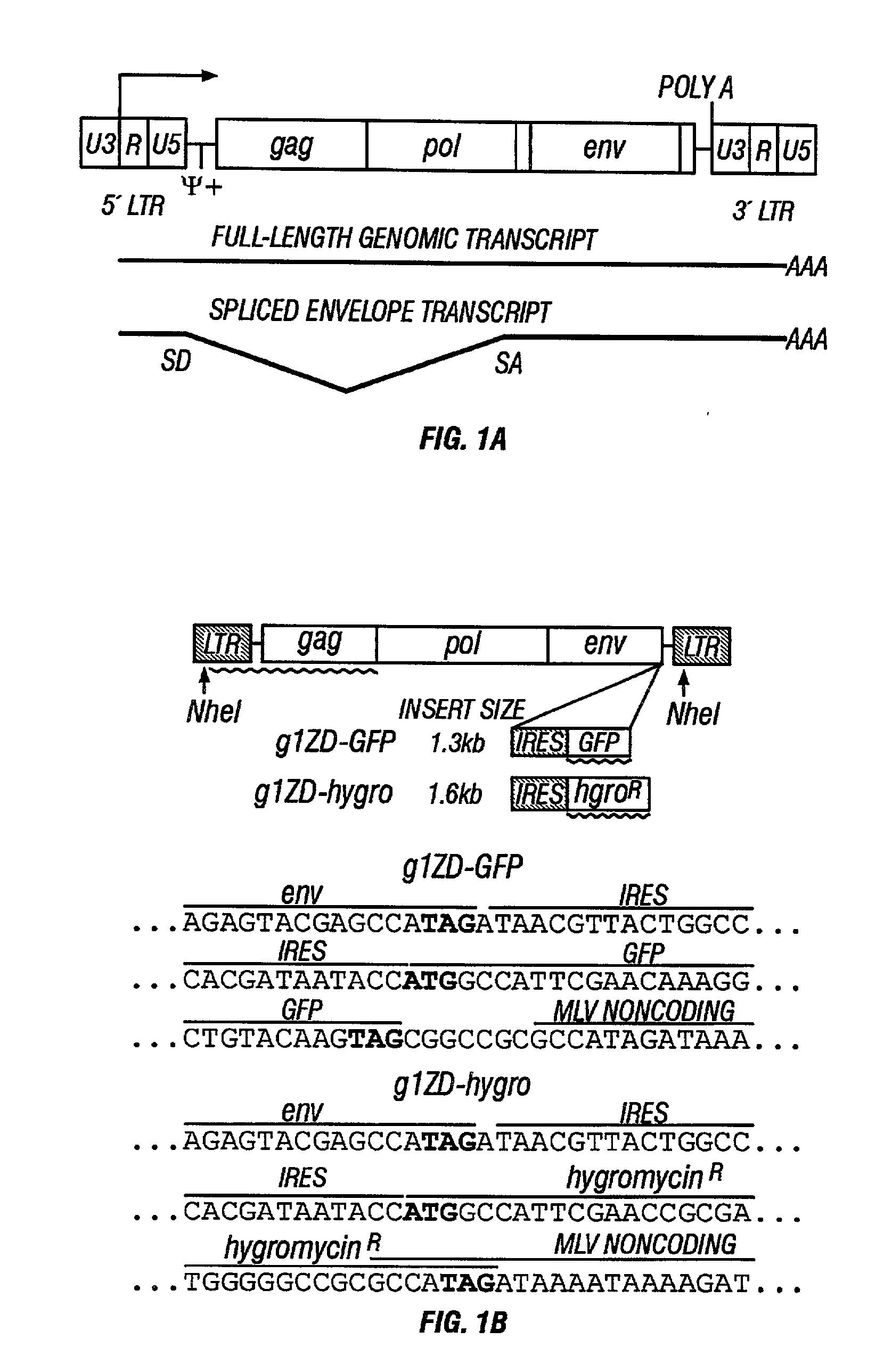
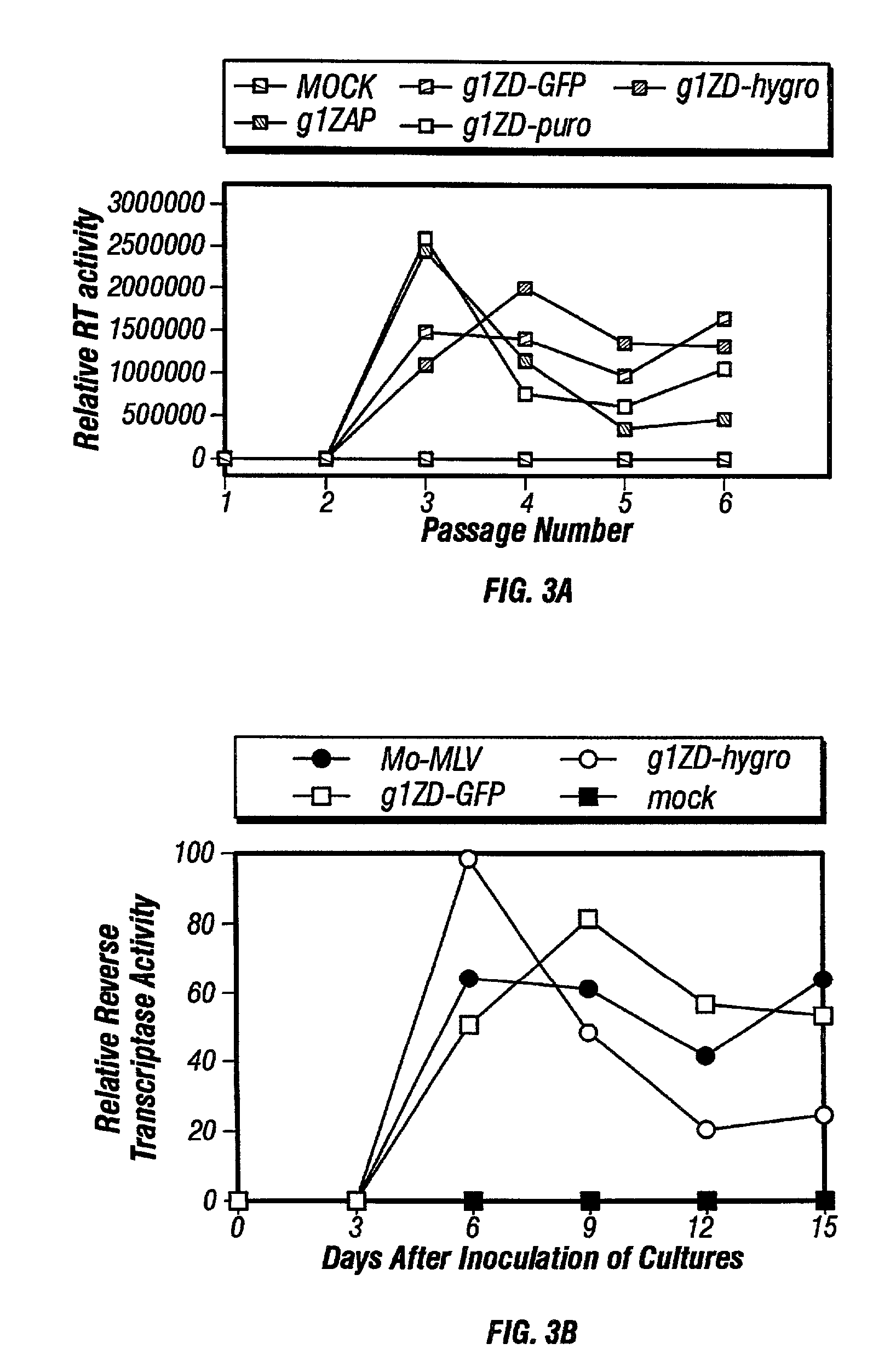
[0113] There have been few reports in the literature regarding the stability of insertions in the context of replication-competent MoMLV, and all of these have used insertion positions within the 31 long terminal repeat sequence (LTR). Most of these insertions were deleted within one or two serial passages of the virus. In this case the size and nature of the inserted sequences seemed to have little correlation with the stability of the vector, as small inserts were often deleted just as quickly as larger inserts. One important consideration may be the positioning of the insertion; as the reverse transcription process entails duplication of the U3 region of the 3′ LTR (FIG. 1), this may result in decreased stability of non-essential sequences inserted into this position.
[0114] An infectious Mo-MLV proviral clone was excised with NheI from plasmid pZAP and ligated to the plasmid backbone of retroviral vector gIZIN. The IRES of encep...
example 2
Construction of RCR Vectors Targeted to Human Breast Cancer Cells
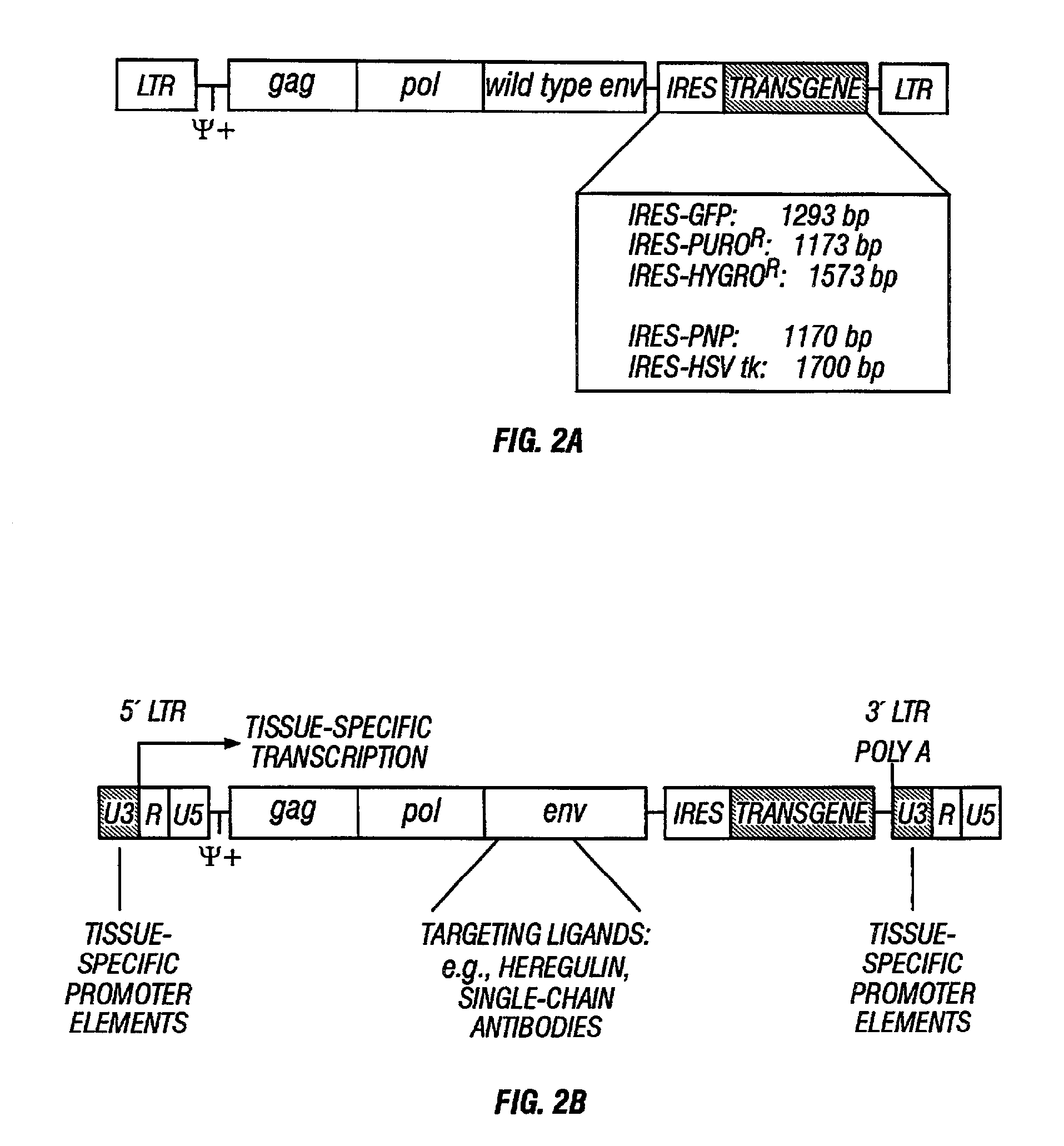
[0121] Chimeric MOMLV and SNV env sequences which contain targeting moieties directed against human breast cancer cells, and which have proven successful for targeting in previous studies, were utilized. The targeting moiety for MOMLV env was the peptide hormone heregulin, and the targeting moiety for SNV env was the single chain antibody B6.2, originally derived by immunizing mice with a membrane-enriched fraction from a human breast tumor. Using an IRES sequence, either a marker gene (such as GFP) or a suicide gene (such as HSV-tk or PNP) is linked to the chimeric envelope construct at the 3′ end. These chimeric envelope / IRES / transgene constructs are then recloned back into the replication-competent wild type forms of MOMLV or SNV, replacing the original env gene (FIG. 2b). This results in replication-competent retrovirus vectors that are targeted specifically to cancer cells.
[0122] Tumors were established by the i...
example 3
Creation of RCR Vector-Producing Cell Lines
[0124] The above MOMLV and SNV genomic constructs are transfected into human breast cancer cell line MD-MB-453 (ATCC accession umber HTB 131), which expresses high levels of HER-2 and HER-4 (Krause et al., EMBO Journal, 6:605-610 (1987)). The constructs which contain the GFP marker gene are transfected first, as the presence of the marker gene enables us to monitor the transfection efficiency by FACS analysis. After transfection, the targeted RCR vectors produced by the primary transfectants are capable of horizontal infection of adjacent cells not initially transfected, by biding via the heregulin or B6.2 single-chain antibody moieties. This can be detected as an increasing percentage of GFP-positive cells over time. Furthermore, the cell culture medium should contain supernatant virus, which can infect and transduce fresh cultures of MDA-MB-453 cells. The GFP-containing vectors thus enable one to determine the time course of transfection...
PUM
| Property | Measurement | Unit |
|---|---|---|
| diameter | aaaaa | aaaaa |
| time | aaaaa | aaaaa |
| time | aaaaa | aaaaa |
Abstract
Description
Claims
Application Information
 Login to View More