
Mobility managing method and mobile terminal
a mobile terminal and mobility management technology, applied in the direction of wireless network protocols, electrical equipment, wireless commuication services, etc., can solve the problems of deficient flexibility in the internet that is a freely distributed network, forcibly lowering communication efficiency and convenience, etc., and achieve the effect of flexible handling the intern
- Summary
- Abstract
- Description
- Claims
- Application Information
AI Technical Summary
Benefits of technology
Problems solved by technology
Method used
Image

Examples
embodiment 1
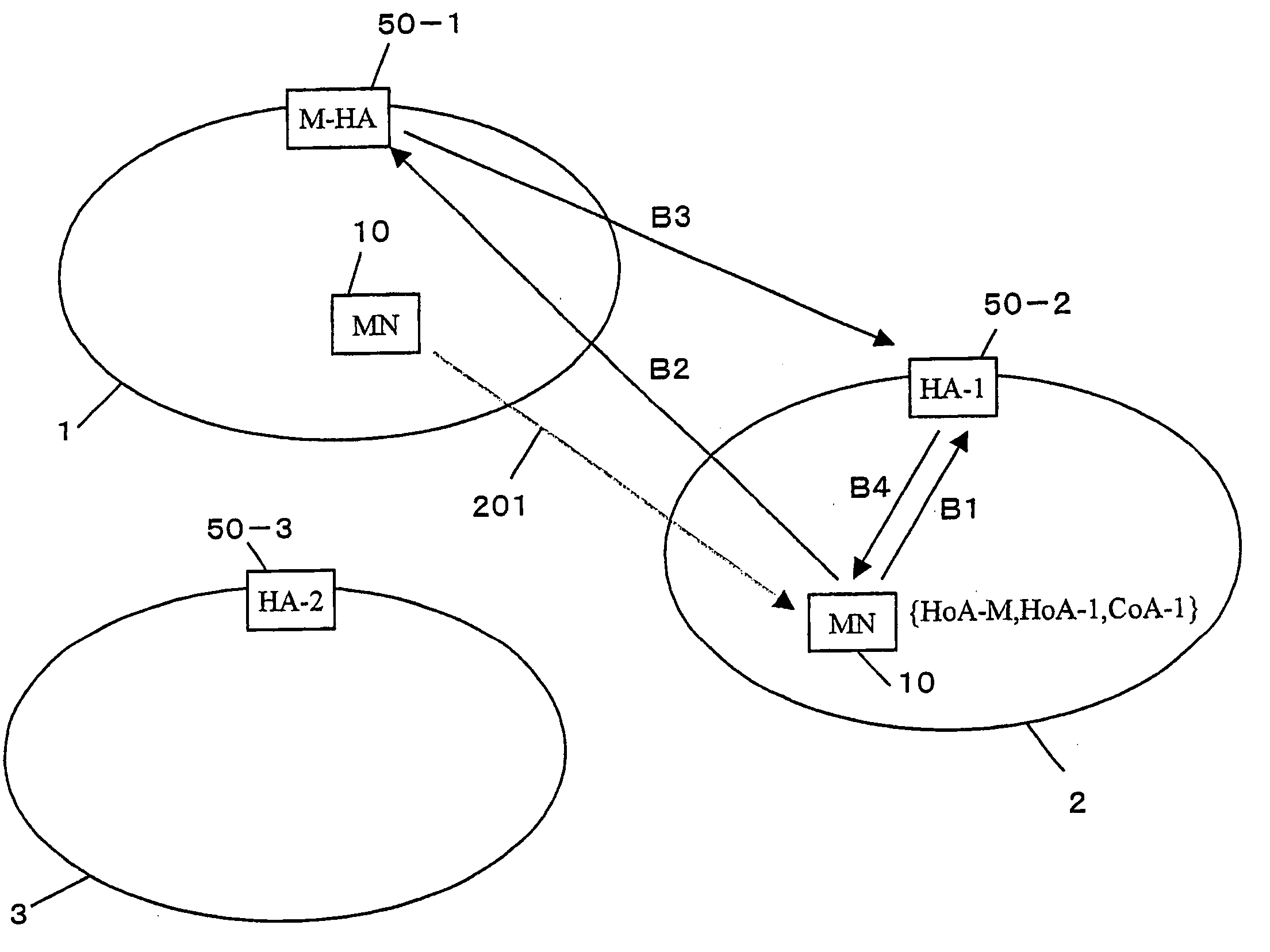
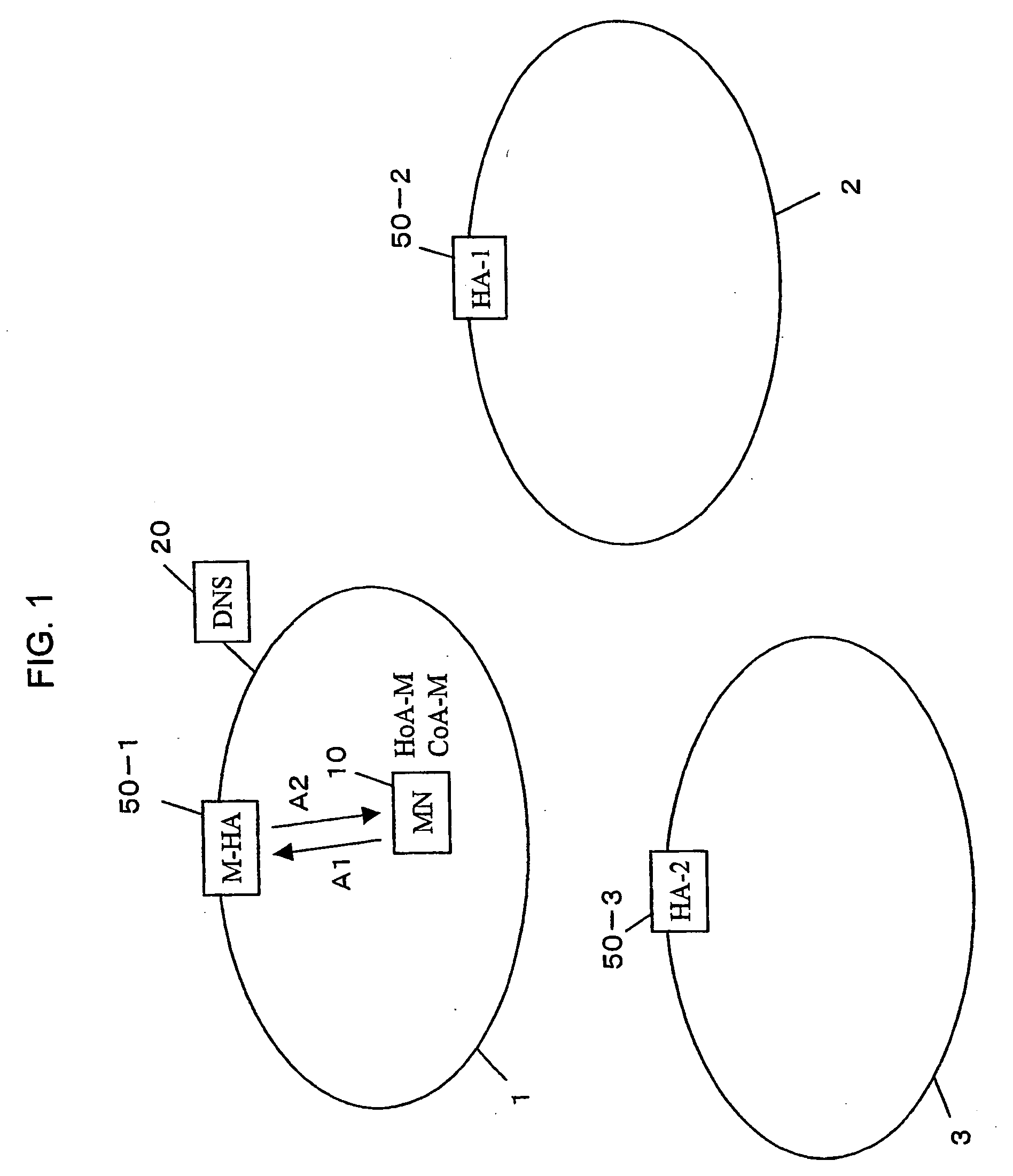
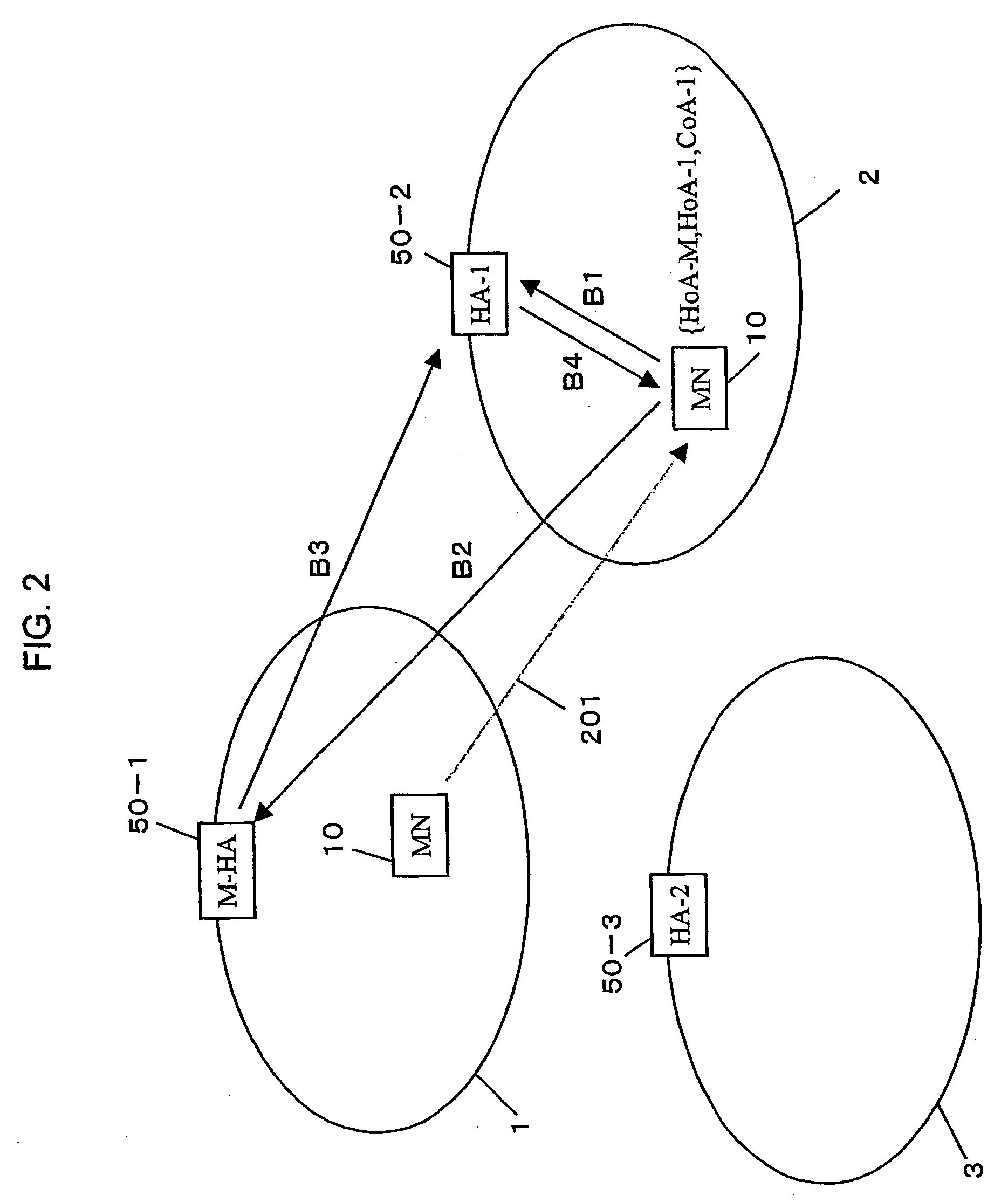
[0069] Embodiment 1 of the invention is explained with using FIGS. 1 to 22.
[0070] FIGS. 1 to 3 and 14 are diagrams showing a network configuration of a mobile communication system according to the invention. In FIGS. 1 to 3, domain networks 1, 2, 3 are the domain networks having different forms in services. Particularly, the domain network 1 is a home domain network selected and determined by a mobile terminal (MN) 10 while the domain networks 2, 3 are external domain networks. Home agent apparatuses (HA) 50-1, 50-2, 50-3 are respectively to manage the domain networks 1, 9, 3. Particularly, the home agent apparatus 50-1 is a main home agent apparatus (M-HA) to manage the home domain network for the mobile terminal 10. Meanwhile, home agent apparatuses 50-2, 50-3 are sub-home agent apparatuses (HA-1, HA-2) arranged in the other domain networks than the home domain network. Meanwhile, a domain network system (DNS) server 20 is to associate a host name with an IP address on the Intern...
embodiment 2
[0189]FIG. 20 shows a network configuration of a mobile communication system in embodiment 2 of the invention.
[0190] This embodiment is different from embodiment 1 in that providing a plurality of main home agent apparatuses (main home agent apparatuses 50-4, 50-5). Besides, the apparatuses configuring the mobile communication system are the same as the apparatuses explained in embodiment 1.
[0191] The mobile communication method in the mobile communication system thus configured is explained below.
[0192] A mobile terminal 10 holds HoA-M1 and HoA-M2 (respectively corresponding to the main home agent apparatuses 50-4 and 50-5) as main home addresses. In this case, the mobile terminal 10 registers (D1, D4) a sub-home address HoA-S and care of address CoA-S, acquired by accessing a moved-in domain network 6, to a sub-home agent apparatus 50-6 of the domain network 6. Together with this, the mobile terminal 10 registers (D2, D3, D4) a main home address HoA-M1 and sub-home address HOA-...
PUM
 Login to View More
 Abstract
Description
Claims
Application Information
 Login to View More