
Biohazard treatment systems
a technology of biohazard treatment and treatment system, applied in the direction of disinfection, chemical/physical/physical-chemical processes, energy-based chemical/physical/physical-chemical processes, etc., can solve the problems of ineffective inactivation of biohazards, ineffective conventional methods and systems, and ineffective conventional techniques for treating surfaces
- Summary
- Abstract
- Description
- Claims
- Application Information
AI Technical Summary
Problems solved by technology
Method used
Image

Examples
Embodiment Construction
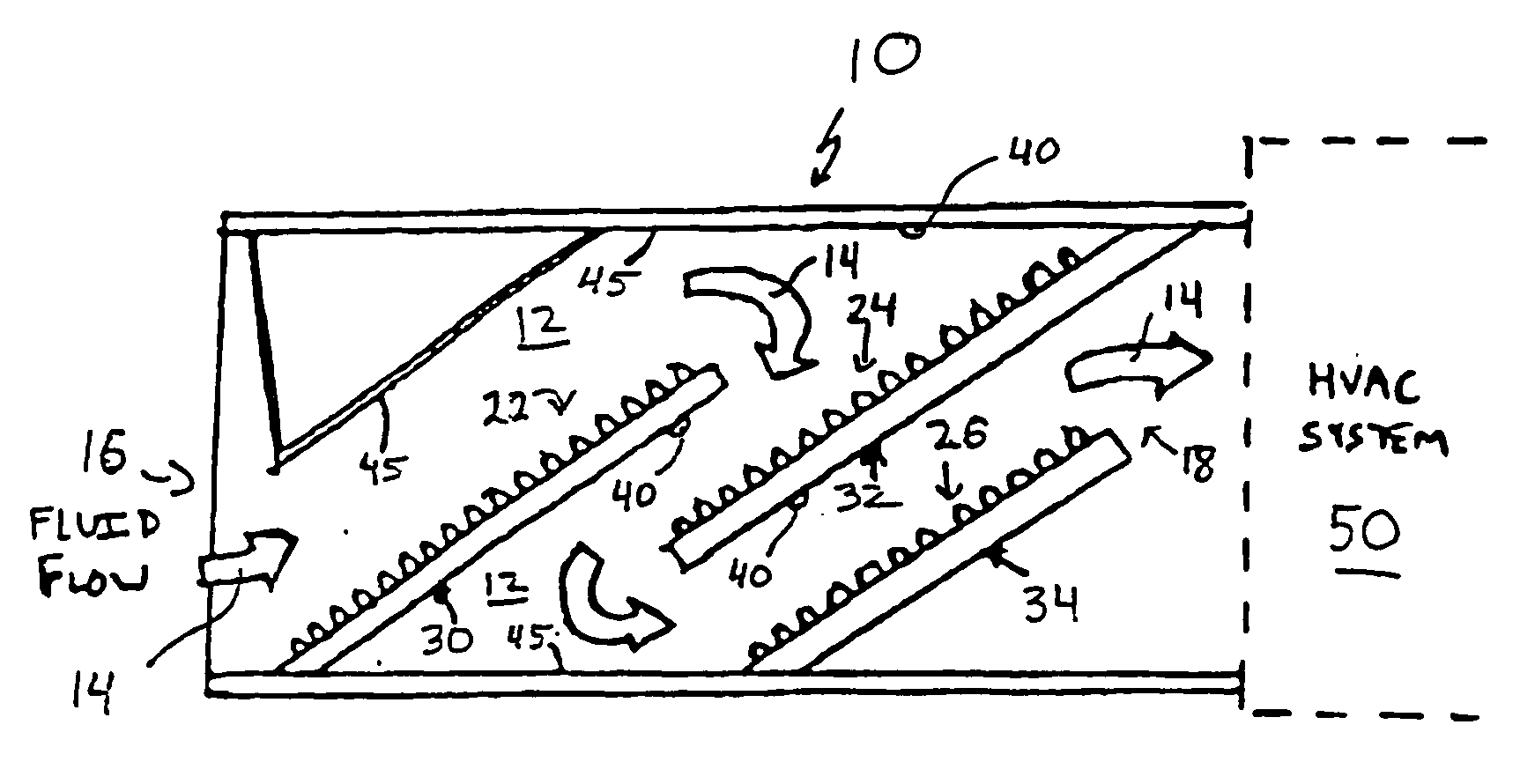
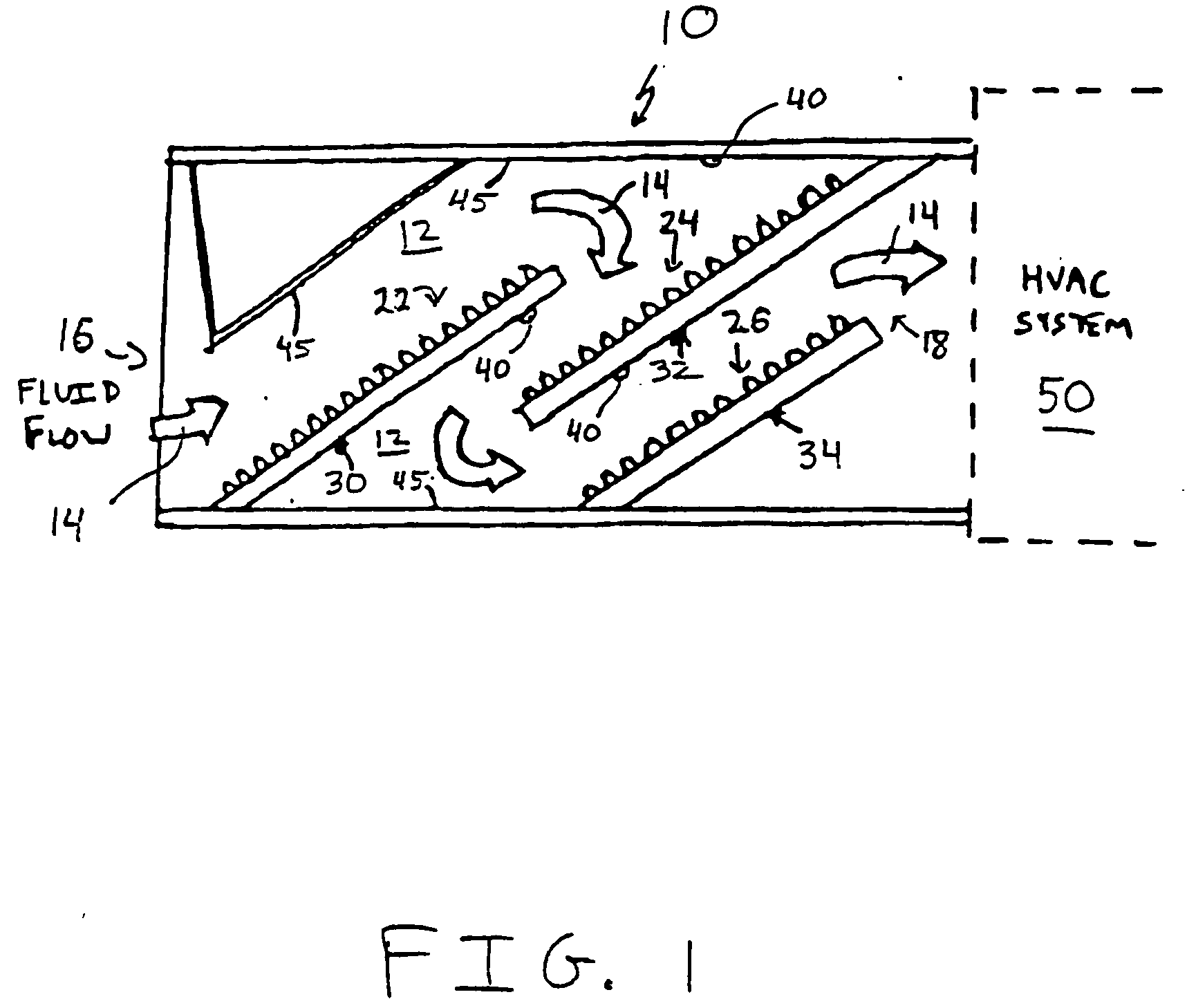
[0039]FIG. 1 shows an illustrative system 10 consistent with this invention for exposing biological hazards that may be present in fluids, such as liquids and gases, to short-wavelength (ultraviolet) radiation. As used herein, biohazards can include mold spores, microorganisms, and other biological organisms that are potentially harmful to humans and other animals. Short-wavelength radiation includes radiation having a wavelength that is less than about 410 nm.
[0040] System 10 includes a conduit 12 for conveying a fluid 14 and at least one array 22, 24, and 26 of solid state light-emitting devices. Conduit 12 has an input 16 coupled to a source of fluid (not shown) and an output 18. Conduit 12 is baffled so that fluid 14 flows more uniformly while being conveyed through conduit 12. The light-emitting devices of arrays 22, 24, and 26 are mounted in the conduit such that they emit sufficient radiation in conduit 12 for neutralizing biohazards, thus forming a “killing zone” in the con...
PUM
| Property | Measurement | Unit |
|---|---|---|
| reflectivity | aaaaa | aaaaa |
| second peak wavelength | aaaaa | aaaaa |
| second peak wavelength | aaaaa | aaaaa |
Abstract
Description
Claims
Application Information
 Login to View More