
Laser apparatus
a laser and apparatus technology, applied in the field of laser apparatuses, can solve the problems of large size of variable-wavelength laser apparatuses, increased cost, and increased complexity, and achieve the effects of compact and inexpensive, excellent reliability and oscillation efficiency
- Summary
- Abstract
- Description
- Claims
- Application Information
AI Technical Summary
Benefits of technology
Problems solved by technology
Method used
Image

Examples
example of implementation 1
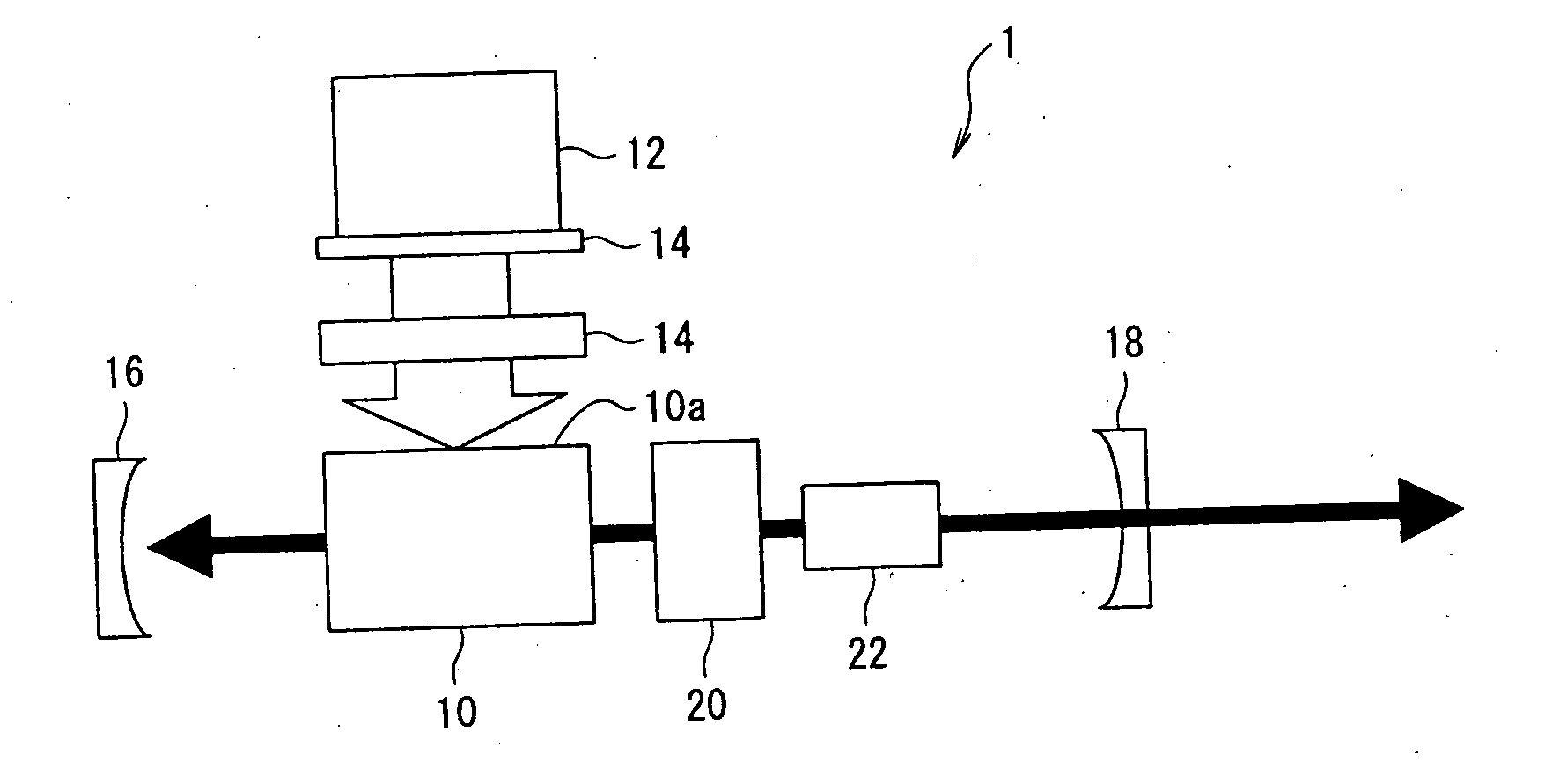
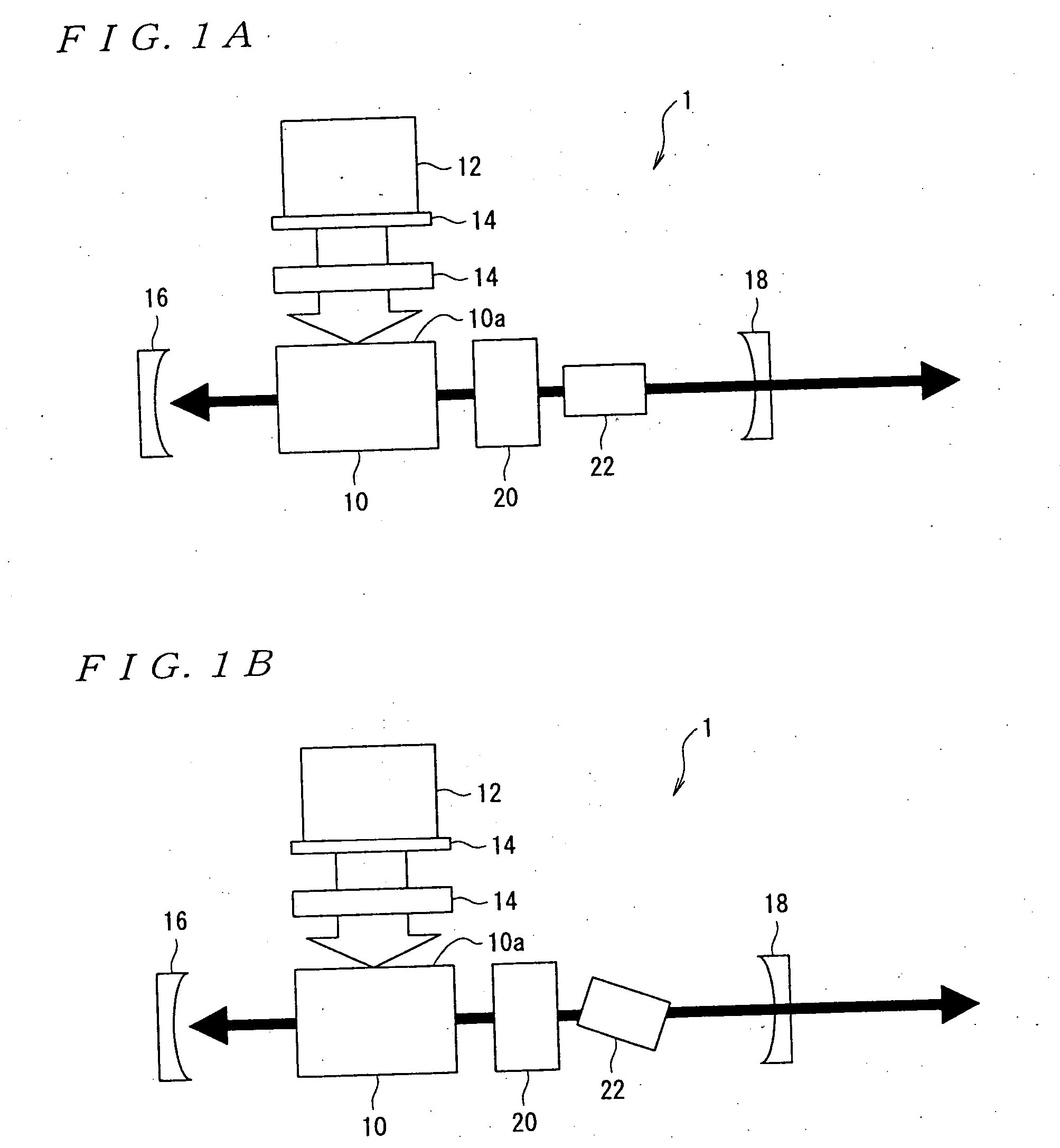
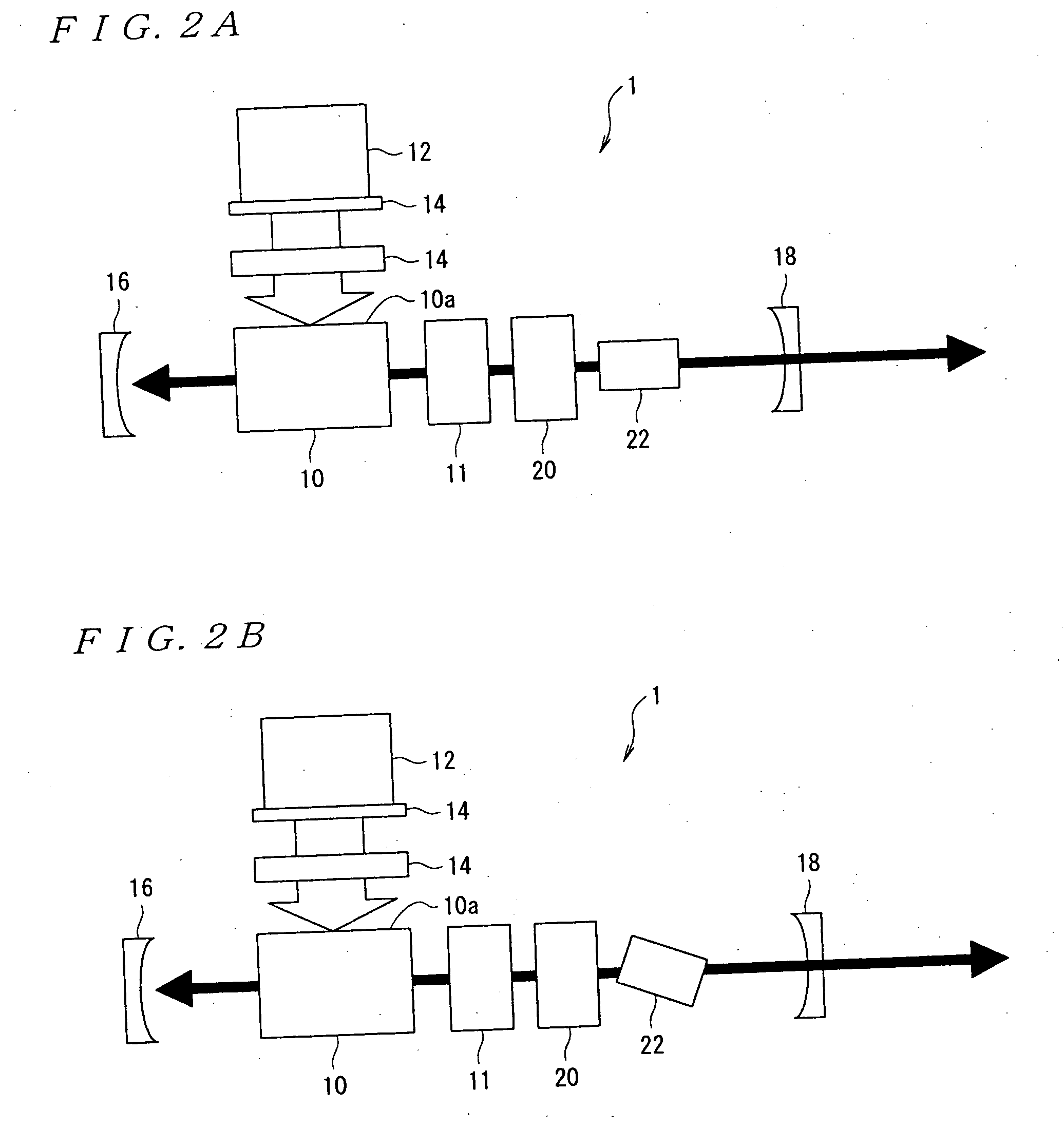
[0047] By using the laser apparatus 1 according to the invention described above, a wavelength was selectively extracted out of multiple wavelengths that were simultaneously generated.
[0048] A current of 90 A was let flow into the laser oscillator 12, and the laser medium 10 was irradiated with the resultant laser-generated excitation light. The irradiation energy of the excitation light was set to 28 mJ. Laser oscillation of 1067 nm in fundamental wavelength was confirmed within the resonance unit consisting of the reflector 16 and the laser output mirror 18. It was confirmed that a Raman wave of 1181 nm and a Raman wave of 1321 nm were generated when the Q switch 20 was used. Then the harmonic element 22 was turned to vary the angle θ of the harmonic element 22 relative to the optical axis, and the resultant wavelength of oscillation was checked.
[0049] As a result, when the angle θ was −1 degree, the oscillation of a blue wavelength (485 nm) was observed.
[0050] When the angle θ...
example of implementation 2
[0056] By using the laser apparatus 1 according to the invention described above, a wavelength was selectively extracted out of multiple wavelengths that were simultaneously generated in the same way as in Example of Implementation 1 except that a KTP crystal was used as the harmonic element 22.
[0057] As a result, when the angle θ was −1.5 degrees, the oscillation of a blue wavelength was observed.
[0058] When the angle θ was 1 degree, the oscillation of a green wavelength was observed.
[0059] When the angle θ was 1.5 degrees, the oscillation of a green wavelength and a yellow wavelength was observed.
[0060] When the angle θ was 2 degrees, the oscillation of a yellow wavelength was observed.
[0061] When the angle θ was 2.5 degrees, the oscillation of a green wavelength, a yellow wavelength and a red wavelength was observed.
[0062] When the angle θ was 3 degrees, the oscillation of a red wavelength was observed.
example of implementation 3
[0063] By using the laser apparatus 1 according to the invention described above, a wavelength was selectively extracted out of multiple wavelengths that were simultaneously generated in the same way as in Example of Implementation 1 except that a KDP crystal was used as the harmonic element 22.
[0064] As a result, when the angle θ was −1.5 degrees, the oscillation of a blue wavelength was observed.
[0065] When the angle θ was 0 degree, the oscillation of a green wavelength was observed.
[0066] When the angle θ was 1 degree, the oscillation of a yellow wavelength was observed.
[0067] When the angle θ was 1.5 degrees, the oscillation of a green wavelength and a yellow wavelength was observed.
[0068] When the angle θ was 2 degrees, the oscillation of a red wavelength was observed.
[0069] When the angle θ was 2.5 degrees, the oscillation of a green wavelength, a yellow wavelength and a red wavelength was observed.
PUM
 Login to View More
 Abstract
Description
Claims
Application Information
 Login to View More