[0012] The invention provides methods, systems, and apparatus which facilitate tissue cauterization in connection with such procedures as tissue resection and removal from patients undergoing a wide variety of procedures. The procedures may involve removal of an entire organ, e.g. hysterectomies, cholecystectomies, prostate removal, lung resection, and the like. Alternatively, the methods may involve removal of a portion of an organ or other tissue, such as tumor removal, often from highly vascularized organs, such as the liver, lung, or the like. The methods generally involve two steps, where the tissue is first necrosed or cauterized in whole or in part using radio frequency energy. In particular, the cauterization is effected at least along a desired resection plane within the tissue. The tissue is then resected along said plane(s). Advantageously, it has been found that resection within the necrosed or cauterized tissue substantially minimizes, and in some cases eliminates, the bleeding caused by the tissue resection. Preferably, the tissue cauterization is effected over a target volume of tissue, typically an entire organ or a portion thereof, e.g. the uterus, the lobe of a liver, a lung section, the prostate, or the like. By effecting substantially complete cauterization of a target tissue volume, the bleeding capacity of that tissue is reduced or eliminated, thus facilitating subsequent morcellization and tissue removal. Thus, organ and tissue removal is greatly facilitated with a substantial reduction in bleeding and the time needed for the surgical procedure.
[0014] High frequency (usually radio frequency) power is applied to the tissue mass through the electrically active regions(s) of the electrode structures, and the power is applied for a time and in an amount sufficient to cauterize or necrose tissue between said electrodes, preferably at least along a desired resection plane. Often, a volume of the tissue is resected by morcellating, e.g. grinding, comminuting, cutting into small pieces, or the like. Such morcellation is greatly facilitated by necrosis of the target tissue volume. By necrosed, it is meant that the cells of the tissue have been killed and that bleeding of the tissue, upon subsequent resection, has been substantially inhibited. The tissue are usually resected along a plane within the necrosed tissue mass, with minimal bleeding as described above.
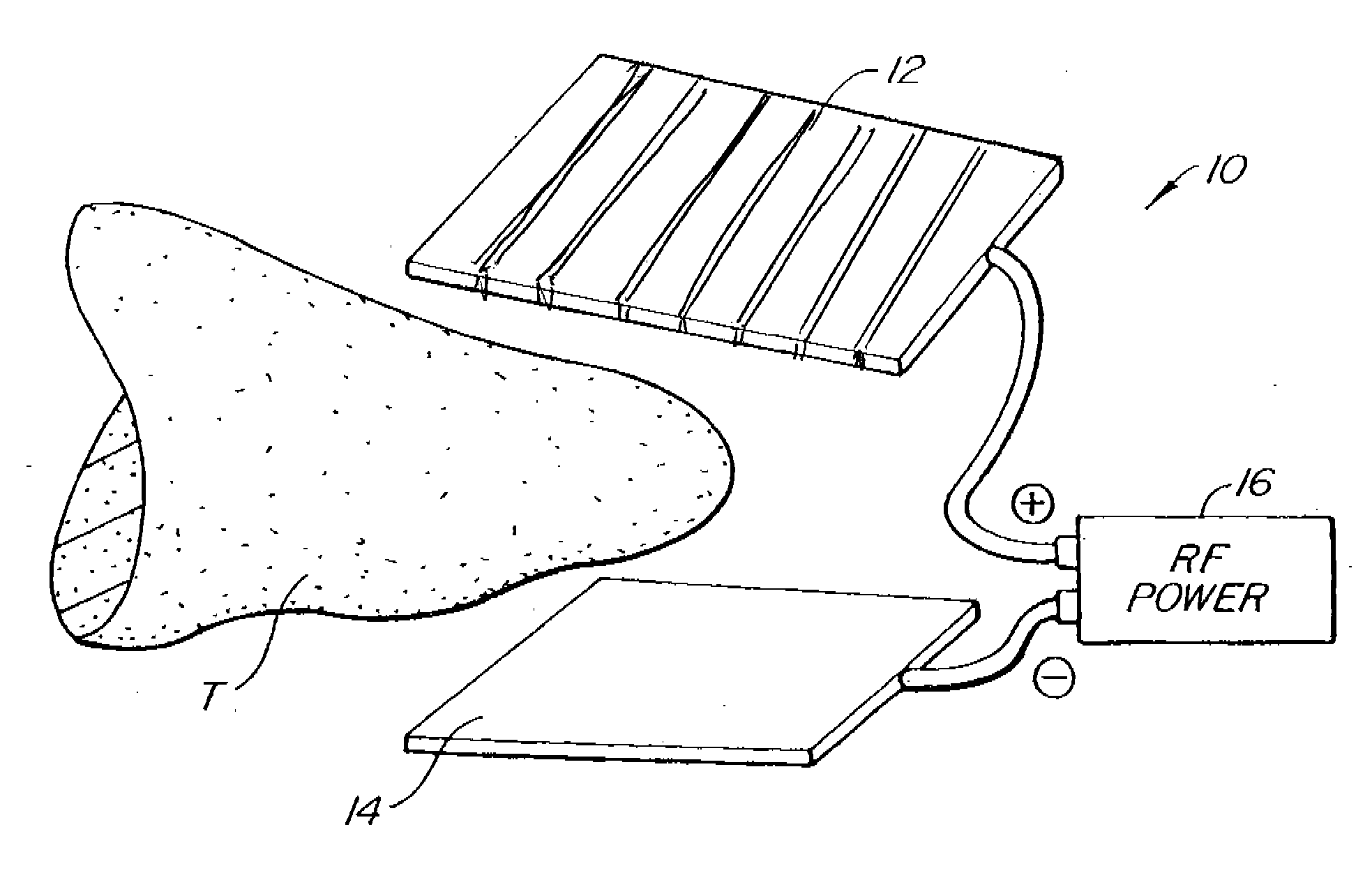
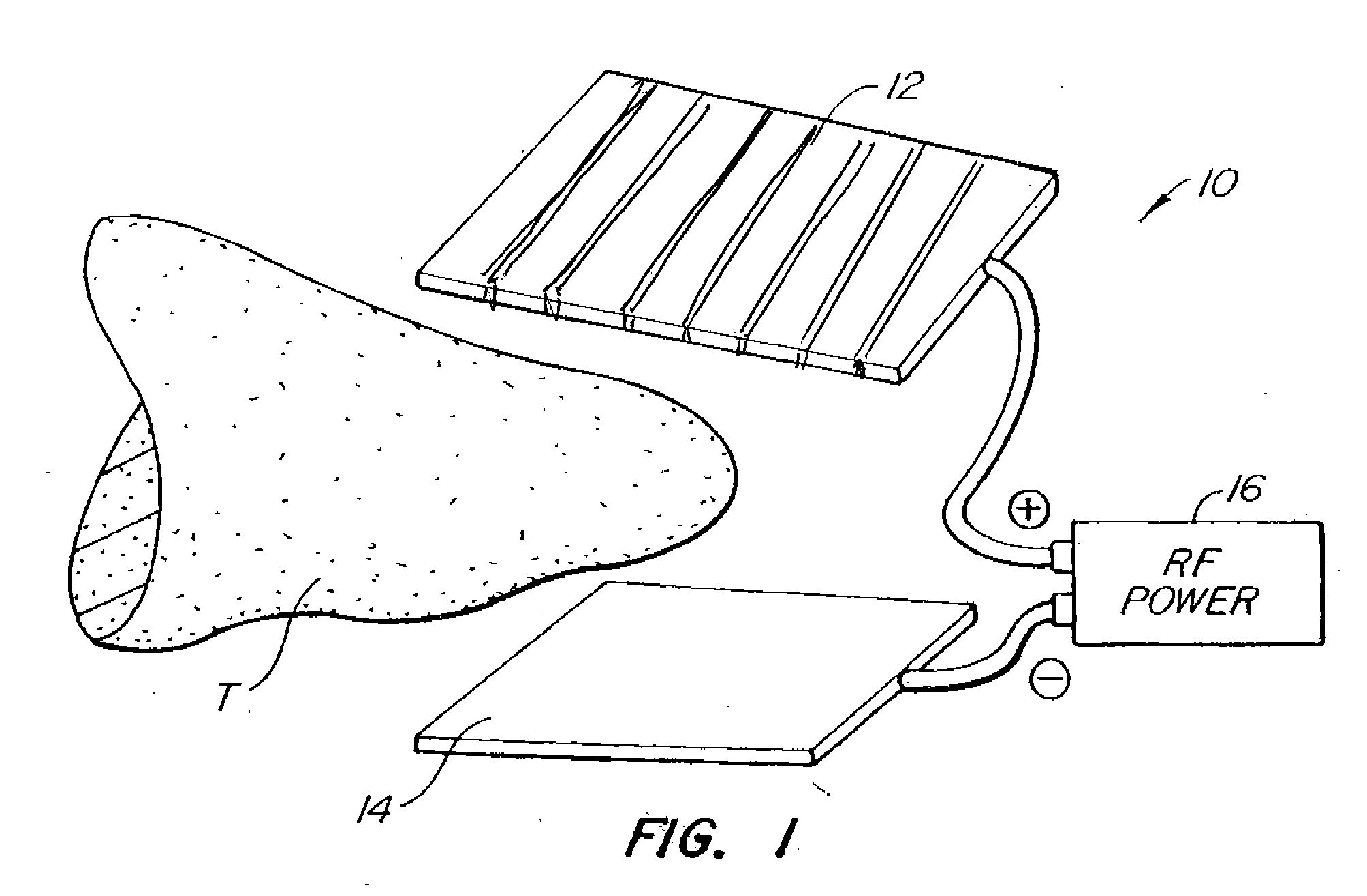
[0016] The electrodes may have a wide variety of characteristics, may generally be rigid, flexible, elastic, malleable, conformable, or the like. Preferably, the electrodes flexible to facilitate engagement of the electrode against, and conformance to, a tissue surface. In at least some instances, it is desirable to provide flexible, elastic electrodes which may be conformed about the outer periphery of a tissue or organ surface, where the elastic nature of the electrode assures firm engagement and electrode contact. In other instances, however, the electrodes may be specifically configured to have a desired geometry for engaging a particular tissue surface. The high frequency energy applied to the organ or tissue is generally provided at radio frequency typically, but not limited to the range from 100 kHz to 10 MHz, is usually from 200 kHz to 750 kHz. The power levels depend on the surface area and volume of tissue being treated, but generally fall within the range from 10 W to 500 W, usually from 25 W to 250 W, more usually from 50 W to 200 W. Power is usually applied at a level of from 1 W / cm2 to 500 W / cm2, more usually from 10 W / cm2 to 100 W / cm2. The power is applied for a time sufficient to raise the tissue temperature in the tissue mass being treated to above a threshold level required for cauterization or necrosis, usually being above at least 60° C., frequently being above 70° C., and often above 80° C., or higher. The application of energy should be limited, however, so that adjacent tissue is not significantly heated or otherwise damaged. The use of opposed, bipolar electrodes is particularly advantageous in this regard because it concentrates the energy flux between the electrodes and limits the effect on adjacent tissue which are not confined within the opposed electrodes. The resulting necrosed tissue may comprise substantially the entire organ being treated, or in other cases may comprise a more narrow region, e.g. a planar region.


 Login to View More
  Login to View More