
Mobile communication terminal
a mobile communication terminal and terminal technology, applied in the field of mobile communication terminals, can solve the problems of increasing the computational complexity of the mobile communication terminal affecting the operation of the mobile communication system, etc., and achieve the effect of reducing the computational complexity of the cancellation
- Summary
- Abstract
- Description
- Claims
- Application Information
AI Technical Summary
Benefits of technology
Problems solved by technology
Method used
Image



Examples
first embodiment
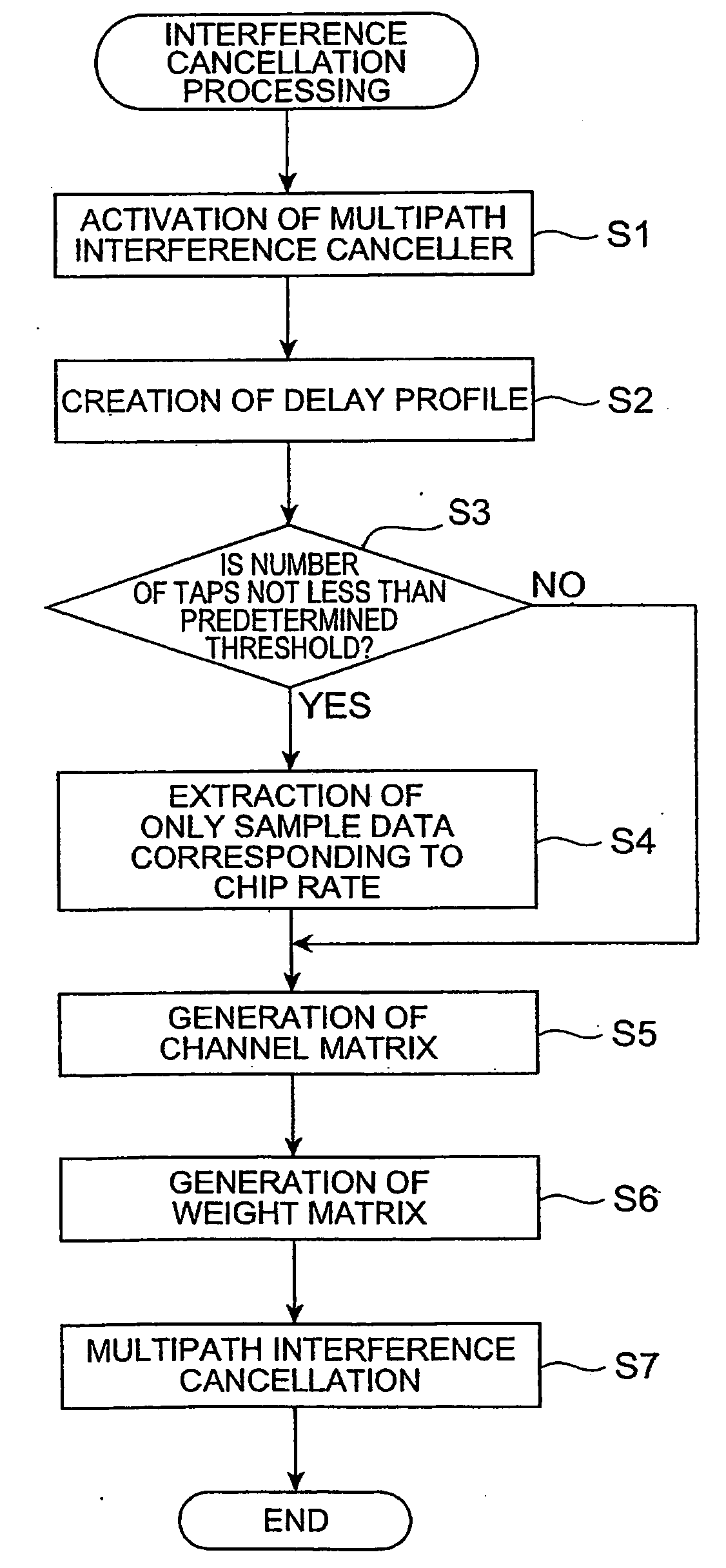
[0037]FIG. 2 is a diagram for exemplifying a functional configuration of mobile communication terminal 1 in the first embodiment. As shown in FIG. 2, the mobile communication terminal 1 has an A / D converter 11, a delay profile creator 12, a number-of-samples controller 13, a channel matrix generator 14, a weight matrix generator 15, and an interference canceller 16.
[0038] The A / D converter 11 samples sample data from a received signal in accordance with a predetermined sampling rate, thereby performing A / D conversion. The A / D converter 11 in the present embodiment performs the A / D conversion at a sampling rate four times as high as the chip rate.
[0039] The delay profile creator 12 despreads a signal transmitted through the use of the common pilot channel from a base station to create a delay profile shown in FIG. 9, in the same manner as the delay profile creator 91 described in the foregoing background art, did.
[0040] The number-of-samples controller 13 extracts sample data corr...
second embodiment
[0060] The second embodiment of the present invention will be described below. A functional configuration of mobile communication terminal 1s in the second embodiment will be first described with reference to FIG. 6. As shown in FIG. 6, the mobile communication terminal 1s in the second embodiment has an A / D converter 11, a delay profile creator 12, a number-of-samples controller 13s, a channel matrix generator 14, a weight matrix generator 15, and an interference canceller 16.
[0061] The mobile communication terminal 1s in the second embodiment is different from the mobile communication terminal 1 in the first embodiment in that the number-of-samples controller 13s in the second embodiment is different in function from the number-of-samples controller 13 in the first embodiment. Therefore, the other functions are basically the same as those of the mobile communication terminal 1 in the first embodiment, and thus the components will be denoted by the same reference symbols, without ...
PUM
 Login to View More
 Abstract
Description
Claims
Application Information
 Login to View More