
Light-emitting device with open-loop control and manufacturing method thereof
- Summary
- Abstract
- Description
- Claims
- Application Information
AI Technical Summary
Benefits of technology
Problems solved by technology
Method used
Image

Examples
first embodiment
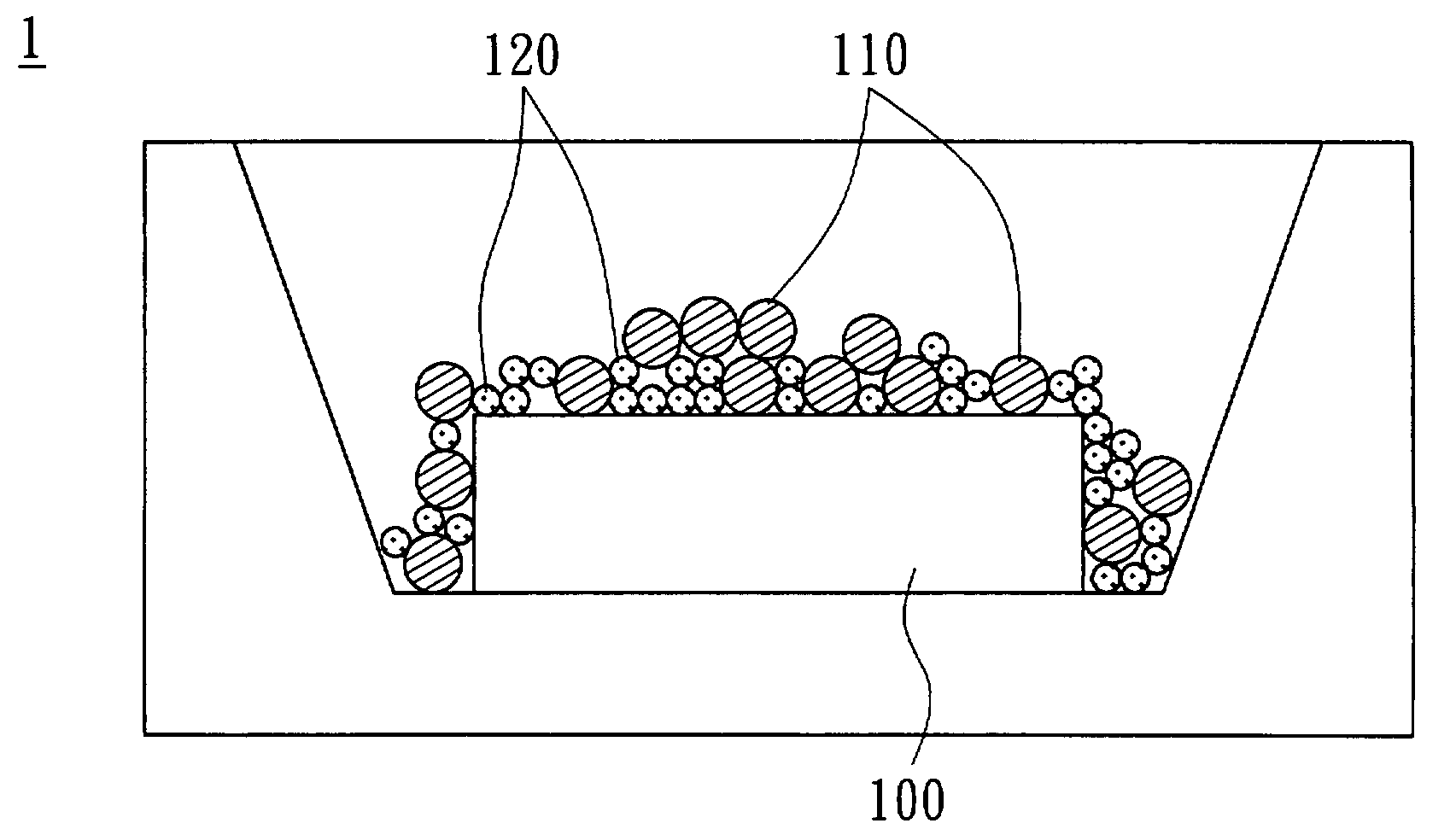
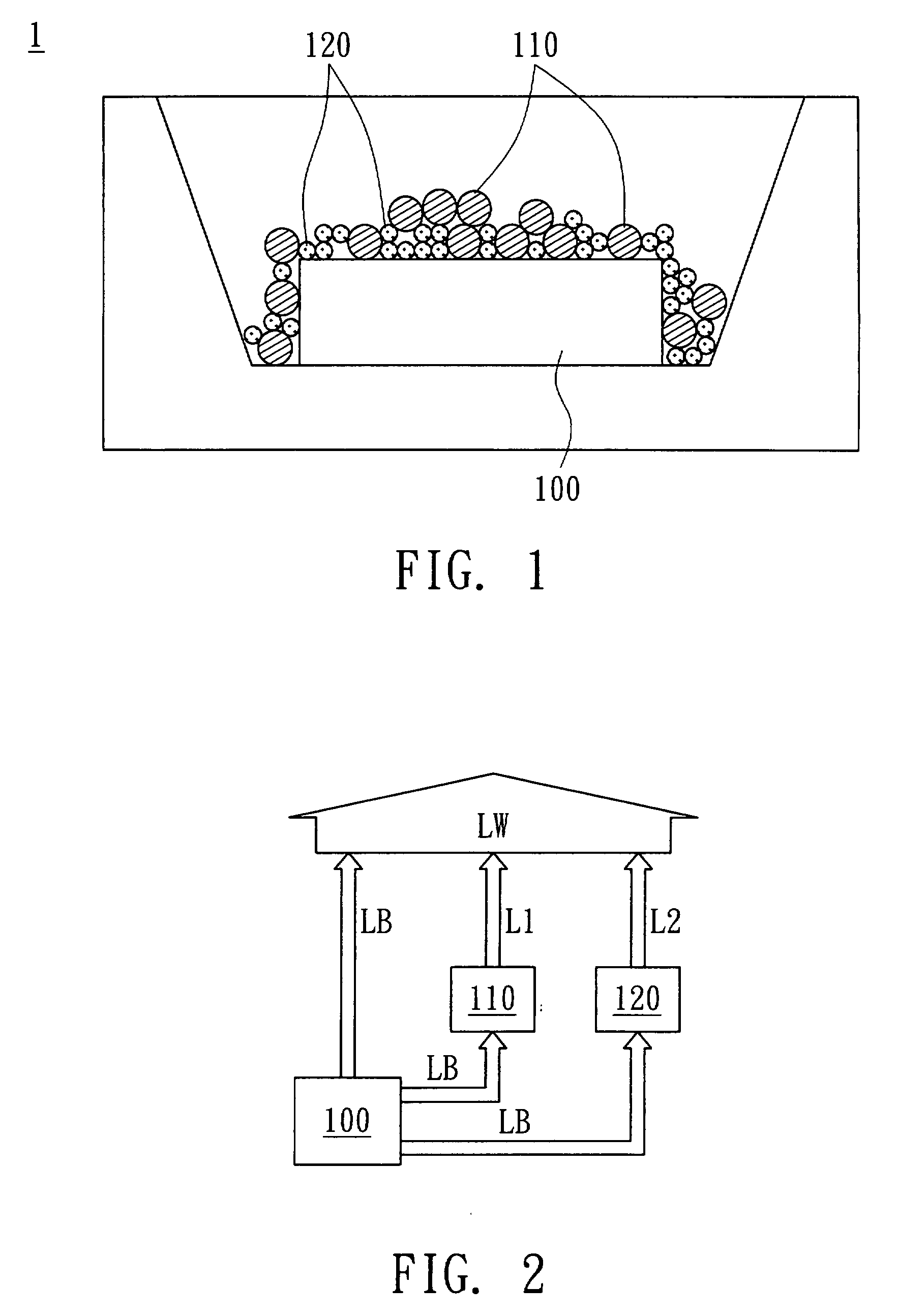
[0028]In the embodiment, the first fluorescent material 110 is exemplified by a phosphor whose synthetic mixture is (Sr, Ba)2SiO4:Eu and chemical expression is (Sr0.35Ba1.6Eu0.05)SiO4. The first fluorescent material 110 can be synthesized by the use of solid-state reaction method. The second fluorescent material 120 is exemplified by a phosphor whose synthetic mixture is (Y3Al5O12:Ce, Gd) and chemical expression is (Y2.3Ce0.05Gd0.65) Al5O12. The second fluorescent material 120 can be synthesized by using solid-state reaction method or chemical synthesis method (such as citric acid gel method and co-precipitation synthesis method).
[0029]Referring to FIG. 4, an excitation spectrum diagram of the first fluorescent material and the second fluorescent material of the first embodiment is shown. The excitation spectrum of the first fluorescent material 110 is detected in the condition that an excitation light whose wavelength is 522 nm is used, and the excitation spectrum of the second flu...
second embodiment
[0041]The first fluorescent material used in this embodiment is the same as that used in the first embodiment, that is, a phosphor whose chemical expression is (Sr0.35Ba1.6Eu0.05)SiO4. However, the second fluorescent material used in this embodiment is a phosphor whose synthetic mixture is CaS:Eu and chemical expression is (Ca0.99Eu0.01)S. The second fluorescent material can be synthesized by the use of solid-state reaction method.
[0042]Referring to FIG. 8, an excitation spectrum diagram of the first fluorescent material and the second fluorescent material of the second embodiment is shown. The excitation spectrum of the first fluorescent material 110 is detected in the condition that an excitation light whose wavelength is 522 nm is used, and the excitation spectrum of the second fluorescent material 120 is detected in the condition that an excitation light whose wavelength is 626 nm. As indicated in FIG. 8, the curve lines of the excitation intensities of the first fluorescent mat...
PUM
| Property | Measurement | Unit |
|---|---|---|
| Wavelength | aaaaa | aaaaa |
| Wavelength | aaaaa | aaaaa |
| Wavelength | aaaaa | aaaaa |
Abstract
Description
Claims
Application Information
 Login to View More